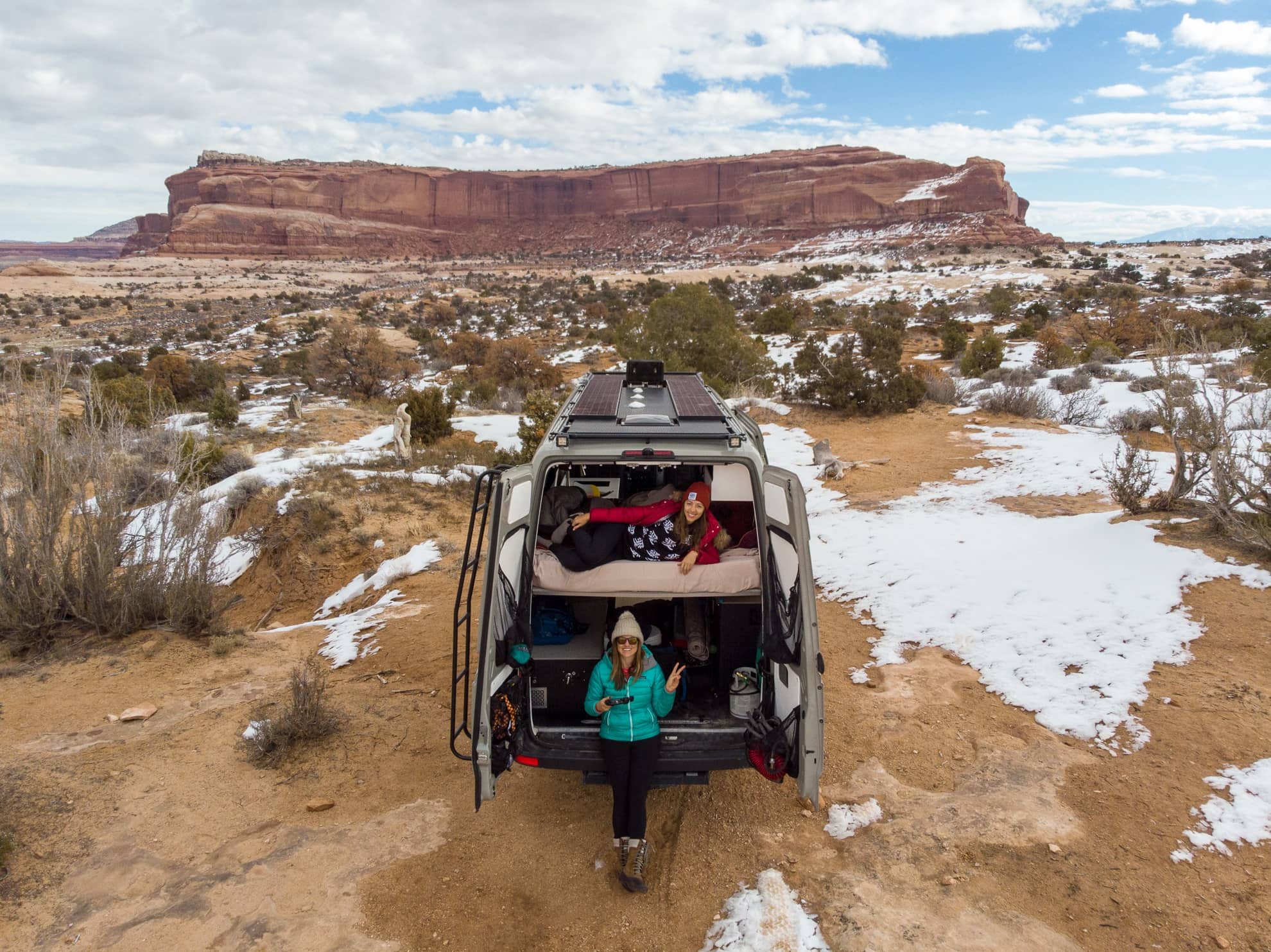
42 Van Life Essentials that Make Life on the Road Easier

This is what I have: When I first hit the road in my first Sprinter Van (nearly a decade ago!), I packed way too much stuff. My kitchen cabinets were overflowing, I packed clothing I never touched, and had a lot of gear that just didn’t hold up to the realities of van life.

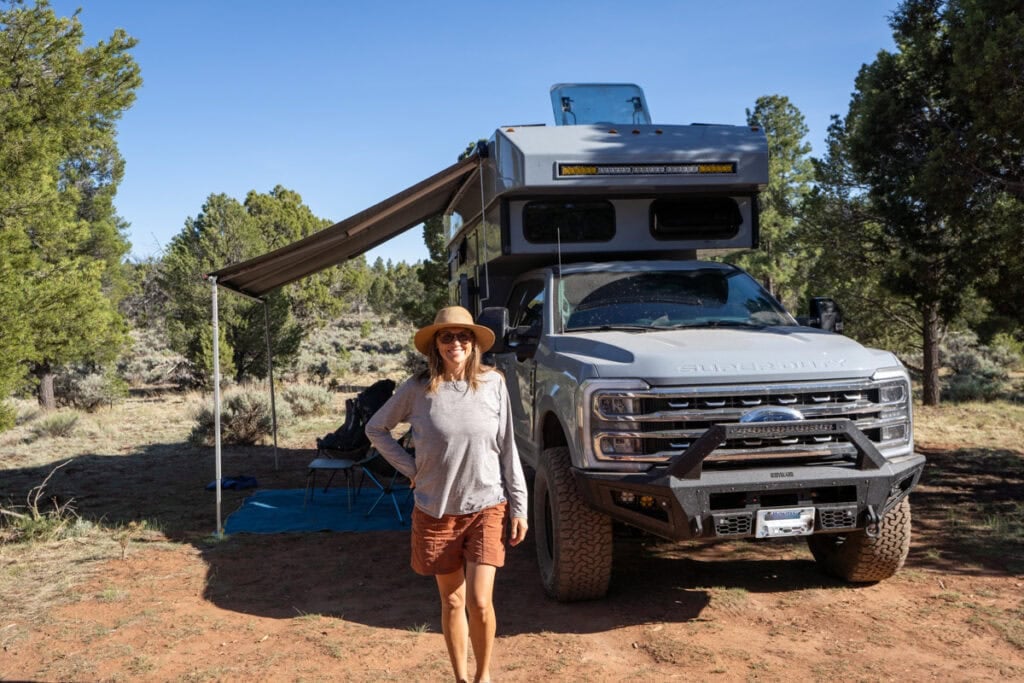
Dusty dirt roads, limited storage, and constantly shifting routines quickly showed me what gear was actually useful vs what was just taking up space. Since then, I’ve lived in multiple vans and now travel full-time with my family in a Rossmonster truck camper.

With each setup, I’ve refined my gear list to the essentials—the things that get used regularly, make life easier, and help keep our camper functional and enjoyable.

Now, I’m sharing the gear that’s truly earned its place – so you can skip the clutter, pack smarter, and make the most of your time on the road. For more recommendations, check out my Van Life Clothing List and my favorite Camper Van Kitchen Gear.

Van Kitchen Must-Haves

Cooking Table

GCI Outdoor Slim-Fold Cook Station

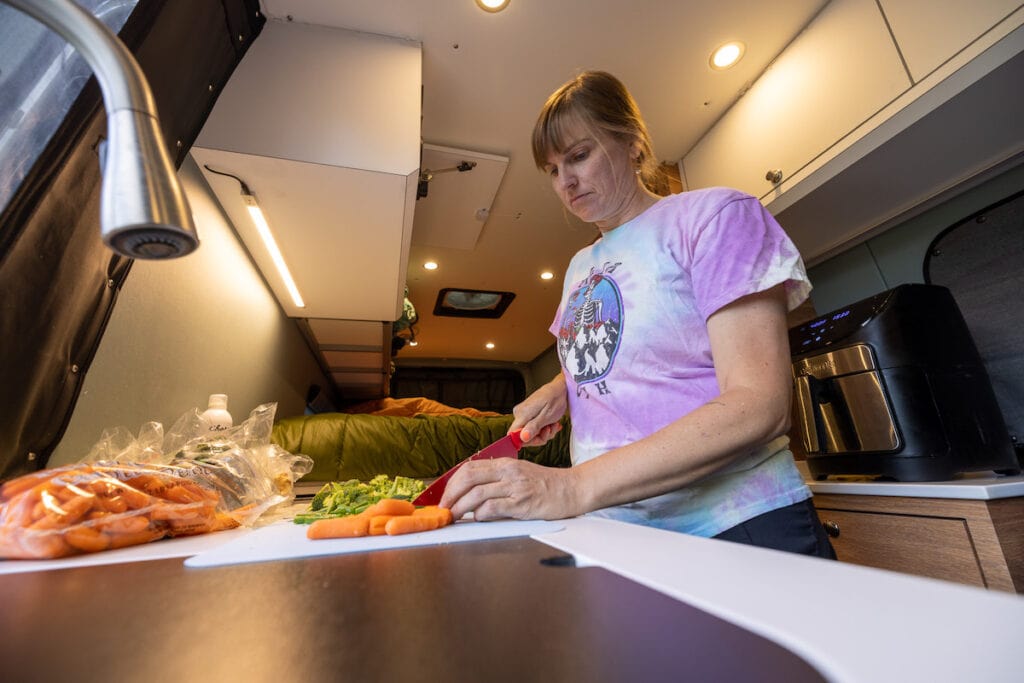
These days we mostly cook on our induction stove, but for years, we prepared all of our meals on this GCI Outdoor Slim Fold Cook Station. It takes just a few seconds to set up and provides tons of counter space for your ingredients and cooking gear. When it’s time to drive, it folds down flat and can be squeezed into any open spot in your van.
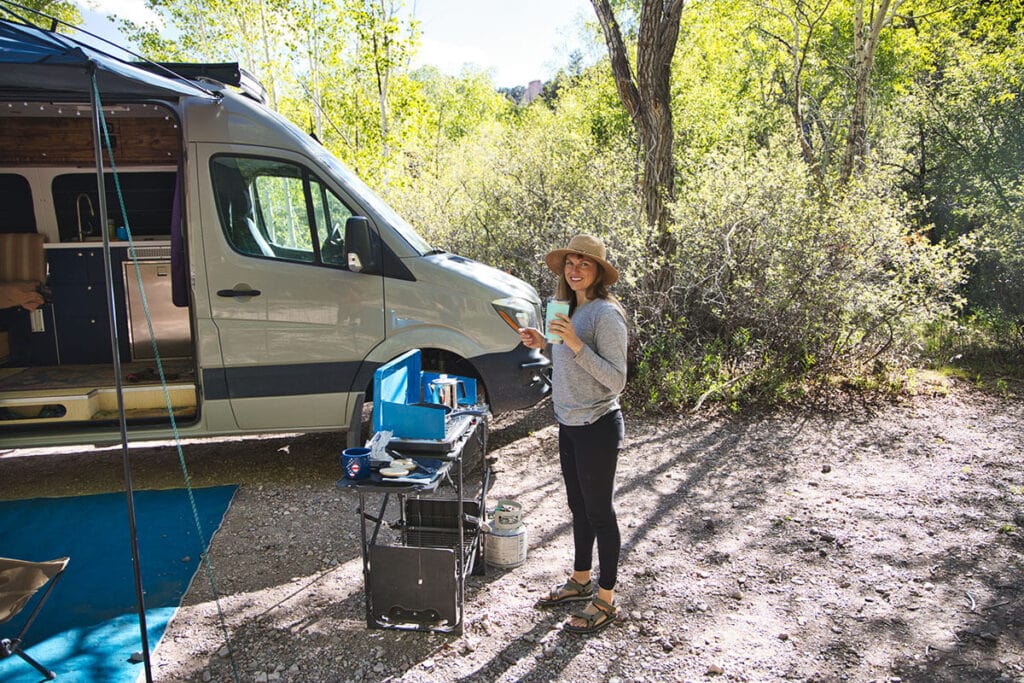
A woman stands next to the Eureka Ignite Camp Stove sitting on a GCI Outdoor Slim Fold Cook Station table. She is standing next to her Sprinter van.
Using the GCI Outdoor Slim-Fold Cook Station
Coffee Maker

Aeropress Go Travel Coffee Press

After trying bulky French presses and percolators, the AeroPress Go has become my go-to for van life mornings. It’s fast, compact, and doesn’t hog power or take up room like a Keurig. Cleanup is a breeze—you just pop the puck of grounds into the trash, so you don’t end up wasting a bunch of water to rinse out the grounds. Plus, it’s small enough to stash anywhere and tough enough to survive cabinet rattles on bumpy roads. Learn more in my Aeropress review.
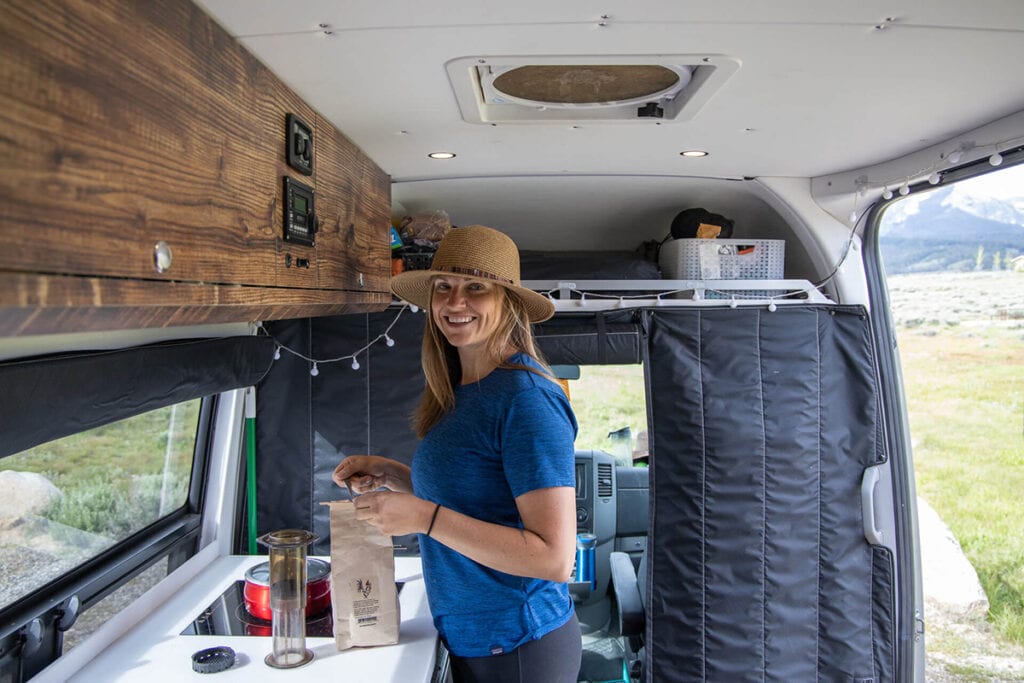
A woman using the Aeropress Go Travel Coffee Press in her Sprinter van
Using the Aeropress Go Travel Coffee Press
Durable Dishes

Hydro Flask Camp Plates and Bowls

After dealing with scratched-up plastic dishes and too-small camp bowls, I finally upgraded to these stainless steel bowls and plates from Hydro Flask. They’re lightweight, easy to clean, and way more durable than anything I used before. They are thick enough that they never are too hot to hold, and they’re actually big enough for a hearty bowl of soup or a big pasta dinner.
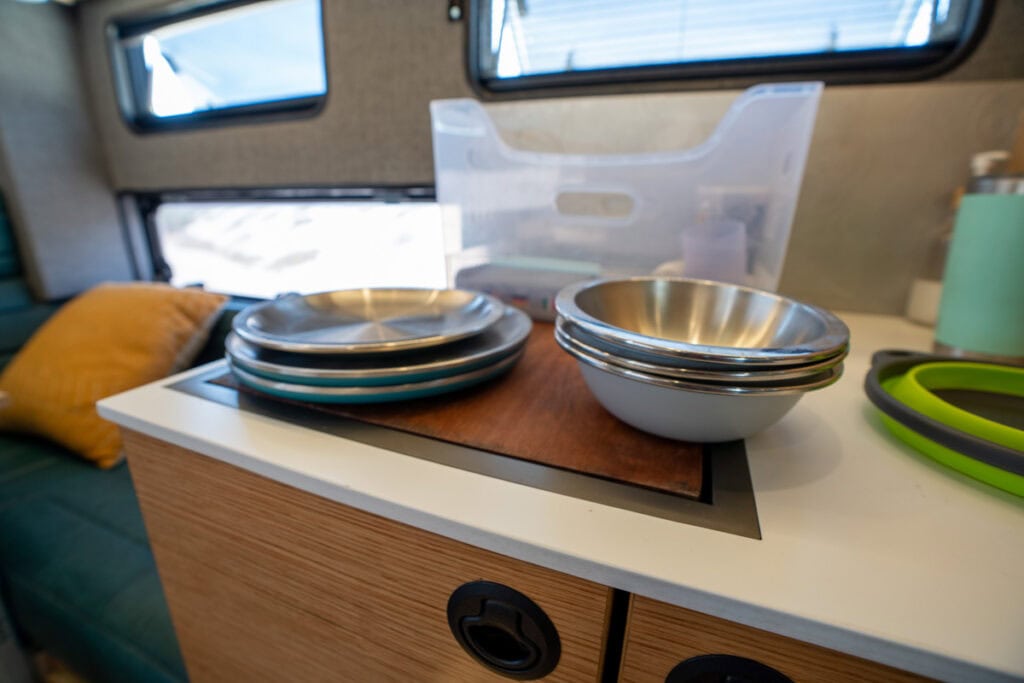
plates and bowls on the counter in the Rossmosnter Baja Trail truck camper
Travel Mug

Yeti Rambler Tumbler

A solid camp mug is non-negotiable in van life, and I’ve been using the Yeti Rambler Tumbler for years. It keeps morning beverage hot for hours and doubles as my go-to cold drink cup in the afternoons. The lid is super easy to clean – there’s no hidden crevices or weird parts – and it does a great job at preventing spills when we’re bumping our way down dirt roads.
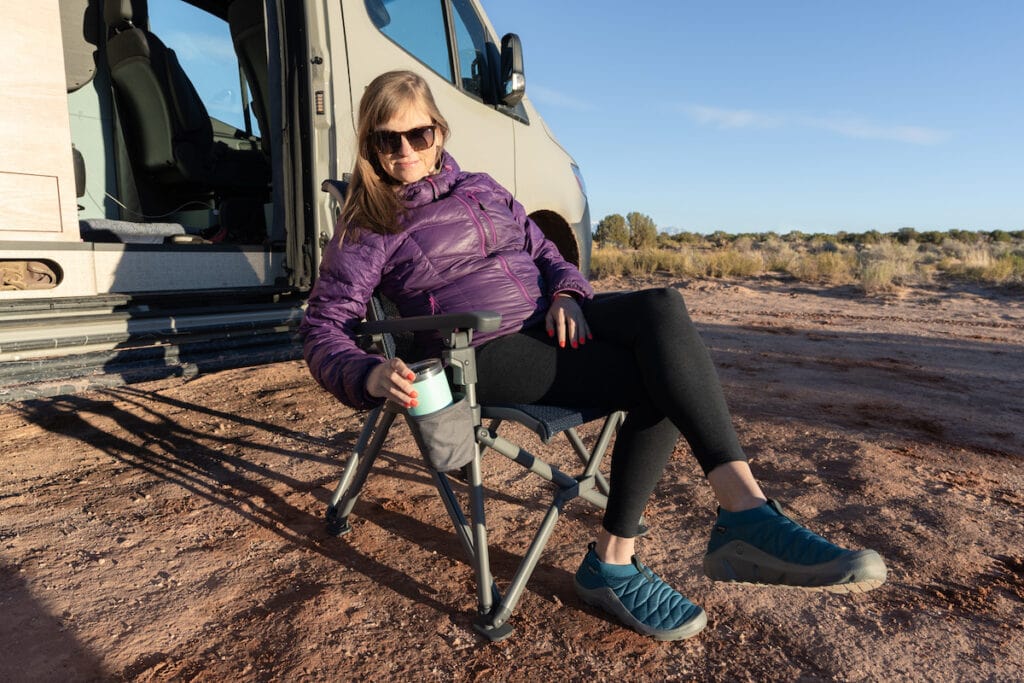
Kristen relaxing in Yeti Camp chair at desert campsite with Sprinter van behind her
Using the Yeti Rambler Tumbler
Food Storage

Stasher Bags

I love using Stasher Bags because they’re reusable, made of durable silicone and hold up to all kinds of van life needs. They’re perfect for packing hiking snacks, storing leftovers, and even reheating since they can be placed in boiling water or in the microwave. Plus, they help cut down on our plastic bag use.
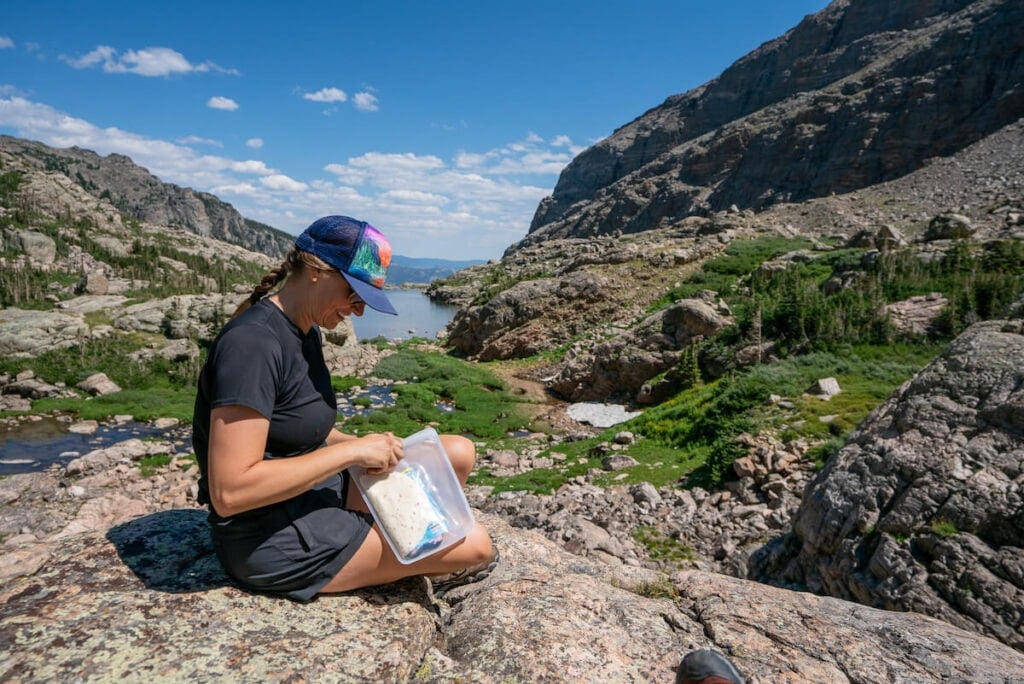
A woman sitting on a rock smiles down at her Stasher Bag with tortilla and tuna packets as a hiking snack inside
Using Stasher Bags on a hike
Water Filter

Stealth Flex Water Filtration System

I have the Guzzle H2O Stealth Flex installed under my sink, and it gives me peace of mind knowing our drinking water is clean and free of harmful toxins. It’s compact, easy to install in tight spaces, and the water tastes great—no matter where we fill up. Guzzle also makes other options like their Stream filter, which I’ve got my eye on for pumping water straight from lakes and rivers into my tanks.

Van Bathroom Essentials

Composting Toilet

CompoCloset Cuddy Lite

I recently upgraded from a foldable toilet to this CompoCloset Cuddy Lite is a compact, portable “composting” toilet that’s about the same size as a cassette toilet, but it’s way easier to clean. It doesn’t require permanent installation or external venting. The toliet separates the pee and poo. You can dump the pee container is easily emptied into any , and the pooptoilet separates the pee and poop and once you dial in the compost setup, it’s low-odor and easy to manage. For other toilet options, see my roundup of the best toilets for van life.

Reusable Pee Cloth

Kula Cloth

The Kula Cloth is one of my go-to hygiene essentials for van life and every outdoor adventure. This reusable pee cloth is super absorbent, antimicrobial, and way more hygienic than drip drying or packing out toilet paper on hikes. Once you try it, you won’t go back. Learn more about the Kula Cloth in my Kula Cloth review.
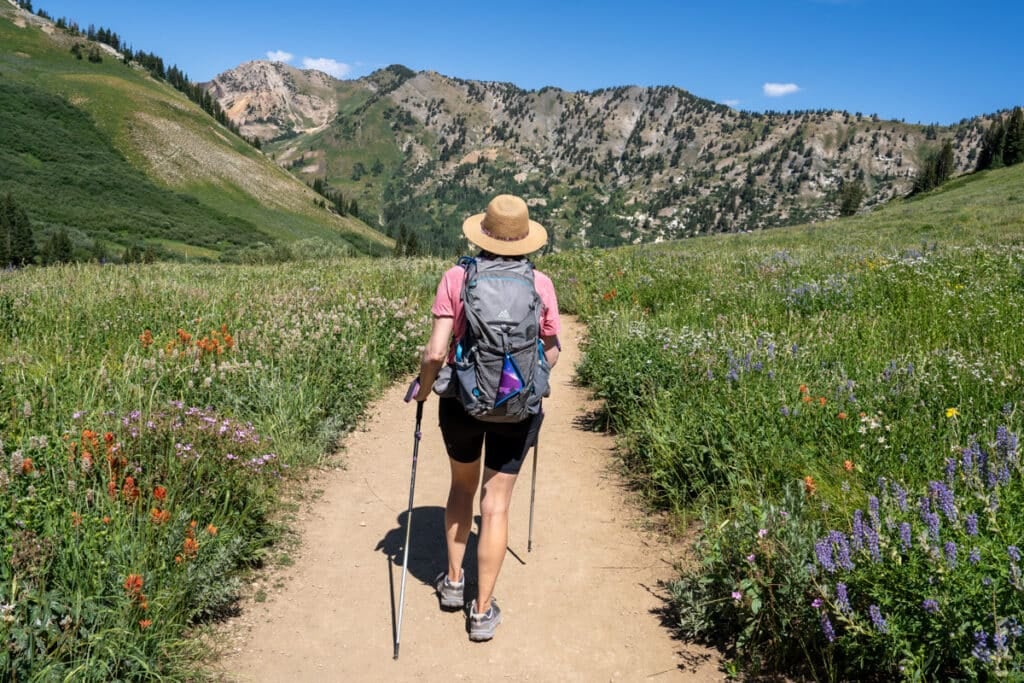
Kristen Bor hiking with a Kula Cloth pee rag hanging on the outside of a hiking backpack
The Kula Cloth is great for in the van and in the outdoors

Everyday Van Essentials

Durable Blanket

Rumpl Blanket

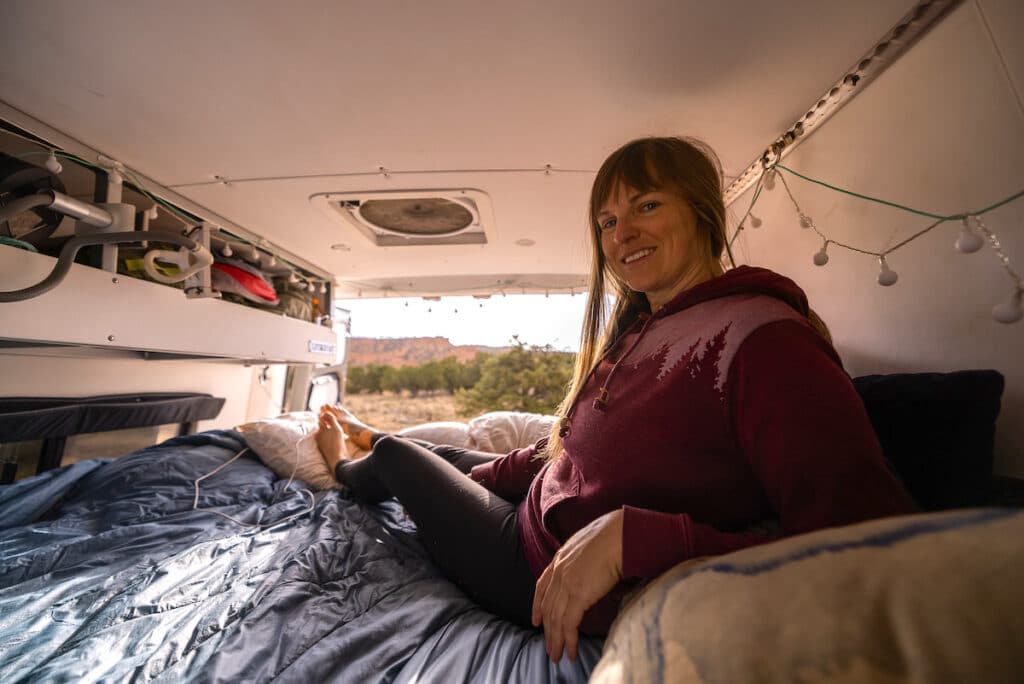
I’ve used Rumpl blankets in my van since 2016 and they’re an absolute essential, especially if you have dogs. Dog hair doesn’t stick to these blankets (just shake em’ outside the van) and they’re fully machine washable.
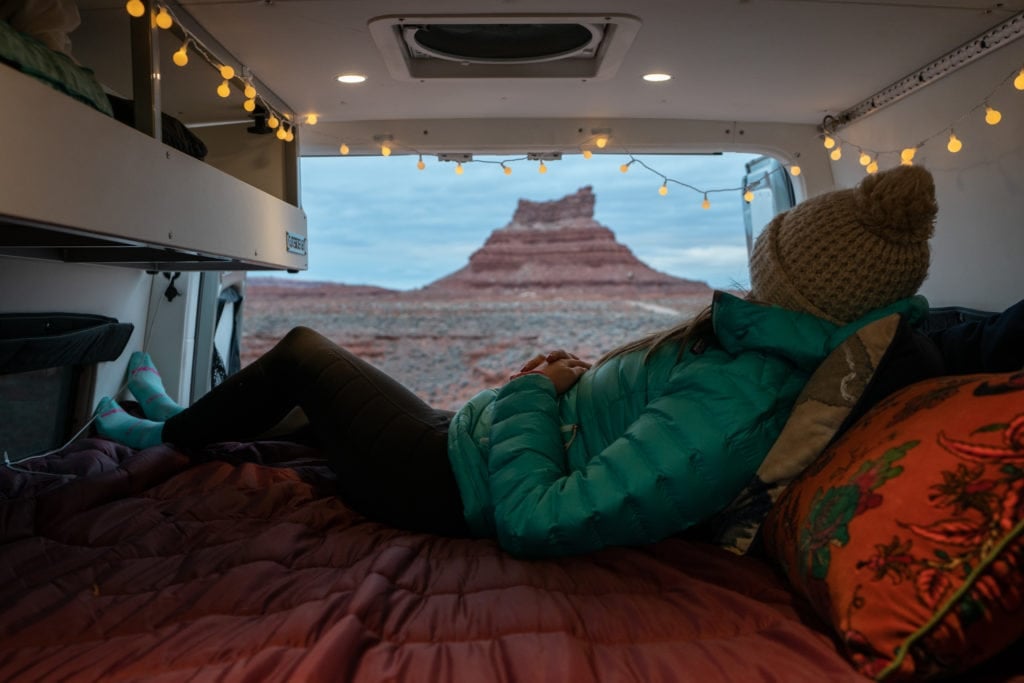
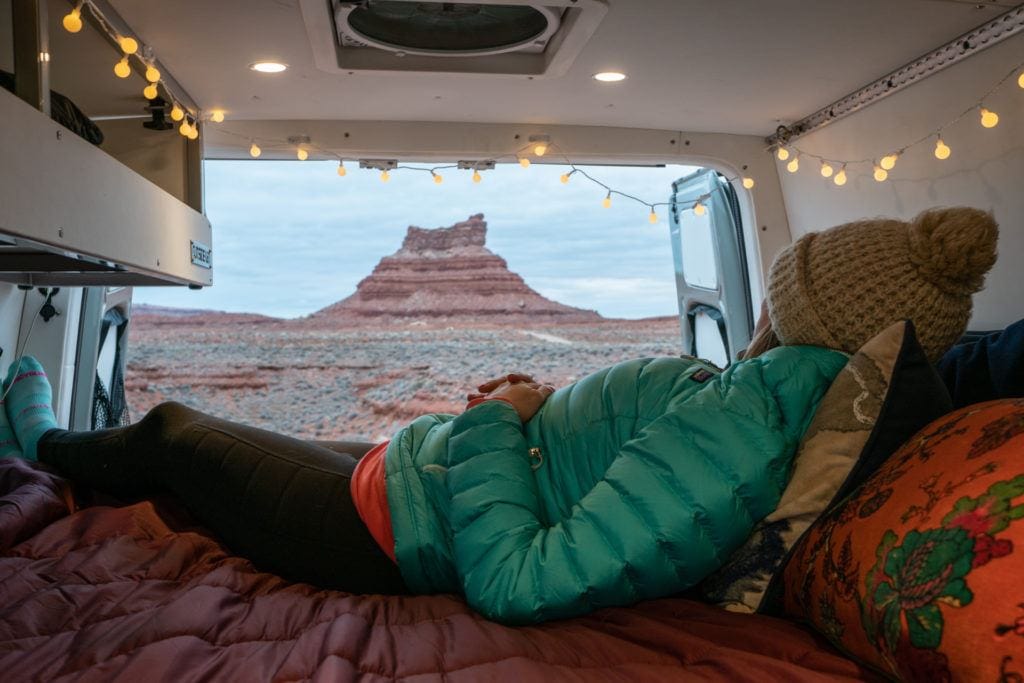
Kristen Bor laying on the bed in a Sprinter van with the back doors open. She is laying on a Rumpl blanket and looking out at a view of a red rock formation.
Rumpl blankets make it easier to keep your van bed clean
Multipurpose Towels

Nomadix Quick Dry Towels

Quick-dry towels pack down small, dry fast, and serve so many purposes on the road. I use Nomadix quick dry towels for everything from post-shower drying to wiping down dishes or laying out at the beach. They’re lightweight, versatile, and way more practical than bulky traditional towels.

Privacy

Blackout Window Coverings

Blackout window coverings are a van life essential for creating a cozy, private space at night and for helping control the temperature inside, so you stay comfortable no matter where you’re parked.

Bug Free Air Flow

Bug Screens

I didn’t have bug screens for the first 5 years I did van life. Now that I have them, I realize how crazy that was! Bug screens allow you to keep your doors open for airflow without letting annoying mosquitoes and other insects in.

Greywater Collection

Sea to Summit Folding Bucket

If your van doesn’t have a built-in greywater tank, a collapsible or folding bucket for collecting grey water is an easy, space-saving solution. It catches used sink water from washing dishes or brushing teeth, making it simple to dispose of responsibly and follow Leave No Trace guidelines on the road.
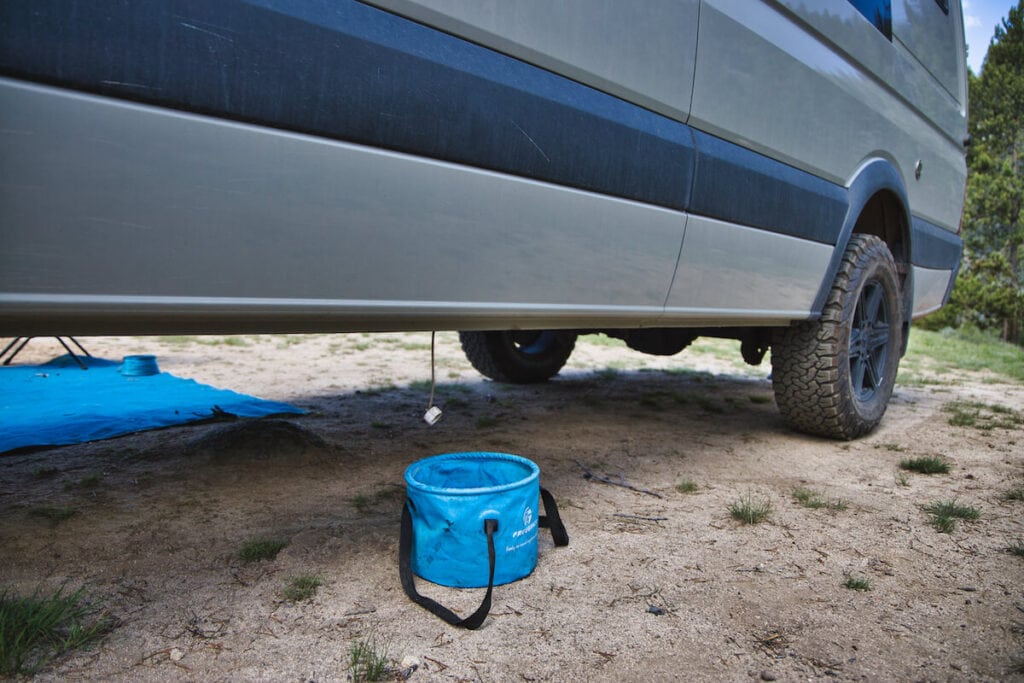
A collapsible bucket collects greywater underneath a sprinter van to follow Leave No Trace principles while campling
Using a collapsible bucket to collect greywater
Backpack

Deuter Trail Series Backpacks

A good backpack is a must-have for hiking, outdoor adventures, and even everyday tasks like errands or grocery runs. I love the Deuter Trail series because it comes in a variety of sizes, so you can pick the one that fits your needs, whether you want something small for quick trips or larger for longer hikes.
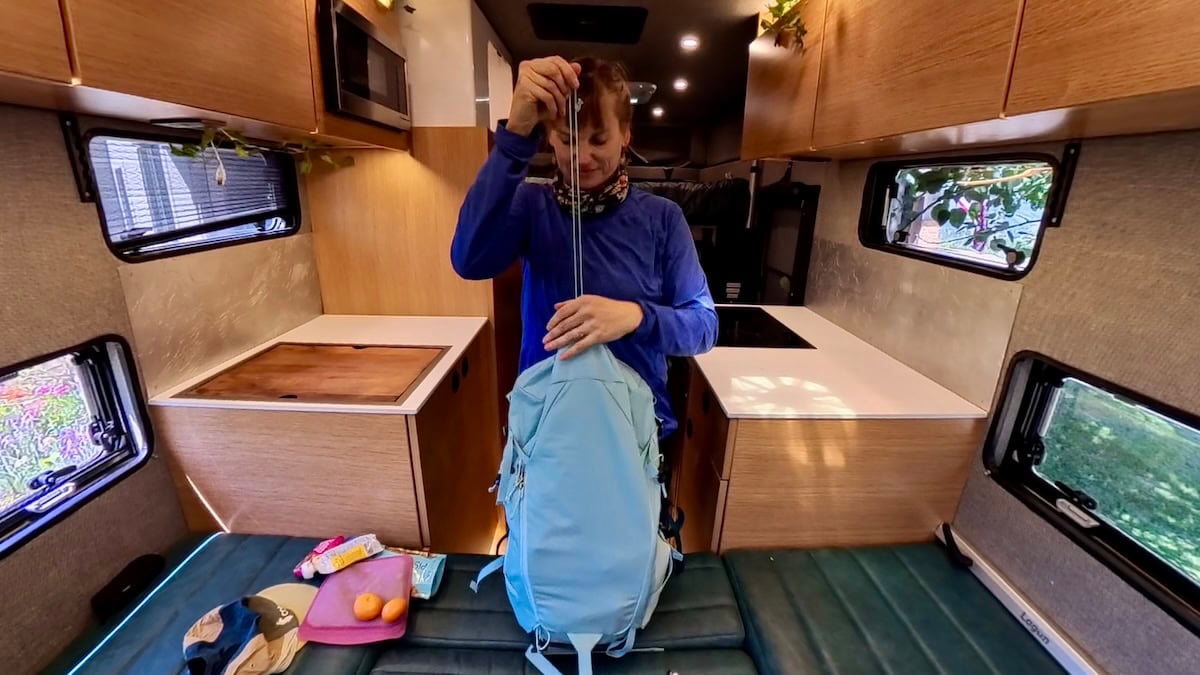
Kristen Bor packing a deuter trail backpack in a rossmonster truck camper

Van Patio Gear

Camp Chair

Helinox Sunset Chair

I’ve tried a lot of camp chairs over the years and I keep coming back to the Helinox Sunset Chair. I love the supportive high back and that it’s relatively lightweight at 3lbs 4oz. It’s packable and can be easily stored in the van.
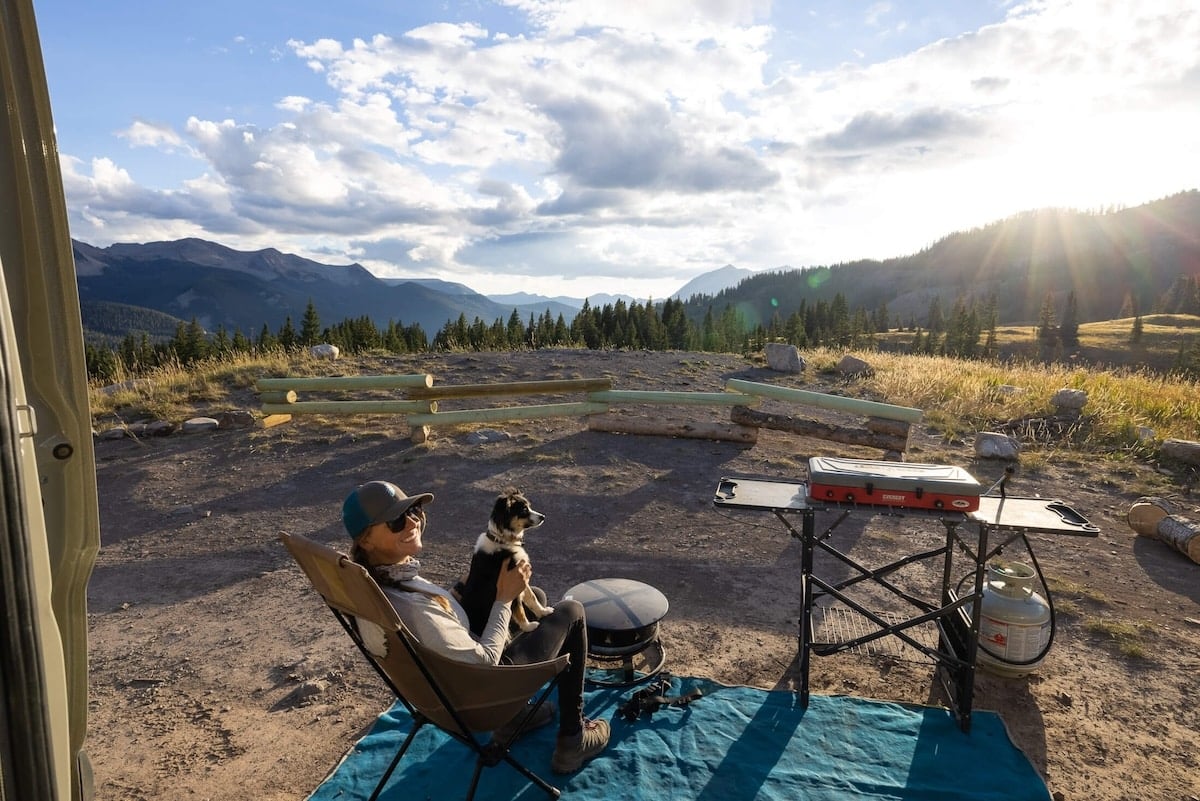
Kristen Bor sitting in camp chair next to camp table at a campsite in Colorado
Using the Helinox Sunset Chair
Camp Table

NEMO Moonlander Table

The NEMO Moonlander is my favorite compact camp table. It’s sturdy, durable, and packs down small, making it easy to store in the van. I love its versatile, dual-height design, perfect for everything from setting up snacks to playing cards or kicking back at camp.
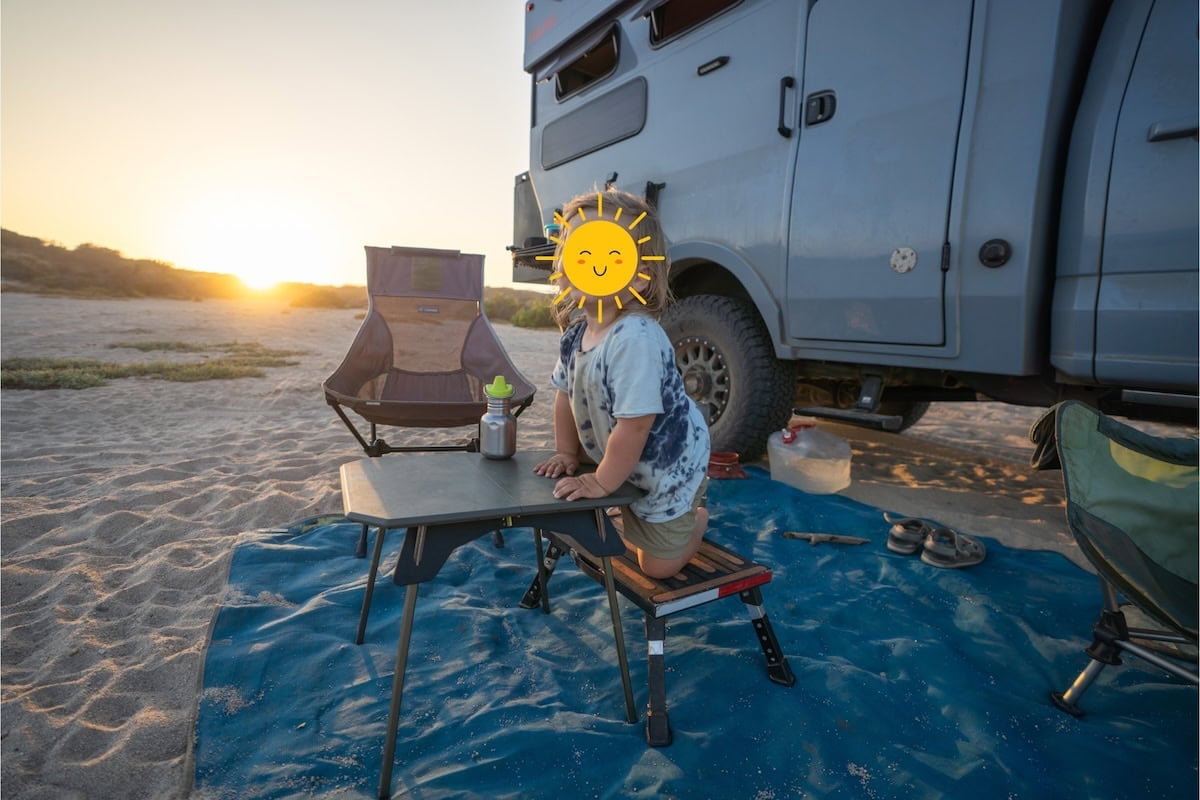
Boy with face blocked out at a campsite on the beach next to a Rossmonster Baja Truck camper. Boy is sitting at NEMO moonlander table
The NEMO Moonlander Table is also great for kiddos since it’s really durable
Outdoor Mat

CGEAR Sand-Free Mat

Having an outdoor mat is essential for keeping dirt, dust, and sand out of your van (or at least creating a buffer). I love the CGEAR mat because it’s more packable than a traditional rug and it filters out fine sand and dirt.
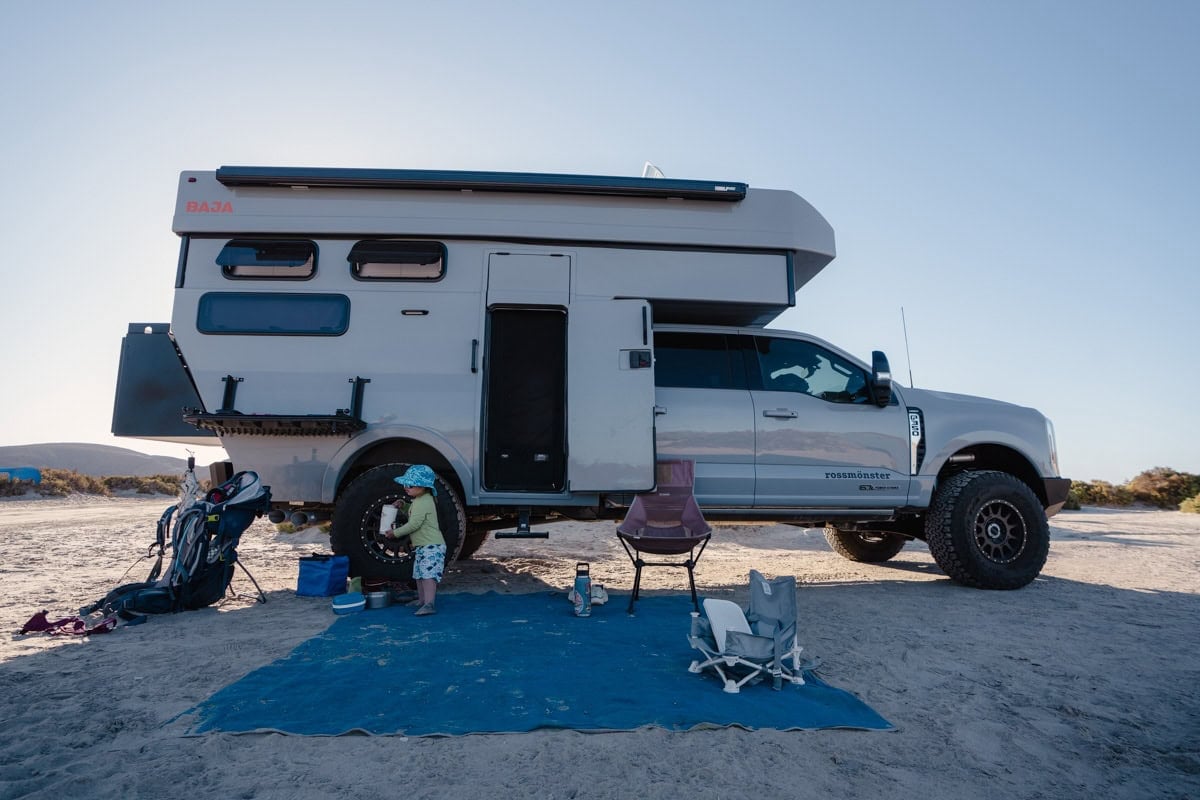
The CGEAR Sand Free Mat helped minimize the amount of sand that made it into my Rossmonster Baja Trail truck camper this winter in Baja, Mexico
Awning

MoonShade Portable Awning

Having an awning is essential if you’re traveling in hot, sunny places. I didn’t have a permanent awning on my second van, so I used the MoonShade as a less expensive and portable solution. It can be set up on your side or back doors, plus it packs down small. I’ve even tested it in windy conditions and the MoonShade holds up!

*Save 10% by using the code BEARFOOTTHEORY at checkout*

String Lights

BioLite Luci Solar String Lights

Create some camp ambiance with these BioLite string lights! These are a great way to brighten up camp and best of all, they’re charged by the sun (or a USB). I especially love having string lights at camp when burn bans mean no campfires.
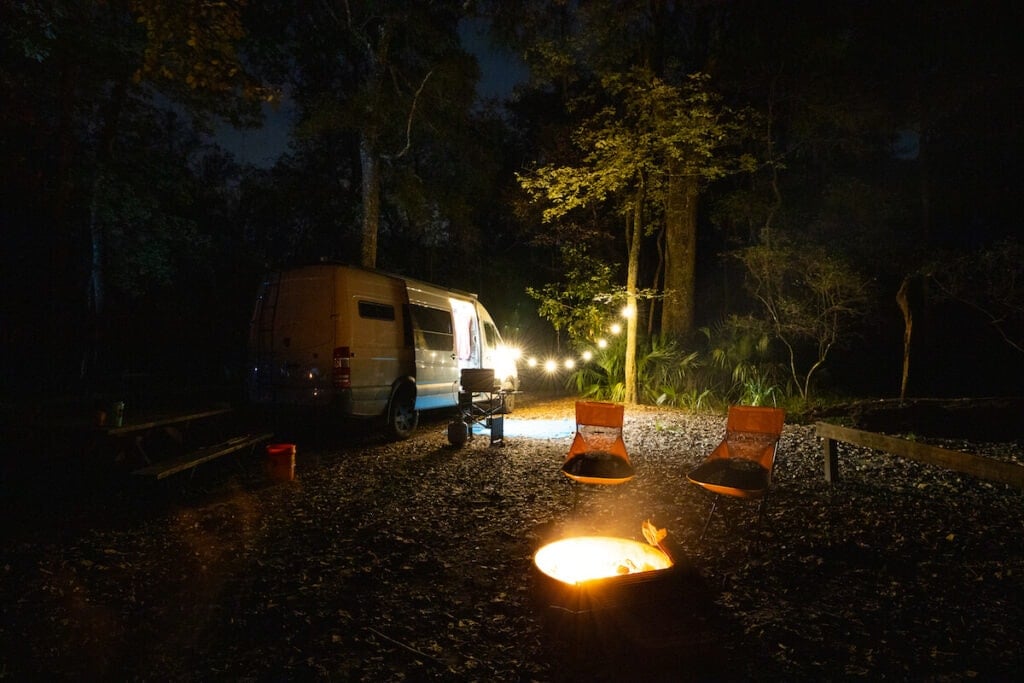
Sprinter Camper Van parked at a campsite at night with two camp chairs set up next to a campfire with string lights hanging for a nice ambiance
Using BioLite string lights to create night time ambience at camp
Camp Light

BioLite AlpenGlow 500 Lantern

The BioLite AlpenGlow lantern is rechargeable and I love that there are a variety of light settings to match any vibe. My son loves the multicolored one! Whether you’re cooking dinner, hanging out at the picnic table, or just need to spot your campsite after an evening walk, this lantern brings plenty of light and a cozy vibe.

Van Life Clothing Essentials

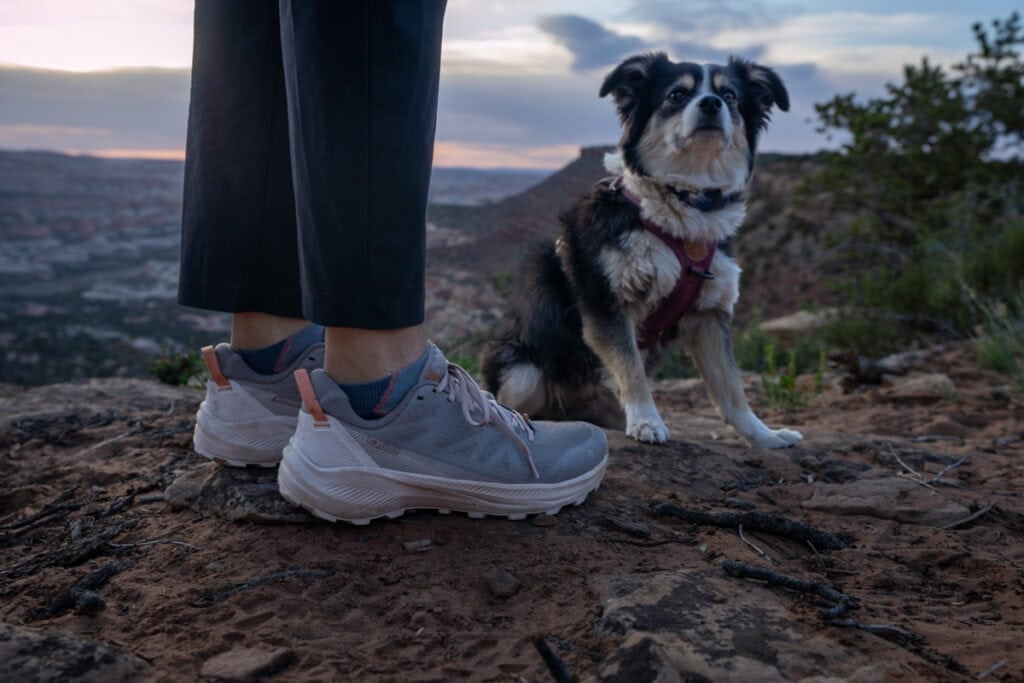
Hiking Shoe

Oboz Katabatic LT Hiking Shoe

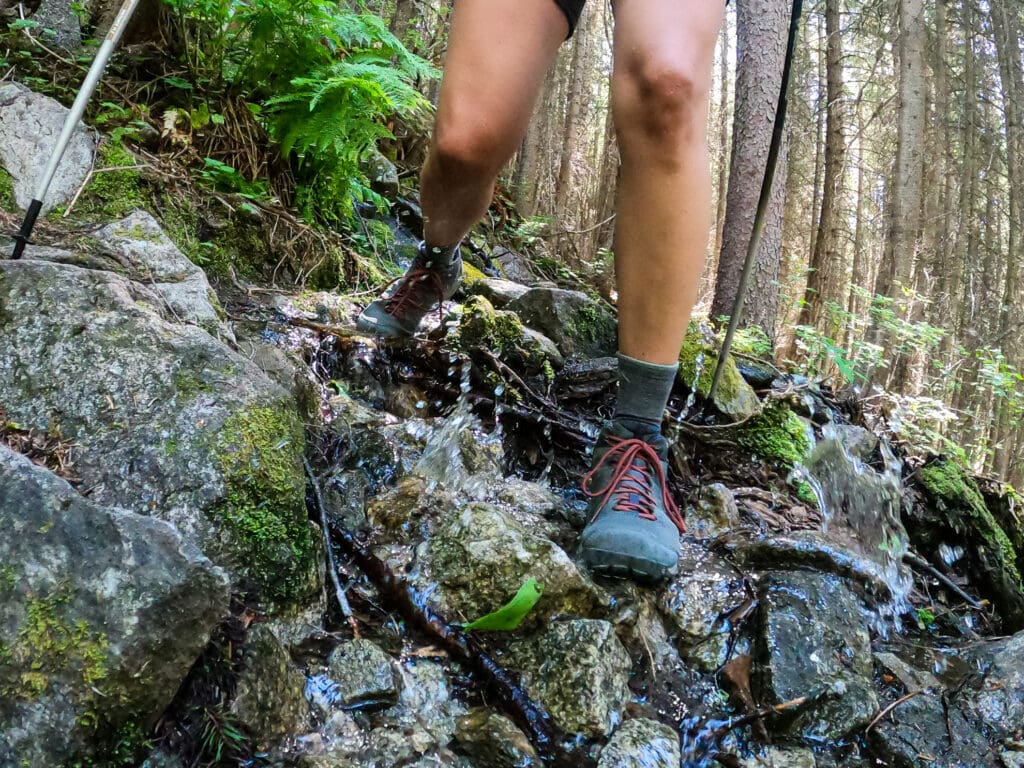
The Oboz Katabatic LT shoes are my go-to for van life because they’re lightweight, supportive, and have great traction. They’re comfortable straight out of the box and easily transition from trail to town—making them a practical, space-saving choice when you live on the road. Read my Oboz Katabatic review for more details!

Sandals

Teva Universal Trail Sandals

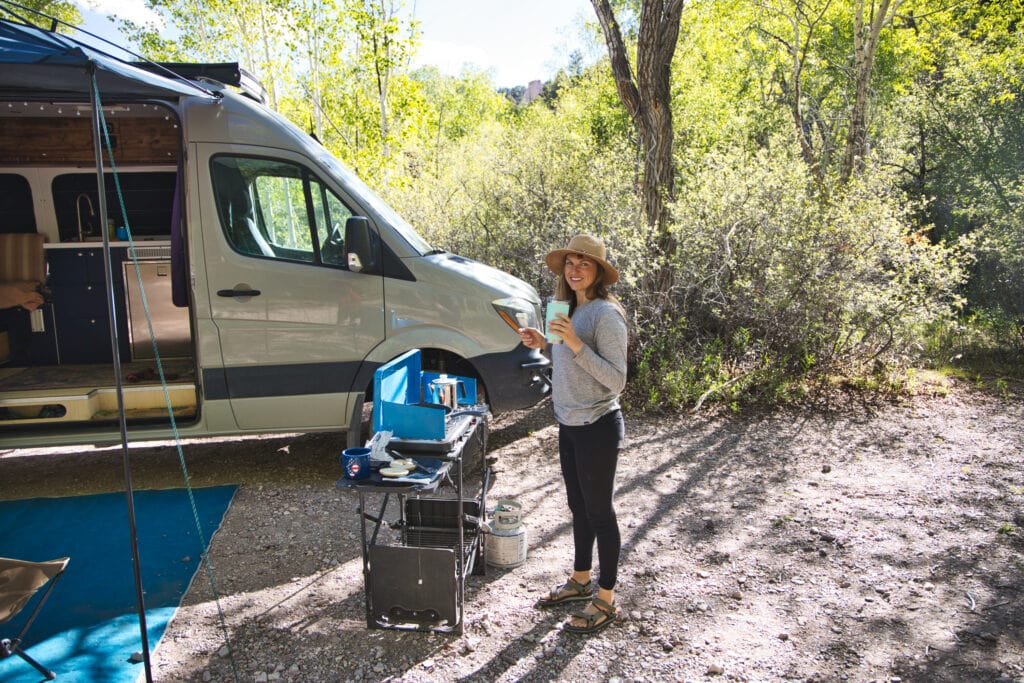
Teva Sandals are a great choice for van life because they are versatile and durable enough to handle various outdoor activities, including hiking and water sports. Their comfortable design and adjustable straps also make them easy to slip on and off. I share more thoughts about the Universal Trail Sandals here.
Looking to upgrade your camp cooking gear for car camping or van life? Here is our checklist for the best outdoor camp kitchen essentials.
Wearing the Teva Universal Trail Sandals at camp
Sun Hat

Wallaroo Sedona Hat

Having a hat is great for sun protection when hiking and spending time outdoors, but let’s be real – I also love that wearing a hat can hide how long it’s been since I’ve last washed my hair. I’ve worn the Sedona hat for years and it’s held up well on all my adventures.

*Get 20% off Wallaroo hats with code BEARFOOT20*
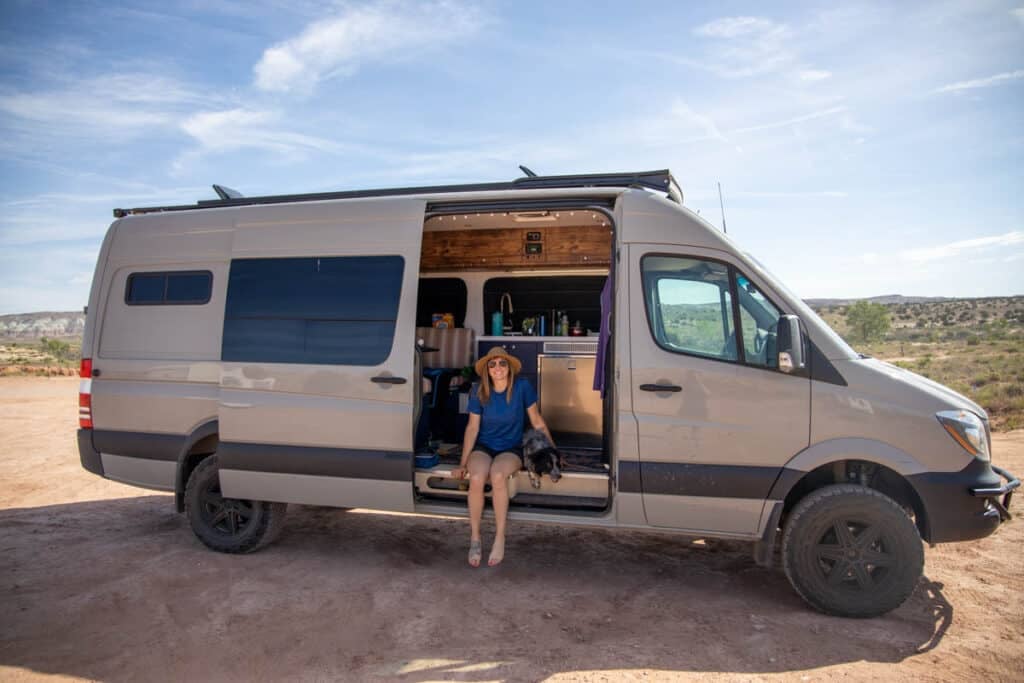
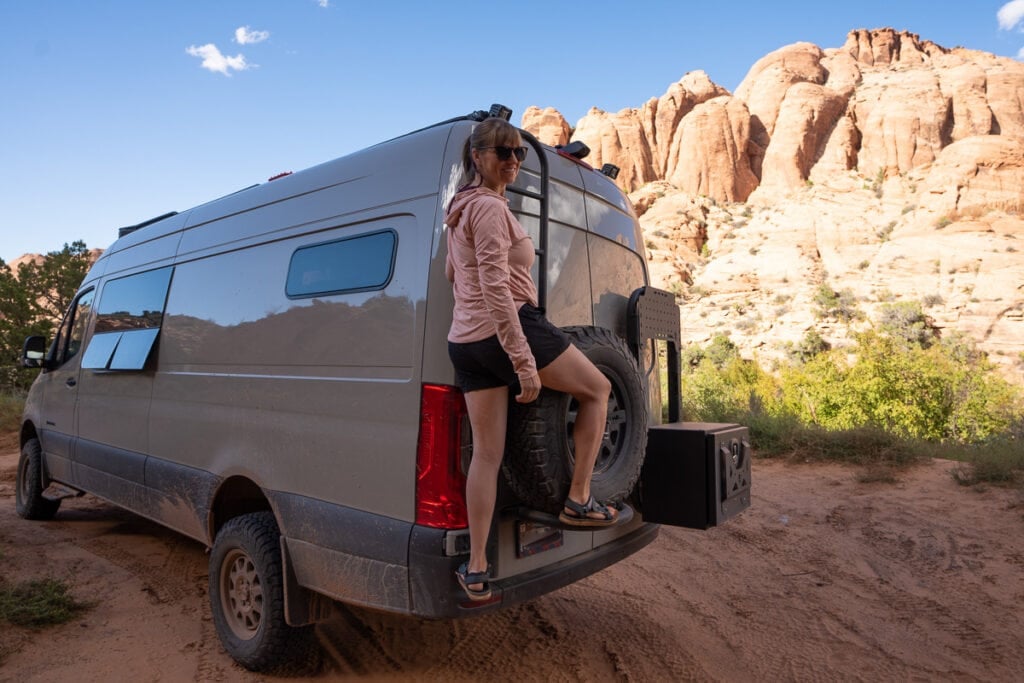
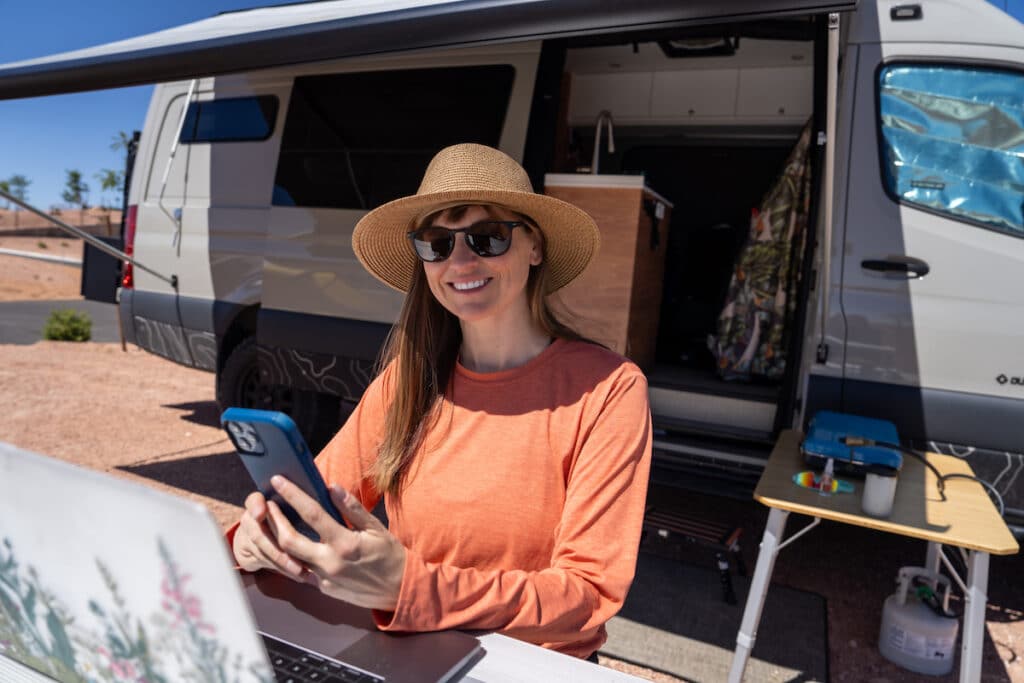
Kristen Bor sitting on edge of Sprinter Van in Moab on a hot summer day
Wearing the Wallaroo Sedona Hat at camp
Clothing

Moisture Wicking Clothing

Moisture-wicking clothing is perfect for van life because it keeps you dry, comfortable, and odor-free. It’s also easy to hand-wash and quick to dry, cutting down on laundry stops. A few of my go-to favorites are the Patagonia Capilene Cool Daily Hoody, the REI Sahara Shade Hoody, and the Outdoor Research Echo Hoody.

Van Life Organizational Gear

Packing Cubes

REI Co-op Packing Cube Set

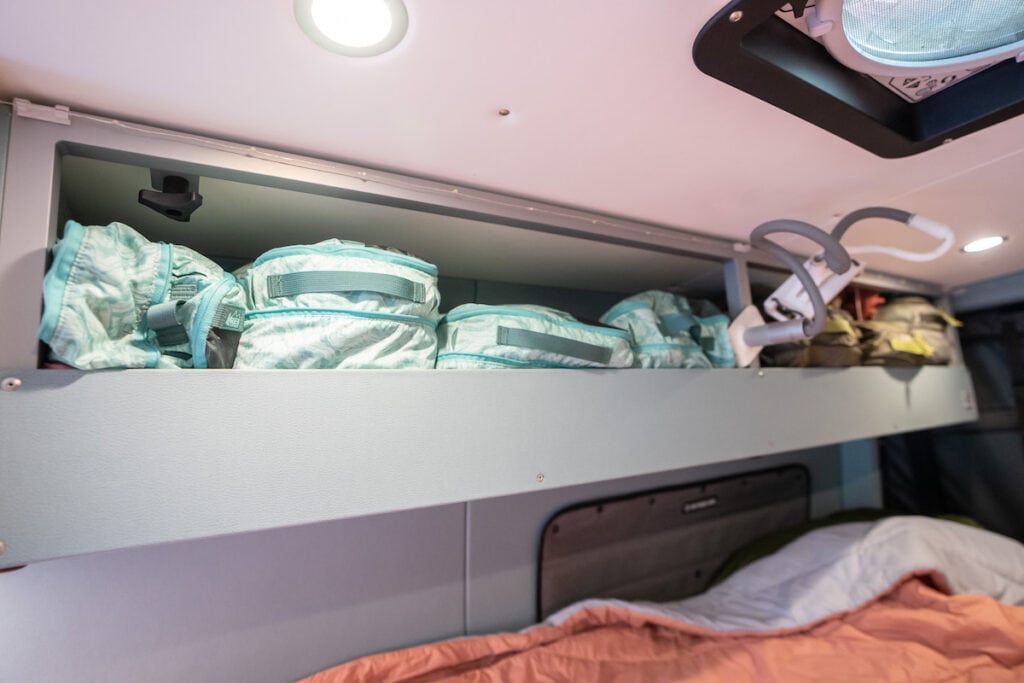
Packing cubes are essential for staying organized in the van. Instead of having to pull out a bunch of clothes looking for a specific item, you can just grab the cube you need. I have one for tops, one for bottoms, one for undies… you get the idea. These are especially useful if you’re living in your van with another person.
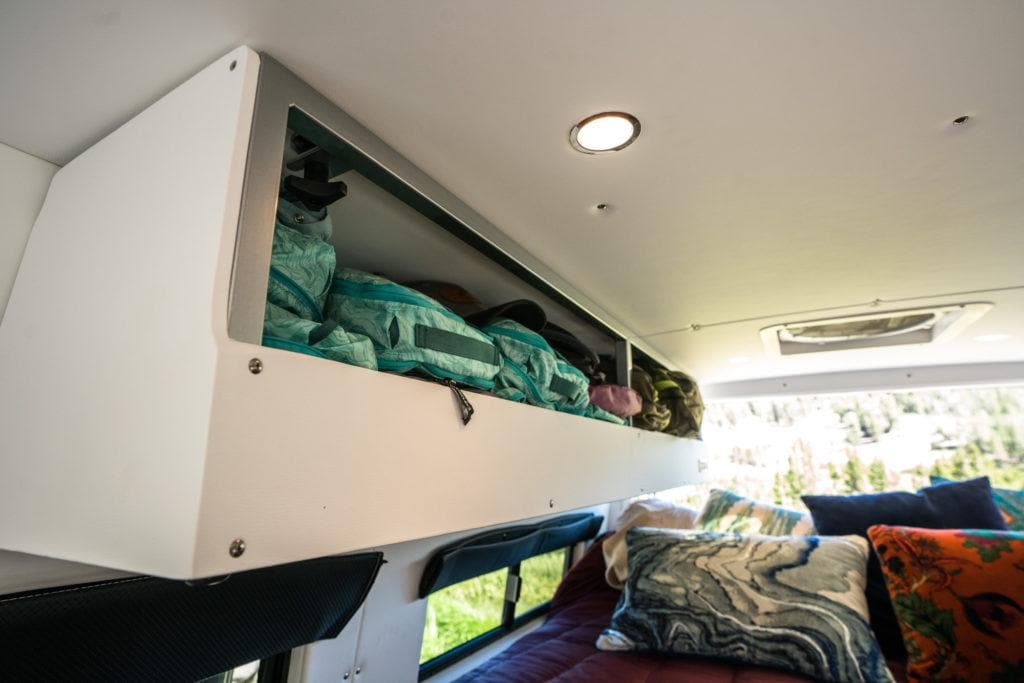
Packing cubes in a cabinet in a Sprinter van
Use different color packing cubes than your van companion so you don’t get them mixed up

Van Electronic Essentials

Portable Power Station

EcoFlow RIVER 2 Pro

If you have a robust power system, you won’t need this…but if you find your battery capacity to be lacking, this River 2 PRO portable power station can help keep you functioning. I have one of these for basic car camping, and it’s charges my laptop and other devices so quickly. The power station itself charges from 0-80% in less than 1 hour using an AC outlet too!

WiFi

Starlink Mini

The Starlink Mini has been a complete game-changer for me. I used to have to go into town and sit in the library or a coffee shop when I had zoom meetings. Now I can take care of business wherever we are camping. It’s also great for streaming shows without eating up the data on your phone plan. Mine is mounted to my roof, which is so convenient. My only complaint is that it consumes a lot of battery power, so you got to make sure to turn it off when you don’t need it. If the Starlink isn’t for you, check out your other options for getting wifi in your van.

Must-Have Recovery & Safety Gear

Recovery boards

Maxtrax

Some dispersed camping roads are sandy or become muddy after rain so having a way to self-recover if you get stuck is important. The Maxtrax recovery boards are my #1 must-have recovery accessories! We got stuck in some deep sand in Baja, and if it weren’t for these boards, getting out would have been near impossible.
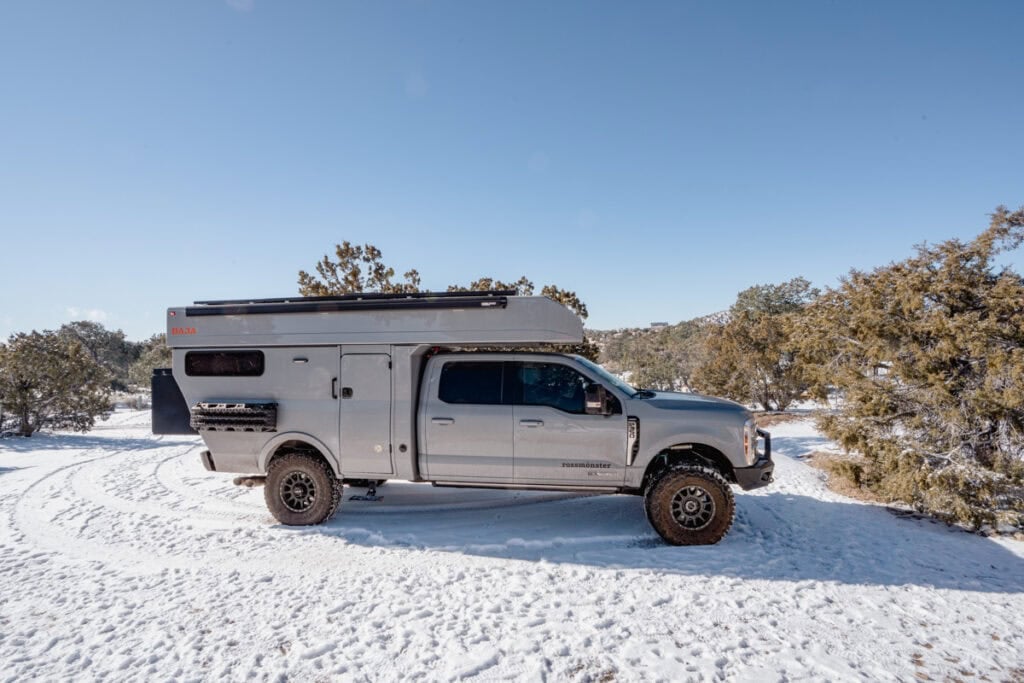
Rossmonster Baja XL truck camper in the snow with Max Trax recovery gear on the side
Easy access Max Trax storage on my Rossmonster Baja XL truck camper makes it easy to self-recover in more terrains.
Battery Jump Starter

Hulkman Jump Starter

Having a battery jump starter is essential for van life because it allows you to easily jump-start your vehicle without having to rely on external assistance, which is important especially if you plan to camp in remote areas.

Portable Air Compressor

Viair Air Compressor

With the miles we put on our vans, tire pressure is something to monitor closely. Airing down your tires before driving on soft surfaces (like sand) helps you avoid getting stuck, however, you need a way to air back up your tires when you get back to pavement. The Viair Air Compressor is a reliable and fast option.

Satellite Communication Device

Garmin InReach Mini 2

Having a two-way satellite communication device for van life gives ultimate peace of mind, especially if you camp often in places without service. A few years ago, my Sprinter battery died in winter when I was camped somewhere without service, and I was able to message my Dad with my location so he could reach out to AAA for me.

Folding Shovel

Gerber E-Tool Folding Spade

A shovel is a multi-functional van life essential, great for digging catholes, getting unstuck, or putting out campfires. I like this Gerber folding spade because it folds down for easy storage.

Carbon Monoxide Detector

Kidde Carbon Monoxide Detector

When you’re living in a small space with a diesel heater, propane stove monoxide detector is a must. This Kidde detector is a reliable option and updates every 15 seconds for an accurate reading.

Levelers

Lynx Leveling Blocks

The most common argument my partner and I have in our camper is whether or not the van is flat. That ended once we got these Lynx leveling blocks. They are inexpensive, lightweight, and are really easy to drive up onto.
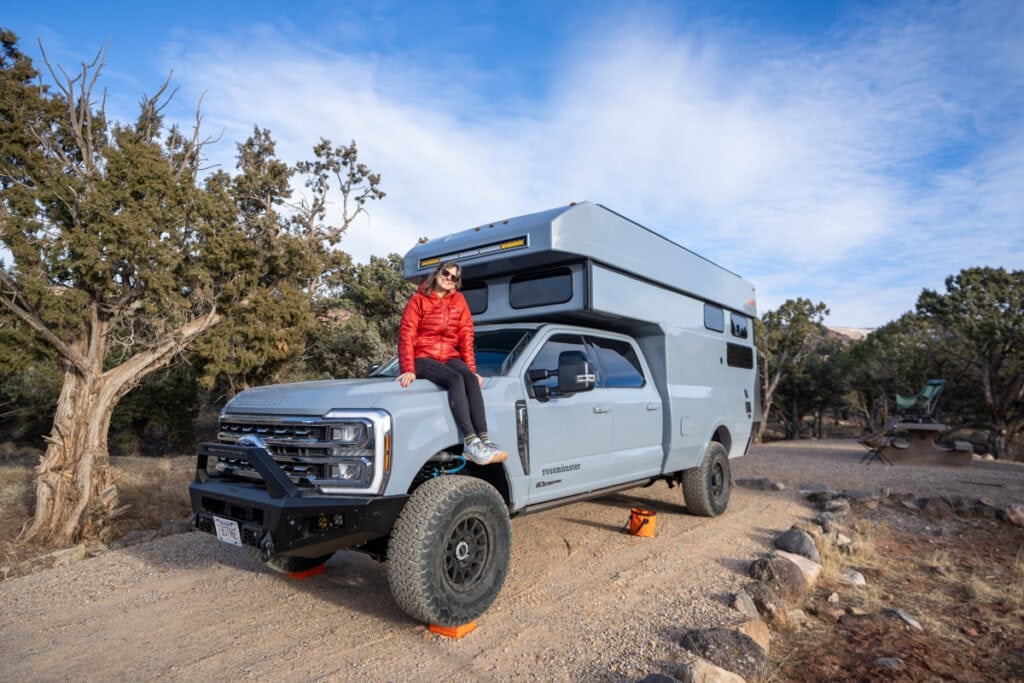
Kristen Bor sitting on the front of the Rossmonster Baja LX Adventure Truck
The leveling blocks can be split up and put under whatever tires are lower
Two Way Radio

Rocky Talkies Mountain Radio

If you plan to caravan with friends, the Rocky Talkies Mountain Radios make communication on the road easy and fun. They’re especially handy to have in areas where cell service is spotty such as in Baja or deep in the mountains.

Best Van Life Cleaning Supplies

Eco-Friendly Cleaners

Attitude Cleaning products

In a small space like a van, what you clean with really matters, both for your health and the environment. I use Attitude’s unscented dishwashing liquid and all-purpose kitchen cleaner because they’re EWG Verified, meaning they’re free of harmful chemicals. That’s especially important when I’m dumping greywater outdoors.

Dish Brush

Oxo Soap Dispensing Brush

I’ve been using the OXO dish soap dispensing brush for years in my van kitchen. It’s super convenient and helps me conserve both soap and water which are two things I’m always trying to stretch on the road. It makes doing dishes in a small sink way easier.

Vacuum

Dyson Car + Boat Handheld Vacuum

Keeping my van clean, especially with dogs, can be a challenge. Between the hair, dirt, and crumbs, it doesn’t take long for things to feel messy. I use a Dyson handheld vacuum because it’s compact and the cordless features means I can use it everywhere in my rig. Make sure to get a flexible hose extension so its easier to use in hard to reach places.

Essential Van Life Memberships

Campsite Finder

iOverlander

iOverlander 2 is one of my favorite tools for finding free campsites, water fill stations, dump spots, and other road trip essentials. The interface is clean and easy to use, and the filters make it simple to find exactly what I need. I recommend the paid membership so you can download maps and campsite info for offline use. It’s a small investment that’s saved me time, stress, and money on the road.

Campsite Finder

Harvest Hosts

If you spend a lot of time driving through states that don’t have a lot of public lands with free camping, Harvest Hosts is a great option for finding places to park overnight. You can “camp” at more than 2,300 unique properties such as wineries, farms, breweries, museums, and more. You can also add on Boondockers Welcome which adds access to 3000+ private properties across the US as well.
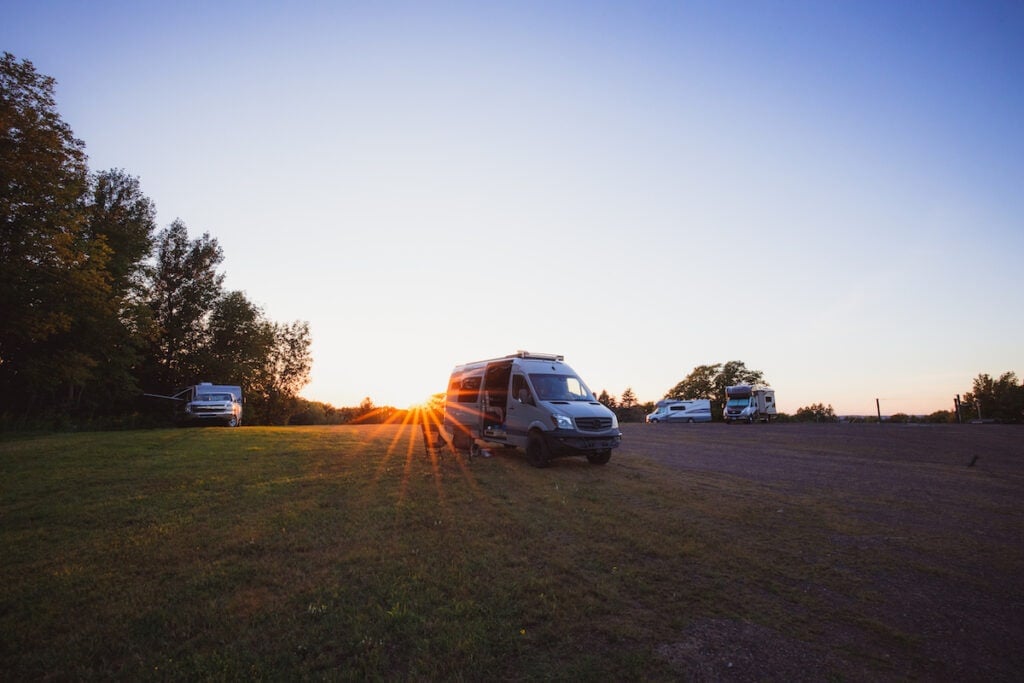
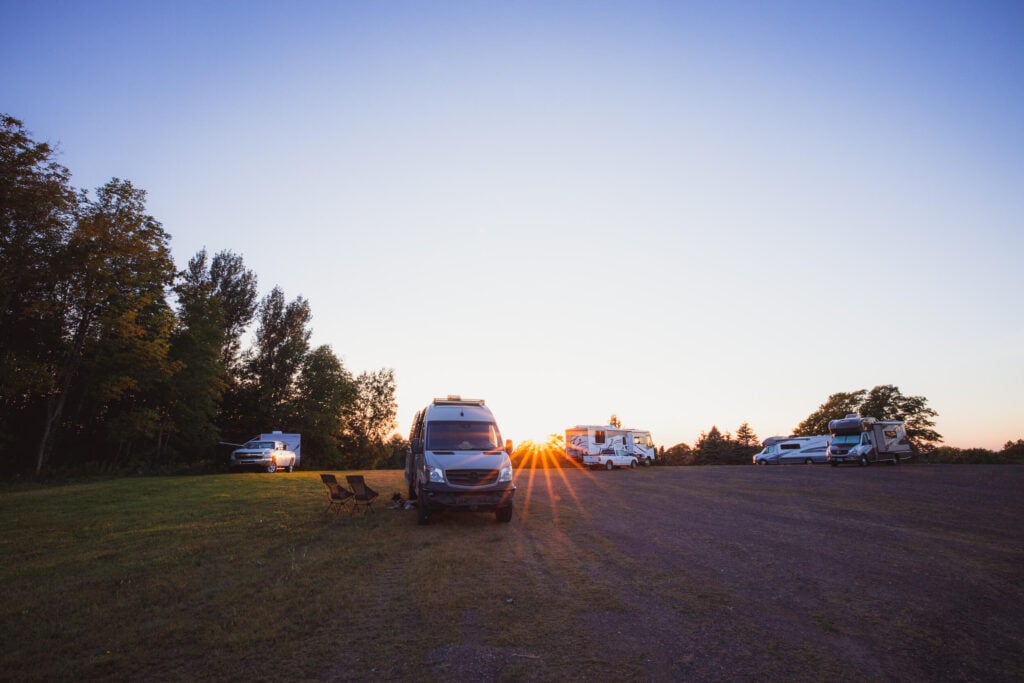
A few camper vans are parked spread out in a field at sunset. They are camped at a Harvest Hosts location in Michigan.
Camping at a Harvest Hosts in Michigan
Hiking Trail Finder

AllTrails+

This is my favorite app for finding local trails while traveling. The free version provides basic functions like searching for nearby trails and getting directions to the trailheads, but the paid version (get 30% off when you sign up for AllTrails+ here) has a lot of extra features (like offline maps.

Annual Park Pass

America The Beautiful National Park Pass

Lots of van lifers hit the road to explore America’s National Parks. Save money on entrance fees by buying an annual park pass which allows you unlimited entry for 12 months from your purchase date.

Save this post to Pinterest

Am I missing any van life essentials from my list? Let me know in the comments!

The post 42 Van Life Essentials that Make Life on the Road Easier appeared first on Bearfoot Theory.
My Minimalist Van Life Clothing Packing Checklist (after 9 years on the road)

After nine years of van life, including my first messy attempt at packing back in 2016, I’ve learned exactly what clothes and gear you actually need for van life. I now live full-time in my 100 square foot truck camper with my partner and young son, and my wardrobe is streamlined, functional, and clutter-free.

In this guide, I’ll help you downsize your closet with confidence so you can feel prepared, comfortable, and ready for adventure — without overflowing cabinets and clutter everywhere. By the end, you’ll know how to create a simple, versatile wardrobe that works for an active, outdoor lifestyle on the road.

The Power of Packing Light

When you have too many clothes in a van, a few things start to happen. I promise you, I’ve been there, and none of these make life on the road easier…

  • You lose valuable storage space. Every drawer, bin, or cabinet taken up by clothes you rarely wear means less room for gear, food, or things that actually enhance your time outside.
  • Getting dressed becomes frustrating. It’s harder to find what you need when you’re digging through piles of stuff.
  • Your van feels cluttered. The mess builds up quickly in such a small space, making it harder to relax and enjoy being in your van.
  • Laundry becomes a bigger chore. More clothes often means more to manage, more to wash, and more to keep organized. And spending the day in the laundromat is never much fun.
  • You end up wearing the same few pieces anyway. Most van lifers find they rotate through the same go-to outfits that are comfortable and practical, while everything else just takes up space. I personally wear each outfit until it’s so dirty, I’m embarassed, and then it goes in the laundry bag.

Downsizing your wardrobe isn’t just about saving space, it’s about making life on the road feel more manageable.

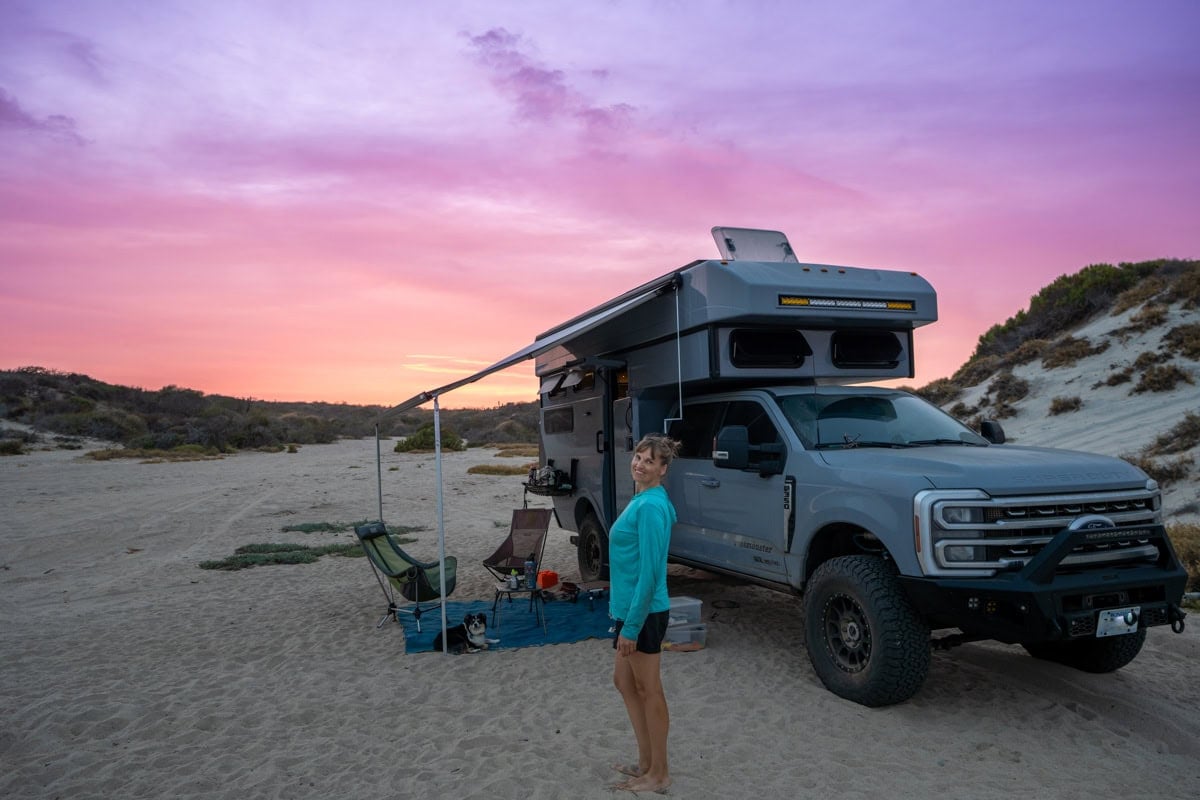
Kristen Bor standing next to Rossmonster Baja Trail adventure truck on sandy beach in Baja at sunset

How to Decide What Clothes to Bring

The kind of lifestyle you’re planning will shape what clothing you actually need. If you’re spending a lot of time in cities, you might want a few more stylish pieces. If your focus is more on hiking trails than hitting restaurants, function is going to matter a lot more than fashion. Or maybe you’re working remotely and need a decent top or two for Zoom calls.

The goal is to build a wardrobe around your lifestyle—so as you read these tips, think about what you do most and pack accordingly.

A good rule of thumb? If you don’t wear it much at home, you probably won’t wear it on the road. The clothes you bring should be the ones you reach for again and again—the ones you feel good in, that fit well, and that make sense for your day-to-day activities. Otherwise, they’ll just sit in a bin, taking up space and collecting dust.

And don’t forget to think seasonally. If you’ll be following the sun, your layers will look different than if you’re chasing snow. Know when you might swap out gear, and plan space in your van for that rotation.

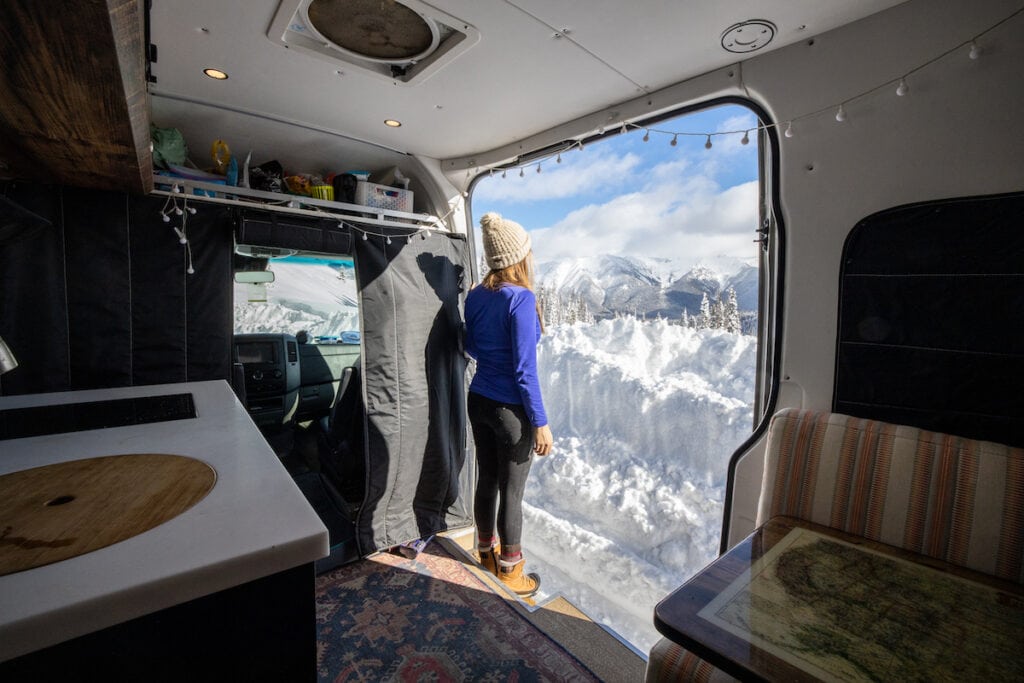
Woman standing in door of open converted Sprinter van looking out into snowy landscape
I spend winters skiing, so I plan my winter van life clothing accordingly

Van Life Clothing Tips

When it comes to choosing clothes for van life, simplicity and versatility are key. You want pieces that are comfortable, low-maintenance, and can keep up with your lifestyle—whether you’re hiking a dusty trail, lounging at camp, or grabbing coffee in town.

  • Focus on versatility. The more ways you can wear a single item, the better. Look for clothing that works across different settings — like a pair of pants that you can hike in and still feel comfortable wearing around town.
  • Fabrics matter. Quick-dry, athletic-style materials are a game-changer, especially if you plan to spend time outdoors. They’re easier to hand wash, don’t stink, and dry fast in wet or sweaty environments. I personally avoid anything that needs dry cleaning or can’t handle a spin through a laundromat machine.
  • Stick with colors and patterns that mix and match. I keep my wardrobe simple by choosing mostly solid colors or easy patterns that coordinate well with each other. That way, I can layer pieces for warmth, and everything works together without much thought.
  • Avoid bulky clothing. Storage adds up fast in a van, and thick items like big sweaters, thick flannels or heavy jackets take up a lot of space. You obviously want to be warm, but try to choose layers that are compressible and pack small.
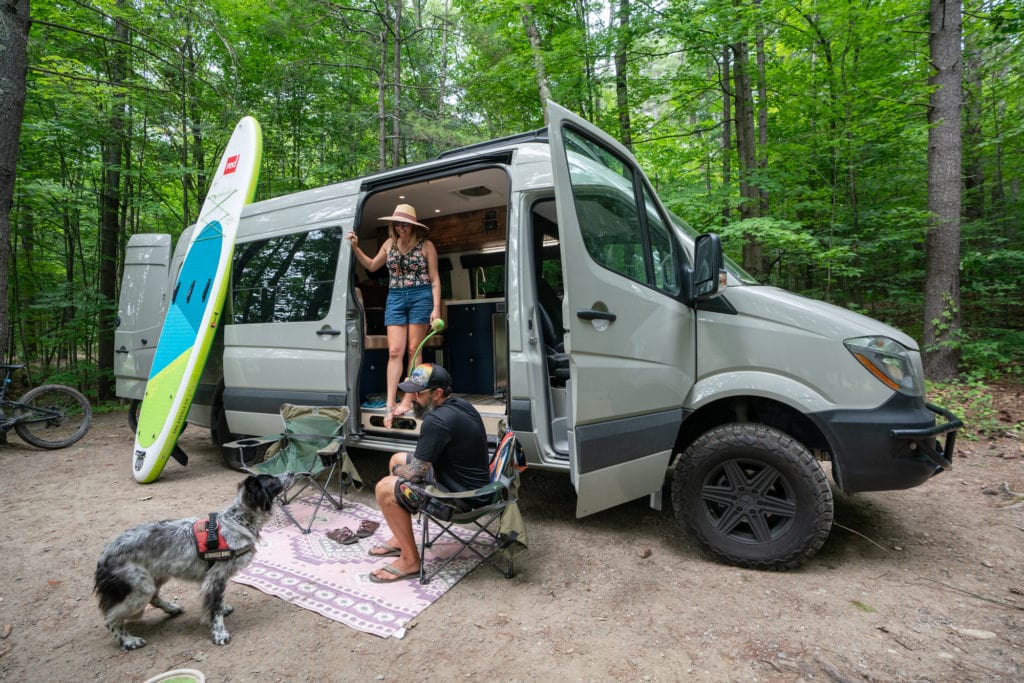
A woman stands in the doorway of a Sprinter camper van and a man sits in a camp chair outside, with a dog and a paddleboard leaned up against the van
You’ll want to make sure your clothing is multi-purpose, especially if you’re traveling with another person and have limited space

How to Organize Your Van Life Clothing

I’ve been using packing cubes for years, and they make van life organization so much easier. I separate my clothes by type—tops in one, bottoms in another, underwear in a third, and one just socks. If you’re sharing your van with a partner, color-coding your cubes is a simple way to keep things separate.

One thing I love about packing cubes is they create a natural limit—once the cube is full, that’s your sign to stop packing. They also make it way easier to find what you’re looking for without tearing apart your whole drawer. In addition to the cubes, I keep a small duffel in my rear storage box with off-season gear, like heavier winter layers, that I can rotate in as the weather shifts.

Cupboards in van 'closet' filled with packing cubes of clothes
Packing cubes make it easy to find and organize your clothing

Van Life Shirts

When it comes to van life clothing, I keep things simple, functional, and low maintenance. I look for breathable, quick-drying materials that don’t wrinkle or hold odor, and I stick to neutral colors that hide dirt and mix easily. For shirts and pants, I gravitate toward looser fits that keep me comfortable both on the trail and around camp, and I’ll often buy multiple colors of the same piece once I find something I love.

Since I live on the road full-time and don’t do laundry more than once or twice a month, I wear each item for a few days before tossing it in the laundry bag. If you’re packing for a shorter trip, you can adjust the numbers based on your needs.

  • Sun Shirts (6x): Sun shirts are a must for van life since they protect your skin without needing constant sunscreen reapplication. They’re lightweight, breathable, and designed to keep you cool even in hot weather. Plus, they’re multifunctional—you can wear them hiking, lounging at camp, or even as a beach cover-up. I rotate between the Patagonia Capilene Cool Daily Hoody, REI Sahara Shade Hoody, and Outdoor Research Echo Hoody—all of which I review in detail in my guide to the best sun protection shirts.
  • Short Sleeve Shirts (6x): I like having a mix of lightweight short-sleeve shirts for warm days at camp or layering under flannels and jackets. I pack a combo of quick-dry shirts like the Patagonia Capilene Cool Daily Tee, a few basic cotton t-shirts, and a tank top or two for lounging and layering.
  • Warmer shirts (2x) – I always pack a couple of warmer long-sleeve layers for the cooler months that I can wear under a jacket on chilly nights. My go-tos are a cozy flannel and my favorite hoody.

Jackets

Weather can shift fast on the road, so I pack a few jackets in different weights to stay comfortable without overpacking.

Van Life Shorts and Pants

For bottoms, you’ll want options that are comfortable enough for long drives, durable enough for outdoor activities, and versatile enough to wear in a variety of scenarios. These are the pants and shorts I pack in my rig.

  • Shorts (6x) – I look for lightweight, multifunctional shorts that that are comfy, quick-drying, and have pockets — like the Free Fly Breeze Shorts, the REI Trail Made shorts, or the REI Swiftland Running tights.
  • Pants (6x) – I pack a mix of leggings and lightweight hiking pants so I’m covered for both active days and lounging in the van. The Mountain Hardwear Dynama Ankle Pants and the Vuori Miles Ankle Pants are some of my go-tos. They are both comfy, have pockets, and the elastic waistband works great with a backpack. I also pack a pair of lounge pants and bring one warmer pair for chilly nights or hiking in colder climates—check out my guide to the best winter hiking pants for a few options I’ve tested.
  • Rain Pants (1x) – I don’t think rain pants are absolutely necessary, but they are nice to have because they give you more options to be outside on rainy days.

A lot of these tops and pants also show up in my What to Wear Hiking blog post. When you live on the road, having van life clothing that works from trail to town is key.

Freebie!

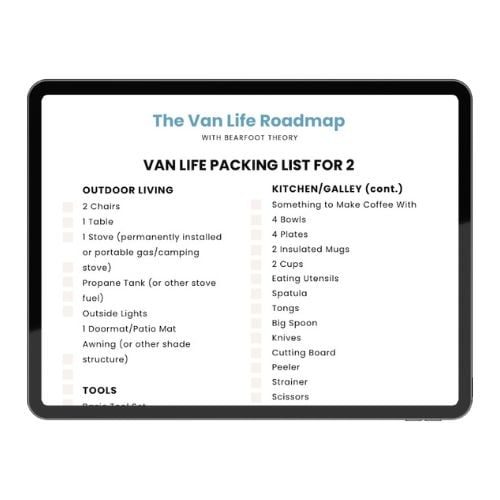
Van Life Packing Checklist

Get this free PDF that will help you pack up your van in a jiffy.

    .formkit-form[data-uid=”1411cbd0a2″] *{box-sizing:border-box;}.formkit-form[data-uid=”1411cbd0a2″]{-webkit-font-smoothing:antialiased;-moz-osx-font-smoothing:grayscale;}.formkit-form[data-uid=”1411cbd0a2″] legend{border:none;font-size:inherit;margin-bottom:10px;padding:0;position:relative;display:table;}.formkit-form[data-uid=”1411cbd0a2″] fieldset{border:0;padding:0.01em 0 0 0;margin:0;min-width:0;}.formkit-form[data-uid=”1411cbd0a2″] body:not(:-moz-handler-blocked) fieldset{display:table-cell;}.formkit-form[data-uid=”1411cbd0a2″] h1,.formkit-form[data-uid=”1411cbd0a2″] h2,.formkit-form[data-uid=”1411cbd0a2″] h3,.formkit-form[data-uid=”1411cbd0a2″] h4,.formkit-form[data-uid=”1411cbd0a2″] h5,.formkit-form[data-uid=”1411cbd0a2″] h6{color:inherit;font-size:inherit;font-weight:inherit;}.formkit-form[data-uid=”1411cbd0a2″] h2{font-size:1.5em;margin:1em 0;}.formkit-form[data-uid=”1411cbd0a2″] h3{font-size:1.17em;margin:1em 0;}.formkit-form[data-uid=”1411cbd0a2″] p{color:inherit;font-size:inherit;font-weight:inherit;}.formkit-form[data-uid=”1411cbd0a2″] ol:not([template-default]),.formkit-form[data-uid=”1411cbd0a2″] ul:not([template-default]),.formkit-form[data-uid=”1411cbd0a2″] blockquote:not([template-default]){text-align:left;}.formkit-form[data-uid=”1411cbd0a2″] p:not([template-default]),.formkit-form[data-uid=”1411cbd0a2″] hr:not([template-default]),.formkit-form[data-uid=”1411cbd0a2″] blockquote:not([template-default]),.formkit-form[data-uid=”1411cbd0a2″] ol:not([template-default]),.formkit-form[data-uid=”1411cbd0a2″] ul:not([template-default]){color:inherit;font-style:initial;}.formkit-form[data-uid=”1411cbd0a2″] .ordered-list,.formkit-form[data-uid=”1411cbd0a2″] .unordered-list{list-style-position:outside !important;padding-left:1em;}.formkit-form[data-uid=”1411cbd0a2″] .list-item{padding-left:0;}.formkit-form[data-uid=”1411cbd0a2″][data-format=”modal”]{display:none;}.formkit-form[data-uid=”1411cbd0a2″][data-format=”slide in”]{display:none;}.formkit-form[data-uid=”1411cbd0a2″][data-format=”sticky bar”]{display:none;}.formkit-sticky-bar .formkit-form[data-uid=”1411cbd0a2″][data-format=”sticky bar”]{display:block;}.formkit-form[data-uid=”1411cbd0a2″] .formkit-input,.formkit-form[data-uid=”1411cbd0a2″] .formkit-select,.formkit-form[data-uid=”1411cbd0a2″] .formkit-checkboxes{width:100%;}.formkit-form[data-uid=”1411cbd0a2″] .formkit-button,.formkit-form[data-uid=”1411cbd0a2″] .formkit-submit{border:0;border-radius:5px;color:#ffffff;cursor:pointer;display:inline-block;text-align:center;font-size:15px;font-weight:500;cursor:pointer;margin-bottom:15px;overflow:hidden;padding:0;position:relative;vertical-align:middle;}.formkit-form[data-uid=”1411cbd0a2″] .formkit-button:hover,.formkit-form[data-uid=”1411cbd0a2″] .formkit-submit:hover,.formkit-form[data-uid=”1411cbd0a2″] .formkit-button:focus,.formkit-form[data-uid=”1411cbd0a2″] .formkit-submit:focus{outline:none;}.formkit-form[data-uid=”1411cbd0a2″] .formkit-button:hover > span,.formkit-form[data-uid=”1411cbd0a2″] .formkit-submit:hover > span,.formkit-form[data-uid=”1411cbd0a2″] .formkit-button:focus > span,.formkit-form[data-uid=”1411cbd0a2″] .formkit-submit:focus > span{background-color:rgba(0,0,0,0.1);}.formkit-form[data-uid=”1411cbd0a2″] .formkit-button > span,.formkit-form[data-uid=”1411cbd0a2″] .formkit-submit > span{display:block;-webkit-transition:all 300ms ease-in-out;transition:all 300ms ease-in-out;padding:12px 24px;}.formkit-form[data-uid=”1411cbd0a2″] .formkit-input{background:#ffffff;font-size:15px;padding:12px;border:1px solid #e3e3e3;-webkit-flex:1 0 auto;-ms-flex:1 0 auto;flex:1 0 auto;line-height:1.4;margin:0;-webkit-transition:border-color ease-out 300ms;transition:border-color ease-out 300ms;}.formkit-form[data-uid=”1411cbd0a2″] .formkit-input:focus{outline:none;border-color:#1677be;-webkit-transition:border-color ease 300ms;transition:border-color ease 300ms;}.formkit-form[data-uid=”1411cbd0a2″] .formkit-input::-webkit-input-placeholder{color:inherit;opacity:0.8;}.formkit-form[data-uid=”1411cbd0a2″] .formkit-input::-moz-placeholder{color:inherit;opacity:0.8;}.formkit-form[data-uid=”1411cbd0a2″] .formkit-input:-ms-input-placeholder{color:inherit;opacity:0.8;}.formkit-form[data-uid=”1411cbd0a2″] .formkit-input::placeholder{color:inherit;opacity:0.8;}.formkit-form[data-uid=”1411cbd0a2″] [data-group=”dropdown”]{position:relative;display:inline-block;width:100%;}.formkit-form[data-uid=”1411cbd0a2″] [data-group=”dropdown”]::before{content:””;top:calc(50% – 2.5px);right:10px;position:absolute;pointer-events:none;border-color:#4f4f4f transparent transparent transparent;border-style:solid;border-width:6px 6px 0 6px;height:0;width:0;z-index:999;}.formkit-form[data-uid=”1411cbd0a2″] [data-group=”dropdown”] select{height:auto;width:100%;cursor:pointer;color:#333333;line-height:1.4;margin-bottom:0;padding:0 6px;-webkit-appearance:none;-moz-appearance:none;appearance:none;font-size:15px;padding:12px;padding-right:25px;border:1px solid #e3e3e3;background:#ffffff;}.formkit-form[data-uid=”1411cbd0a2″] [data-group=”dropdown”] select:focus{outline:none;}.formkit-form[data-uid=”1411cbd0a2″] [data-group=”checkboxes”]{text-align:left;margin:0;}.formkit-form[data-uid=”1411cbd0a2″] [data-group=”checkboxes”] [data-group=”checkbox”]{margin-bottom:10px;}.formkit-form[data-uid=”1411cbd0a2″] [data-group=”checkboxes”] [data-group=”checkbox”] *{cursor:pointer;}.formkit-form[data-uid=”1411cbd0a2″] [data-group=”checkboxes”] [data-group=”checkbox”]:last-of-type{margin-bottom:0;}.formkit-form[data-uid=”1411cbd0a2″] [data-group=”checkboxes”] [data-group=”checkbox”] input[type=”checkbox”]{display:none;}.formkit-form[data-uid=”1411cbd0a2″] [data-group=”checkboxes”] [data-group=”checkbox”] input[type=”checkbox”] + label::after{content:none;}.formkit-form[data-uid=”1411cbd0a2″] [data-group=”checkboxes”] [data-group=”checkbox”] input[type=”checkbox”]:checked + label::after{border-color:#ffffff;content:””;}.formkit-form[data-uid=”1411cbd0a2″] [data-group=”checkboxes”] [data-group=”checkbox”] input[type=”checkbox”]:checked + label::before{background:#10bf7a;border-color:#10bf7a;}.formkit-form[data-uid=”1411cbd0a2″] [data-group=”checkboxes”] [data-group=”checkbox”] label{position:relative;display:inline-block;padding-left:28px;}.formkit-form[data-uid=”1411cbd0a2″] [data-group=”checkboxes”] [data-group=”checkbox”] label::before,.formkit-form[data-uid=”1411cbd0a2″] [data-group=”checkboxes”] [data-group=”checkbox”] label::after{position:absolute;content:””;display:inline-block;}.formkit-form[data-uid=”1411cbd0a2″] [data-group=”checkboxes”] [data-group=”checkbox”] label::before{height:16px;width:16px;border:1px solid #e3e3e3;background:#ffffff;left:0px;top:3px;}.formkit-form[data-uid=”1411cbd0a2″] [data-group=”checkboxes”] [data-group=”checkbox”] label::after{height:4px;width:8px;border-left:2px solid #4d4d4d;border-bottom:2px solid #4d4d4d;-webkit-transform:rotate(-45deg);-ms-transform:rotate(-45deg);transform:rotate(-45deg);left:4px;top:8px;}.formkit-form[data-uid=”1411cbd0a2″] .formkit-alert{background:#f9fafb;border:1px solid #e3e3e3;border-radius:5px;-webkit-flex:1 0 auto;-ms-flex:1 0 auto;flex:1 0 auto;list-style:none;margin:25px auto;padding:12px;text-align:center;width:100%;}.formkit-form[data-uid=”1411cbd0a2″] .formkit-alert:empty{display:none;}.formkit-form[data-uid=”1411cbd0a2″] .formkit-alert-success{background:#d3fbeb;border-color:#10bf7a;color:#0c905c;}.formkit-form[data-uid=”1411cbd0a2″] .formkit-alert-error{background:#fde8e2;border-color:#f2643b;color:#ea4110;}.formkit-form[data-uid=”1411cbd0a2″] .formkit-spinner{display:-webkit-box;display:-webkit-flex;display:-ms-flexbox;display:flex;height:0px;width:0px;margin:0 auto;position:absolute;top:0;left:0;right:0;width:0px;overflow:hidden;text-align:center;-webkit-transition:all 300ms ease-in-out;transition:all 300ms ease-in-out;}.formkit-form[data-uid=”1411cbd0a2″] .formkit-spinner > div{margin:auto;width:12px;height:12px;background-color:#fff;opacity:0.3;border-radius:100%;display:inline-block;-webkit-animation:formkit-bouncedelay-formkit-form-data-uid-1411cbd0a2- 1.4s infinite ease-in-out both;animation:formkit-bouncedelay-formkit-form-data-uid-1411cbd0a2- 1.4s infinite ease-in-out both;}.formkit-form[data-uid=”1411cbd0a2″] .formkit-spinner > div:nth-child(1){-webkit-animation-delay:-0.32s;animation-delay:-0.32s;}.formkit-form[data-uid=”1411cbd0a2″] .formkit-spinner > div:nth-child(2){-webkit-animation-delay:-0.16s;animation-delay:-0.16s;}.formkit-form[data-uid=”1411cbd0a2″] .formkit-submit[data-active] .formkit-spinner{opacity:1;height:100%;width:50px;}.formkit-form[data-uid=”1411cbd0a2″] .formkit-submit[data-active] .formkit-spinner ~ span{opacity:0;}.formkit-form[data-uid=”1411cbd0a2″] .formkit-powered-by[data-active=”false”]{opacity:0.35;}.formkit-form[data-uid=”1411cbd0a2″] .formkit-powered-by-convertkit-container{display:-webkit-box;display:-webkit-flex;display:-ms-flexbox;display:flex;width:100%;z-index:5;margin:10px 0;position:relative;}.formkit-form[data-uid=”1411cbd0a2″] .formkit-powered-by-convertkit-container[data-active=”false”]{opacity:0.35;}.formkit-form[data-uid=”1411cbd0a2″] .formkit-powered-by-convertkit{-webkit-align-items:center;-webkit-box-align:center;-ms-flex-align:center;align-items:center;background-color:#ffffff;border:1px solid #dde2e7;border-radius:4px;color:#373f45;cursor:pointer;display:block;height:36px;margin:0 auto;opacity:0.95;padding:0;-webkit-text-decoration:none;text-decoration:none;text-indent:100%;-webkit-transition:ease-in-out all 200ms;transition:ease-in-out all 200ms;white-space:nowrap;overflow:hidden;-webkit-user-select:none;-moz-user-select:none;-ms-user-select:none;user-select:none;width:190px;background-repeat:no-repeat;background-position:center;background-image:url(“data:image/svg+xml;charset=utf8,%3Csvg width=’162′ height=’20’ viewBox=’0 0 162 20′ fill=’none’ xmlns=’http://www.w3.org/2000/svg’%3E%3Cpath d=’M83.0561 15.2457C86.675 15.2457 89.4722 12.5154 89.4722 9.14749C89.4722 5.99211 86.8443 4.06563 85.1038 4.06563C82.6801 4.06563 80.7373 5.76407 80.4605 8.28551C80.4092 8.75244 80.0387 9.14403 79.5686 9.14069C78.7871 9.13509 77.6507 9.12841 76.9314 9.13092C76.6217 9.13199 76.3658 8.88106 76.381 8.57196C76.4895 6.38513 77.2218 4.3404 78.618 2.76974C80.1695 1.02445 82.4289 0 85.1038 0C89.5979 0 93.8406 4.07791 93.8406 9.14749C93.8406 14.7608 89.1832 19.3113 83.1517 19.3113C78.8502 19.3113 74.5179 16.5041 73.0053 12.5795C72.9999 12.565 72.9986 12.5492 73.0015 12.534C73.0218 12.4179 73.0617 12.3118 73.1011 12.2074C73.1583 12.0555 73.2143 11.907 73.2062 11.7359L73.18 11.1892C73.174 11.0569 73.2075 10.9258 73.2764 10.8127C73.3452 10.6995 73.4463 10.6094 73.5666 10.554L73.7852 10.4523C73.9077 10.3957 74.0148 10.3105 74.0976 10.204C74.1803 10.0974 74.2363 9.97252 74.2608 9.83983C74.3341 9.43894 74.6865 9.14749 75.0979 9.14749C75.7404 9.14749 76.299 9.57412 76.5088 10.1806C77.5188 13.1 79.1245 15.2457 83.0561 15.2457Z’ fill=’%23373F45’/%3E%3Cpath d=’M155.758 6.91365C155.028 6.91365 154.804 6.47916 154.804 5.98857C154.804 5.46997 154.986 5.06348 155.758 5.06348C156.53 5.06348 156.712 5.46997 156.712 5.98857C156.712 6.47905 156.516 6.91365 155.758 6.91365ZM142.441 12.9304V9.32833L141.415 9.32323V8.90392C141.415 8.44719 141.786 8.07758 142.244 8.07986L142.441 8.08095V6.55306L144.082 6.09057V8.08073H145.569V8.50416C145.569 8.61242 145.548 8.71961 145.506 8.81961C145.465 8.91961 145.404 9.01047 145.328 9.08699C145.251 9.16351 145.16 9.2242 145.06 9.26559C144.96 9.30698 144.853 9.32826 144.745 9.32822H144.082V12.7201C144.082 13.2423 144.378 13.4256 144.76 13.4887C145.209 13.5629 145.583 13.888 145.583 14.343V14.9626C144.029 14.9626 142.441 14.8942 142.441 12.9304Z’ fill=’%23373F45’/%3E%3Cpath d=’M110.058 7.92554C108.417 7.88344 106.396 8.92062 106.396 11.5137C106.396 14.0646 108.417 15.0738 110.058 15.0318C111.742 15.0738 113.748 14.0646 113.748 11.5137C113.748 8.92062 111.742 7.88344 110.058 7.92554ZM110.07 13.7586C108.878 13.7586 108.032 12.8905 108.032 11.461C108.032 10.1013 108.878 9.20569 110.071 9.20569C111.263 9.20569 112.101 10.0995 112.101 11.459C112.101 12.8887 111.263 13.7586 110.07 13.7586Z’ fill=’%23373F45’/%3E%3Cpath d=’M118.06 7.94098C119.491 7.94098 120.978 8.33337 120.978 11.1366V14.893H120.063C119.608 14.893 119.238 14.524 119.238 14.0689V10.9965C119.238 9.66506 118.747 9.16047 117.891 9.16047C117.414 9.16047 116.797 9.52486 116.502 9.81915V14.069C116.502 14.1773 116.481 14.2845 116.44 14.3845C116.398 14.4845 116.337 14.5753 116.261 14.6519C116.184 14.7284 116.093 14.7891 115.993 14.8305C115.893 14.8719 115.786 14.8931 115.678 14.8931H114.847V8.10918H115.773C115.932 8.10914 116.087 8.16315 116.212 8.26242C116.337 8.36168 116.424 8.50033 116.46 8.65577C116.881 8.19328 117.428 7.94098 118.06 7.94098ZM122.854 8.09713C123.024 8.09708 123.19 8.1496 123.329 8.2475C123.468 8.34541 123.574 8.48391 123.631 8.64405L125.133 12.8486L126.635 8.64415C126.692 8.48402 126.798 8.34551 126.937 8.2476C127.076 8.1497 127.242 8.09718 127.412 8.09724H128.598L126.152 14.3567C126.091 14.5112 125.986 14.6439 125.849 14.7374C125.711 14.831 125.549 14.881 125.383 14.8809H124.333L121.668 8.09713H122.854Z’ fill=’%23373F45’/%3E%3Cpath d=’M135.085 14.5514C134.566 14.7616 133.513 15.0416 132.418 15.0416C130.496 15.0416 129.024 13.9345 129.024 11.4396C129.024 9.19701 130.451 7.99792 132.191 7.99792C134.338 7.99792 135.254 9.4378 135.158 11.3979C135.139 11.8029 134.786 12.0983 134.38 12.0983H130.679C130.763 13.1916 131.562 13.7662 132.615 13.7662C133.028 13.7662 133.462 13.7452 133.983 13.6481C134.535 13.545 135.085 13.9375 135.085 14.4985V14.5514ZM133.673 10.949C133.785 9.87621 133.061 9.28752 132.191 9.28752C131.321 9.28752 130.734 9.93979 130.679 10.9489L133.673 10.949Z’ fill=’%23373F45’/%3E%3Cpath d=’M137.345 8.11122C137.497 8.11118 137.645 8.16229 137.765 8.25635C137.884 8.35041 137.969 8.48197 138.005 8.62993C138.566 8.20932 139.268 7.94303 139.759 7.94303C139.801 7.94303 140.068 7.94303 140.489 7.99913V8.7265C140.489 9.11748 140.15 9.4147 139.759 9.4147C139.31 9.4147 138.651 9.5829 138.131 9.8773V14.8951H136.462V8.11112L137.345 8.11122ZM156.6 14.0508V8.09104H155.769C155.314 8.09104 154.944 8.45999 154.944 8.9151V14.8748H155.775C156.23 14.8748 156.6 14.5058 156.6 14.0508ZM158.857 12.9447V9.34254H157.749V8.91912C157.749 8.46401 158.118 8.09506 158.574 8.09506H158.857V6.56739L160.499 6.10479V8.09506H161.986V8.51848C161.986 8.97359 161.617 9.34254 161.161 9.34254H160.499V12.7345C160.499 13.2566 160.795 13.44 161.177 13.503C161.626 13.5774 162 13.9024 162 14.3574V14.977C160.446 14.977 158.857 14.9086 158.857 12.9447ZM98.1929 10.1124C98.2033 6.94046 100.598 5.16809 102.895 5.16809C104.171 5.16809 105.342 5.44285 106.304 6.12953L105.914 6.6631C105.654 7.02011 105.16 7.16194 104.749 6.99949C104.169 6.7702 103.622 6.7218 103.215 6.7218C101.335 6.7218 99.9169 7.92849 99.9068 10.1123C99.9169 12.2959 101.335 13.5201 103.215 13.5201C103.622 13.5201 104.169 13.4717 104.749 13.2424C105.16 13.0799 105.654 13.2046 105.914 13.5615L106.304 14.0952C105.342 14.7819 104.171 15.0566 102.895 15.0566C100.598 15.0566 98.2033 13.2842 98.1929 10.1124ZM147.619 5.21768C148.074 5.21768 148.444 5.58663 148.444 6.04174V9.81968L151.82 5.58131C151.897 5.47733 151.997 5.39282 152.112 5.3346C152.227 5.27638 152.355 5.24607 152.484 5.24611H153.984L150.166 10.0615L153.984 14.8749H152.484C152.355 14.8749 152.227 14.8446 152.112 14.7864C151.997 14.7281 151.897 14.6436 151.82 14.5397L148.444 10.3025V14.0508C148.444 14.5059 148.074 14.8749 147.619 14.8749H146.746V5.21768H147.619Z’ fill=’%23373F45’/%3E%3Cpath d=’M0.773438 6.5752H2.68066C3.56543 6.5752 4.2041 6.7041 4.59668 6.96191C4.99219 7.21973 5.18994 7.62695 5.18994 8.18359C5.18994 8.55859 5.09326 8.87061 4.8999 9.11963C4.70654 9.36865 4.42822 9.52539 4.06494 9.58984V9.63379C4.51611 9.71875 4.84717 9.88721 5.05811 10.1392C5.27197 10.3882 5.37891 10.7266 5.37891 11.1543C5.37891 11.7314 5.17676 12.1841 4.77246 12.5122C4.37109 12.8374 3.81152 13 3.09375 13H0.773438V6.5752ZM1.82373 9.22949H2.83447C3.27393 9.22949 3.59473 9.16064 3.79688 9.02295C3.99902 8.88232 4.1001 8.64502 4.1001 8.31104C4.1001 8.00928 3.99023 7.79102 3.77051 7.65625C3.55371 7.52148 3.20801 7.4541 2.7334 7.4541H1.82373V9.22949ZM1.82373 10.082V12.1167H2.93994C3.37939 12.1167 3.71045 12.0332 3.93311 11.8662C4.15869 11.6963 4.27148 11.4297 4.27148 11.0664C4.27148 10.7324 4.15723 10.4849 3.92871 10.3237C3.7002 10.1626 3.35303 10.082 2.88721 10.082H1.82373Z’ fill=’%23373F45’/%3E%3Cpath d=’M13.011 6.5752V10.7324C13.011 11.207 12.9084 11.623 12.7034 11.9805C12.5012 12.335 12.2068 12.6089 11.8201 12.8022C11.4363 12.9927 10.9763 13.0879 10.4402 13.0879C9.6433 13.0879 9.02368 12.877 8.5813 12.4551C8.13892 12.0332 7.91772 11.4531 7.91772 10.7148V6.5752H8.9724V10.6401C8.9724 11.1704 9.09546 11.5615 9.34155 11.8135C9.58765 12.0654 9.96557 12.1914 10.4753 12.1914C11.4656 12.1914 11.9607 11.6714 11.9607 10.6313V6.5752H13.011Z’ fill=’%23373F45’/%3E%3Cpath d=’M15.9146 13V6.5752H16.9649V13H15.9146Z’ fill=’%23373F45’/%3E%3Cpath d=’M19.9255 13V6.5752H20.9758V12.0991H23.696V13H19.9255Z’ fill=’%23373F45’/%3E%3Cpath d=’M28.2828 13H27.2325V7.47607H25.3428V6.5752H30.1724V7.47607H28.2828V13Z’ fill=’%23373F45’/%3E%3Cpath d=’M41.9472 13H40.8046L39.7148 9.16796C39.6679 9.00097 39.6093 8.76074 39.539 8.44727C39.4687 8.13086 39.4262 7.91113 39.4116 7.78809C39.3823 7.97559 39.3339 8.21875 39.2665 8.51758C39.2021 8.81641 39.1479 9.03905 39.1039 9.18554L38.0405 13H36.8979L36.0673 9.7832L35.2236 6.5752H36.2958L37.2143 10.3193C37.3578 10.9199 37.4604 11.4502 37.5219 11.9102C37.5541 11.6611 37.6025 11.3828 37.6669 11.0752C37.7314 10.7676 37.79 10.5186 37.8427 10.3281L38.8886 6.5752H39.9301L41.0024 10.3457C41.1049 10.6943 41.2133 11.2158 41.3276 11.9102C41.3715 11.4912 41.477 10.958 41.644 10.3105L42.558 6.5752H43.6215L41.9472 13Z’ fill=’%23373F45’/%3E%3Cpath d=’M45.7957 13V6.5752H46.846V13H45.7957Z’ fill=’%23373F45’/%3E%3Cpath d=’M52.0258 13H50.9755V7.47607H49.0859V6.5752H53.9155V7.47607H52.0258V13Z’ fill=’%23373F45’/%3E%3Cpath d=’M61.2312 13H60.1765V10.104H57.2146V13H56.1643V6.5752H57.2146V9.20312H60.1765V6.5752H61.2312V13Z’ fill=’%23373F45’/%3E%3C/svg%3E”);}.formkit-form[data-uid=”1411cbd0a2″] .formkit-powered-by-convertkit:hover,.formkit-form[data-uid=”1411cbd0a2″] .formkit-powered-by-convertkit:focus{background-color:#ffffff;-webkit-transform:scale(1.025) perspective(1px);-ms-transform:scale(1.025) perspective(1px);transform:scale(1.025) perspective(1px);opacity:1;}.formkit-form[data-uid=”1411cbd0a2″] .formkit-powered-by-convertkit[data-variant=”dark”],.formkit-form[data-uid=”1411cbd0a2″] .formkit-powered-by-convertkit[data-variant=”light”]{background-color:transparent;border-color:transparent;width:166px;}.formkit-form[data-uid=”1411cbd0a2″] .formkit-powered-by-convertkit[data-variant=”light”]{color:#ffffff;background-image:url(“data:image/svg+xml;charset=utf8,%3Csvg width=’162′ height=’20’ viewBox=’0 0 162 20′ fill=’none’ xmlns=’http://www.w3.org/2000/svg’%3E%3Cpath d=’M83.0561 15.2457C86.675 15.2457 89.4722 12.5154 89.4722 9.14749C89.4722 5.99211 86.8443 4.06563 85.1038 4.06563C82.6801 4.06563 80.7373 5.76407 80.4605 8.28551C80.4092 8.75244 80.0387 9.14403 79.5686 9.14069C78.7871 9.13509 77.6507 9.12841 76.9314 9.13092C76.6217 9.13199 76.3658 8.88106 76.381 8.57196C76.4895 6.38513 77.2218 4.3404 78.618 2.76974C80.1695 1.02445 82.4289 0 85.1038 0C89.5979 0 93.8406 4.07791 93.8406 9.14749C93.8406 14.7608 89.1832 19.3113 83.1517 19.3113C78.8502 19.3113 74.5179 16.5041 73.0053 12.5795C72.9999 12.565 72.9986 12.5492 73.0015 12.534C73.0218 12.4179 73.0617 12.3118 73.1011 12.2074C73.1583 12.0555 73.2143 11.907 73.2062 11.7359L73.18 11.1892C73.174 11.0569 73.2075 10.9258 73.2764 10.8127C73.3452 10.6995 73.4463 10.6094 73.5666 10.554L73.7852 10.4523C73.9077 10.3957 74.0148 10.3105 74.0976 10.204C74.1803 10.0974 74.2363 9.97252 74.2608 9.83983C74.3341 9.43894 74.6865 9.14749 75.0979 9.14749C75.7404 9.14749 76.299 9.57412 76.5088 10.1806C77.5188 13.1 79.1245 15.2457 83.0561 15.2457Z’ fill=’white’/%3E%3Cpath d=’M155.758 6.91365C155.028 6.91365 154.804 6.47916 154.804 5.98857C154.804 5.46997 154.986 5.06348 155.758 5.06348C156.53 5.06348 156.712 5.46997 156.712 5.98857C156.712 6.47905 156.516 6.91365 155.758 6.91365ZM142.441 12.9304V9.32833L141.415 9.32323V8.90392C141.415 8.44719 141.786 8.07758 142.244 8.07986L142.441 8.08095V6.55306L144.082 6.09057V8.08073H145.569V8.50416C145.569 8.61242 145.548 8.71961 145.506 8.81961C145.465 8.91961 145.404 9.01047 145.328 9.08699C145.251 9.16351 145.16 9.2242 145.06 9.26559C144.96 9.30698 144.853 9.32826 144.745 9.32822H144.082V12.7201C144.082 13.2423 144.378 13.4256 144.76 13.4887C145.209 13.5629 145.583 13.888 145.583 14.343V14.9626C144.029 14.9626 142.441 14.8942 142.441 12.9304Z’ fill=’white’/%3E%3Cpath d=’M110.058 7.92554C108.417 7.88344 106.396 8.92062 106.396 11.5137C106.396 14.0646 108.417 15.0738 110.058 15.0318C111.742 15.0738 113.748 14.0646 113.748 11.5137C113.748 8.92062 111.742 7.88344 110.058 7.92554ZM110.07 13.7586C108.878 13.7586 108.032 12.8905 108.032 11.461C108.032 10.1013 108.878 9.20569 110.071 9.20569C111.263 9.20569 112.101 10.0995 112.101 11.459C112.101 12.8887 111.263 13.7586 110.07 13.7586Z’ fill=’white’/%3E%3Cpath d=’M118.06 7.94098C119.491 7.94098 120.978 8.33337 120.978 11.1366V14.893H120.063C119.608 14.893 119.238 14.524 119.238 14.0689V10.9965C119.238 9.66506 118.747 9.16047 117.891 9.16047C117.414 9.16047 116.797 9.52486 116.502 9.81915V14.069C116.502 14.1773 116.481 14.2845 116.44 14.3845C116.398 14.4845 116.337 14.5753 116.261 14.6519C116.184 14.7284 116.093 14.7891 115.993 14.8305C115.893 14.8719 115.786 14.8931 115.678 14.8931H114.847V8.10918H115.773C115.932 8.10914 116.087 8.16315 116.212 8.26242C116.337 8.36168 116.424 8.50033 116.46 8.65577C116.881 8.19328 117.428 7.94098 118.06 7.94098ZM122.854 8.09713C123.024 8.09708 123.19 8.1496 123.329 8.2475C123.468 8.34541 123.574 8.48391 123.631 8.64405L125.133 12.8486L126.635 8.64415C126.692 8.48402 126.798 8.34551 126.937 8.2476C127.076 8.1497 127.242 8.09718 127.412 8.09724H128.598L126.152 14.3567C126.091 14.5112 125.986 14.6439 125.849 14.7374C125.711 14.831 125.549 14.881 125.383 14.8809H124.333L121.668 8.09713H122.854Z’ fill=’white’/%3E%3Cpath d=’M135.085 14.5514C134.566 14.7616 133.513 15.0416 132.418 15.0416C130.496 15.0416 129.024 13.9345 129.024 11.4396C129.024 9.19701 130.451 7.99792 132.191 7.99792C134.338 7.99792 135.254 9.4378 135.158 11.3979C135.139 11.8029 134.786 12.0983 134.38 12.0983H130.679C130.763 13.1916 131.562 13.7662 132.615 13.7662C133.028 13.7662 133.462 13.7452 133.983 13.6481C134.535 13.545 135.085 13.9375 135.085 14.4985V14.5514ZM133.673 10.949C133.785 9.87621 133.061 9.28752 132.191 9.28752C131.321 9.28752 130.734 9.93979 130.679 10.9489L133.673 10.949Z’ fill=’white’/%3E%3Cpath d=’M137.345 8.11122C137.497 8.11118 137.645 8.16229 137.765 8.25635C137.884 8.35041 137.969 8.48197 138.005 8.62993C138.566 8.20932 139.268 7.94303 139.759 7.94303C139.801 7.94303 140.068 7.94303 140.489 7.99913V8.7265C140.489 9.11748 140.15 9.4147 139.759 9.4147C139.31 9.4147 138.651 9.5829 138.131 9.8773V14.8951H136.462V8.11112L137.345 8.11122ZM156.6 14.0508V8.09104H155.769C155.314 8.09104 154.944 8.45999 154.944 8.9151V14.8748H155.775C156.23 14.8748 156.6 14.5058 156.6 14.0508ZM158.857 12.9447V9.34254H157.749V8.91912C157.749 8.46401 158.118 8.09506 158.574 8.09506H158.857V6.56739L160.499 6.10479V8.09506H161.986V8.51848C161.986 8.97359 161.617 9.34254 161.161 9.34254H160.499V12.7345C160.499 13.2566 160.795 13.44 161.177 13.503C161.626 13.5774 162 13.9024 162 14.3574V14.977C160.446 14.977 158.857 14.9086 158.857 12.9447ZM98.1929 10.1124C98.2033 6.94046 100.598 5.16809 102.895 5.16809C104.171 5.16809 105.342 5.44285 106.304 6.12953L105.914 6.6631C105.654 7.02011 105.16 7.16194 104.749 6.99949C104.169 6.7702 103.622 6.7218 103.215 6.7218C101.335 6.7218 99.9169 7.92849 99.9068 10.1123C99.9169 12.2959 101.335 13.5201 103.215 13.5201C103.622 13.5201 104.169 13.4717 104.749 13.2424C105.16 13.0799 105.654 13.2046 105.914 13.5615L106.304 14.0952C105.342 14.7819 104.171 15.0566 102.895 15.0566C100.598 15.0566 98.2033 13.2842 98.1929 10.1124ZM147.619 5.21768C148.074 5.21768 148.444 5.58663 148.444 6.04174V9.81968L151.82 5.58131C151.897 5.47733 151.997 5.39282 152.112 5.3346C152.227 5.27638 152.355 5.24607 152.484 5.24611H153.984L150.166 10.0615L153.984 14.8749H152.484C152.355 14.8749 152.227 14.8446 152.112 14.7864C151.997 14.7281 151.897 14.6436 151.82 14.5397L148.444 10.3025V14.0508C148.444 14.5059 148.074 14.8749 147.619 14.8749H146.746V5.21768H147.619Z’ fill=’white’/%3E%3Cpath d=’M0.773438 6.5752H2.68066C3.56543 6.5752 4.2041 6.7041 4.59668 6.96191C4.99219 7.21973 5.18994 7.62695 5.18994 8.18359C5.18994 8.55859 5.09326 8.87061 4.8999 9.11963C4.70654 9.36865 4.42822 9.52539 4.06494 9.58984V9.63379C4.51611 9.71875 4.84717 9.88721 5.05811 10.1392C5.27197 10.3882 5.37891 10.7266 5.37891 11.1543C5.37891 11.7314 5.17676 12.1841 4.77246 12.5122C4.37109 12.8374 3.81152 13 3.09375 13H0.773438V6.5752ZM1.82373 9.22949H2.83447C3.27393 9.22949 3.59473 9.16064 3.79688 9.02295C3.99902 8.88232 4.1001 8.64502 4.1001 8.31104C4.1001 8.00928 3.99023 7.79102 3.77051 7.65625C3.55371 7.52148 3.20801 7.4541 2.7334 7.4541H1.82373V9.22949ZM1.82373 10.082V12.1167H2.93994C3.37939 12.1167 3.71045 12.0332 3.93311 11.8662C4.15869 11.6963 4.27148 11.4297 4.27148 11.0664C4.27148 10.7324 4.15723 10.4849 3.92871 10.3237C3.7002 10.1626 3.35303 10.082 2.88721 10.082H1.82373Z’ fill=’white’/%3E%3Cpath d=’M13.011 6.5752V10.7324C13.011 11.207 12.9084 11.623 12.7034 11.9805C12.5012 12.335 12.2068 12.6089 11.8201 12.8022C11.4363 12.9927 10.9763 13.0879 10.4402 13.0879C9.6433 13.0879 9.02368 12.877 8.5813 12.4551C8.13892 12.0332 7.91772 11.4531 7.91772 10.7148V6.5752H8.9724V10.6401C8.9724 11.1704 9.09546 11.5615 9.34155 11.8135C9.58765 12.0654 9.96557 12.1914 10.4753 12.1914C11.4656 12.1914 11.9607 11.6714 11.9607 10.6313V6.5752H13.011Z’ fill=’white’/%3E%3Cpath d=’M15.9146 13V6.5752H16.9649V13H15.9146Z’ fill=’white’/%3E%3Cpath d=’M19.9255 13V6.5752H20.9758V12.0991H23.696V13H19.9255Z’ fill=’white’/%3E%3Cpath d=’M28.2828 13H27.2325V7.47607H25.3428V6.5752H30.1724V7.47607H28.2828V13Z’ fill=’white’/%3E%3Cpath d=’M41.9472 13H40.8046L39.7148 9.16796C39.6679 9.00097 39.6093 8.76074 39.539 8.44727C39.4687 8.13086 39.4262 7.91113 39.4116 7.78809C39.3823 7.97559 39.3339 8.21875 39.2665 8.51758C39.2021 8.81641 39.1479 9.03905 39.1039 9.18554L38.0405 13H36.8979L36.0673 9.7832L35.2236 6.5752H36.2958L37.2143 10.3193C37.3578 10.9199 37.4604 11.4502 37.5219 11.9102C37.5541 11.6611 37.6025 11.3828 37.6669 11.0752C37.7314 10.7676 37.79 10.5186 37.8427 10.3281L38.8886 6.5752H39.9301L41.0024 10.3457C41.1049 10.6943 41.2133 11.2158 41.3276 11.9102C41.3715 11.4912 41.477 10.958 41.644 10.3105L42.558 6.5752H43.6215L41.9472 13Z’ fill=’white’/%3E%3Cpath d=’M45.7957 13V6.5752H46.846V13H45.7957Z’ fill=’white’/%3E%3Cpath d=’M52.0258 13H50.9755V7.47607H49.0859V6.5752H53.9155V7.47607H52.0258V13Z’ fill=’white’/%3E%3Cpath d=’M61.2312 13H60.1765V10.104H57.2146V13H56.1643V6.5752H57.2146V9.20312H60.1765V6.5752H61.2312V13Z’ fill=’white’/%3E%3C/svg%3E”);}@-webkit-keyframes formkit-bouncedelay-formkit-form-data-uid-1411cbd0a2-{0%,80%,100%{-webkit-transform:scale(0);-ms-transform:scale(0);transform:scale(0);}40%{-webkit-transform:scale(1);-ms-transform:scale(1);transform:scale(1);}}@keyframes formkit-bouncedelay-formkit-form-data-uid-1411cbd0a2-{0%,80%,100%{-webkit-transform:scale(0);-ms-transform:scale(0);transform:scale(0);}40%{-webkit-transform:scale(1);-ms-transform:scale(1);transform:scale(1);}}.formkit-form[data-uid=”1411cbd0a2″] blockquote{padding:10px 20px;margin:0 0 20px;border-left:5px solid #e1e1e1;}.formkit-form[data-uid=”1411cbd0a2″] .seva-custom-content{padding:15px;font-size:16px;color:#fff;mix-blend-mode:difference;}.formkit-form[data-uid=”1411cbd0a2″] .formkit-modal.guard{max-width:420px;width:100%;} .formkit-form[data-uid=”1411cbd0a2″]{max-width:700px;}.formkit-form[data-uid=”1411cbd0a2″] [data-style=”clean”]{width:100%;}.formkit-form[data-uid=”1411cbd0a2″] .formkit-fields{display:-webkit-box;display:-webkit-flex;display:-ms-flexbox;display:flex;-webkit-flex-wrap:wrap;-ms-flex-wrap:wrap;flex-wrap:wrap;margin:0 auto;}.formkit-form[data-uid=”1411cbd0a2″] .formkit-field,.formkit-form[data-uid=”1411cbd0a2″] .formkit-submit{margin:0 0 15px 0;-webkit-flex:1 0 100%;-ms-flex:1 0 100%;flex:1 0 100%;}.formkit-form[data-uid=”1411cbd0a2″] .formkit-powered-by-convertkit-container{margin:0;}.formkit-form[data-uid=”1411cbd0a2″] .formkit-submit{position:static;}.formkit-form[data-uid=”1411cbd0a2″][min-width~=”700″] [data-style=”clean”],.formkit-form[data-uid=”1411cbd0a2″][min-width~=”800″] [data-style=”clean”]{padding:10px;}.formkit-form[data-uid=”1411cbd0a2″][min-width~=”700″] .formkit-fields[data-stacked=”false”],.formkit-form[data-uid=”1411cbd0a2″][min-width~=”800″] .formkit-fields[data-stacked=”false”]{margin-left:-5px;margin-right:-5px;}.formkit-form[data-uid=”1411cbd0a2″][min-width~=”700″] .formkit-fields[data-stacked=”false”] .formkit-field,.formkit-form[data-uid=”1411cbd0a2″][min-width~=”800″] .formkit-fields[data-stacked=”false”] .formkit-field,.formkit-form[data-uid=”1411cbd0a2″][min-width~=”700″] .formkit-fields[data-stacked=”false”] .formkit-submit,.formkit-form[data-uid=”1411cbd0a2″][min-width~=”800″] .formkit-fields[data-stacked=”false”] .formkit-submit{margin:0 5px 15px 5px;}.formkit-form[data-uid=”1411cbd0a2″][min-width~=”700″] .formkit-fields[data-stacked=”false”] .formkit-field,.formkit-form[data-uid=”1411cbd0a2″][min-width~=”800″] .formkit-fields[data-stacked=”false”] .formkit-field{-webkit-flex:100 1 auto;-ms-flex:100 1 auto;flex:100 1 auto;}.formkit-form[data-uid=”1411cbd0a2″][min-width~=”700″] .formkit-fields[data-stacked=”false”] .formkit-submit,.formkit-form[data-uid=”1411cbd0a2″][min-width~=”800″] .formkit-fields[data-stacked=”false”] .formkit-submit{-webkit-flex:1 1 auto;-ms-flex:1 1 auto;flex:1 1 auto;} .formkit-form[data-uid=”1411cbd0a2″] .formkit-header{margin-top:-20px !important;margin-bottom:80px !important;}

    Undergarments

    These don’t take up much space, so I like to pack enough so that running out of clean underwear isn’t what sends me to the laundromat. I stick to moisture-wicking, quick-dry fabrics so I can rinse a pair in the sink if needed, and they’ll be ready to go the next day. Comfort is key—especially when you’re moving, sweating, and sitting for long drives.

    Here are the undergarments I pack in my van:

    • Sports bras (5x) – I wear a sports bra pretty much every day on the road, whether I’m hiking, driving, or just hanging around camp. I like the Nike Swoosh bras because they’re supportive, comfortable, and hold up well after lots of wear.
    • Underwear (15x) – I pack enough to go a couple of weeks without doing laundry, but I’ll hand wash a pair or two in the sink if needed. I like the Lululemon InvisiWear Boyshorts because they’re quick-drying and seamless so I can wear them with leggings without having panty lines.
    • Socks (12x) – I pack a mix of ankle and crew-height hiking socks, mostly synthetic or wool blends that can go a couple of days between washes. Darn Tough socks are my favorite—they’re durable, super comfy, and come with a lifetime warranty (they’ll send you a new pair if you get a hole!).
    Close up of women's feet hiking wearing Oboz hiking boots and Darn Tough Socks
    Darn Tough Socks are great for van life and outdoor activities and I love their lifetime warranty

    For additional underwear recommendations, check out our guide to the best women’s underwear for outdoor adventures.

    Hats

    Hats are an important part of your van life wardrobe. They help cover up your hair when it gets greasy and protect your face when you’re in the sun all day.

    • Lightweight Hiking Hat (1x): For hiking and hot weather, I love the Cotopaxi Tech 5-Panel Hat. It’s super lightweight, doesn’t make my head overheat, and fits comfortably with sunglasses.
    • Beanie (1x): A cozy beanie for chilly mornings and evenings is a van life necessity, especially if you’re traveling in the mountains or during the shoulder seasons.
    • Sun Hat (1x): The Wallaroo Sedona Sun Hat has been my go-to for over six years—it’s cute, has great sun protection with its wide brim, and folds down easily without getting crushed, which makes it perfect for travel. *Use the code BEARFOOT20 to get 20% off your Wallaroo purchase*

    Swimwear

    • Rashguard (1x): Rashguards aren’t just for surfers. They’re great for protecting your skin from the sun when you’re swimming, paddleboarding, kayaking, or just hanging out on a sandy beach. I love my Carve Designs Cruz rashguard and pack it for any summer van trip.
    • Swimsuits (2x): I pack two swimsuits for van life, and my go-to is the Nani Swimwear Cut Back Crop Top with the matching ruched bottoms. They’re supportive and stay put during high-movement activities. Nani suits are made from recycled materials and are designed by a women-run company, which makes me love them even more.
    Kristen Bor wearing a Nani swimsuit in baja

    Footwear

    Shoes take up more space in your van than you’d think, so it’s important to stick to the pairs you’ll actually wear. Most days, I’m in sandals or low-ankle hiking shoes, but I also keep a pair of sturdy boots in my Rossmonster Baja Trail truck camper for longer hikes and backpacking trips. I store my family’s shoes in a large hamper in the truck—and it still fills up fast—so choose carefully and keep it minimal.

    Here are my favorite shoes for van life:

    • Oboz Katabatic LT Low – These are my go-to everyday shoes for van life. They’re lightweight, breathable, and supportive—perfect for walking around camp, running errands, or hitting mellow trails. I wear the non-waterproof, low-ankle version for better airflow, and they’re comfortable straight out of the box with great traction for uneven ground.
    • Oboz Katabatic LT Mid (Waterproof) – I keep these in the truck for bigger hikes or when I need extra support and protection on rougher terrain. The mid-ankle design gives me more stability, and the waterproofing is great for wet or unpredictable conditions. They’re still surprisingly lightweight, so I don’t feel weighed down on longer days.
    • Teva Universal Trail Sandals – These are my favorite camp and travel sandals—they’ve come everywhere with me since 2020. With just the right amount of cushion, grippy soles, and soft, adjustable straps, they’re perfect for everything from beach days to outdoor concerts. I’m on my second pair now, and still think they’re the best sandals I’ve owned. Read my full Teva Sandal review here.
    • Blundstone Chelsea Boots – It’s nice to have a closed-toe boot you can slip on for walking around town or heading out to eat. I’ve been wearing this boot for a while now, and I love how comfortable and versatile they are—they look great and hold up well for everyday wear off the trail.

    To get more shoe recommendations, check out my roundup of the best women’s hiking shoes.

    “Going-Out Clothes”

    We don’t go out often, but I like having a few pieces in the truck for those unexpected nights out—a concert, a nice dinner, or meeting up with friends. I keep a couple of nicer tops, a cozy sweater for cooler evenings, and one sundress that’s easy to throw on but still feels put-together. I try to choose pieces from sustainable outdoor brands so they last and align with my values on the road.

    Here are the “going out” clothes I pack for van life:

    • Jeans (1x): Pack your absolute favorite pair of jeans.
    • Nice tops (1–2x) – I keep a couple of nicer tops in the truck for dinners out or casual gatherings. The Carve Designs Dylan Gauze Shirt is one of my favorites—it’s lightweight, packs down small, and can be dressed up or down depending on the vibe.
    • Sweater (1x) – I always pack a cozy, go-to sweater to throw on when the temps drop. Look for something warm, comfortable, and in a neutral color that pairs easily with the rest of your wardrobe.
    • Sundress (1x): I don’t wear dresses often, but I like keeping one for when I want to feel a little more put together. A wrinkle-free option is perfect for summer nights at camp or casual van life potlucks.

    Packing for van life doesn’t have to be overwhelming. With a little intention and a focus on comfort and versatility, you can build a wardrobe that makes life on the road easier. Stick to what you actually wear, keep it simple, and you’ll be ready for whatever adventures come your way.

    Am I missing anything from my van life clothing packing list? Let me know in the comments, and be sure to sign up for my weekly van life newsletter!

    More Van Life Tips

    Still figuring out your van set-up and daily van life? Check out these helpful van life 101 posts:

    Save this post to Pinterest

    The post My Minimalist Van Life Clothing Packing Checklist (after 9 years on the road) appeared first on Bearfoot Theory.
    My Exact Process for Finding Free Dispersed Campsites Away from Crowds

    I’ve been doing van life for the last 9 years, and during this time I’ve tested just about every method and app out there for finding free campsites on public lands — also known as dispersed camping or boondocking.

    In this post, I’m sharing exactly how I find quiet, beautiful, free places to camp, even in popular areas. I’ll break down which apps and websites I rely on (and which I don’t), plus how I go beyond the top search results to find campsites away from the crowds.

    Whether you’re a new van lifer, an overlander, weekend road tripper, or just trying to stretch your travel budget, this guide will help you confidently find free campsites across the U.S.—and enjoy the kind of solitude and starry skies that make life on the road worth it.

    Some Helpful Terms

    • Dispersed Camping: This is the official free camping term used by the National Forest Service (USFS) and Bureau of Land Management (BLM), the two agencies that oversee the majority of free camping lands in the US. This is camping anywhere legally on public lands outside of an established campground. Typically there are no amenities – no bathrooms, trash facilities, water, electrical hookups, or picnic tables, so you need to come prepared with everything you need, and always pack out what you pack in.
    • Boondocking: Boondocking is a blanket term for all free camping. This is commonly used by RVers and can be used interchangeably with any other term for free camping.
    • Dry Camping: Dry camping refers to camping without potable water access or electrical hookups. Most free dispersed campsites are dry camping.
    • Stealth Camping: Stealth camping is “camping” in urban areas and requires sleeping inside your vehicle. It involves parking on a street, often in a residential neighborhood, and keeping a low profile so you don’t draw attention to yourself or your vehicle. This means no setting up chairs outside, no visible lights at night, and ideally arriving late and leaving early to avoid raising suspicion. It’s more like “free overnight parking” than true dispersed camping, but if you’re new to van life, it’s helpful to know how to do it in a pinch (more on that later).
    Kristen Bor and dog at a free dispersed campsite at sunset
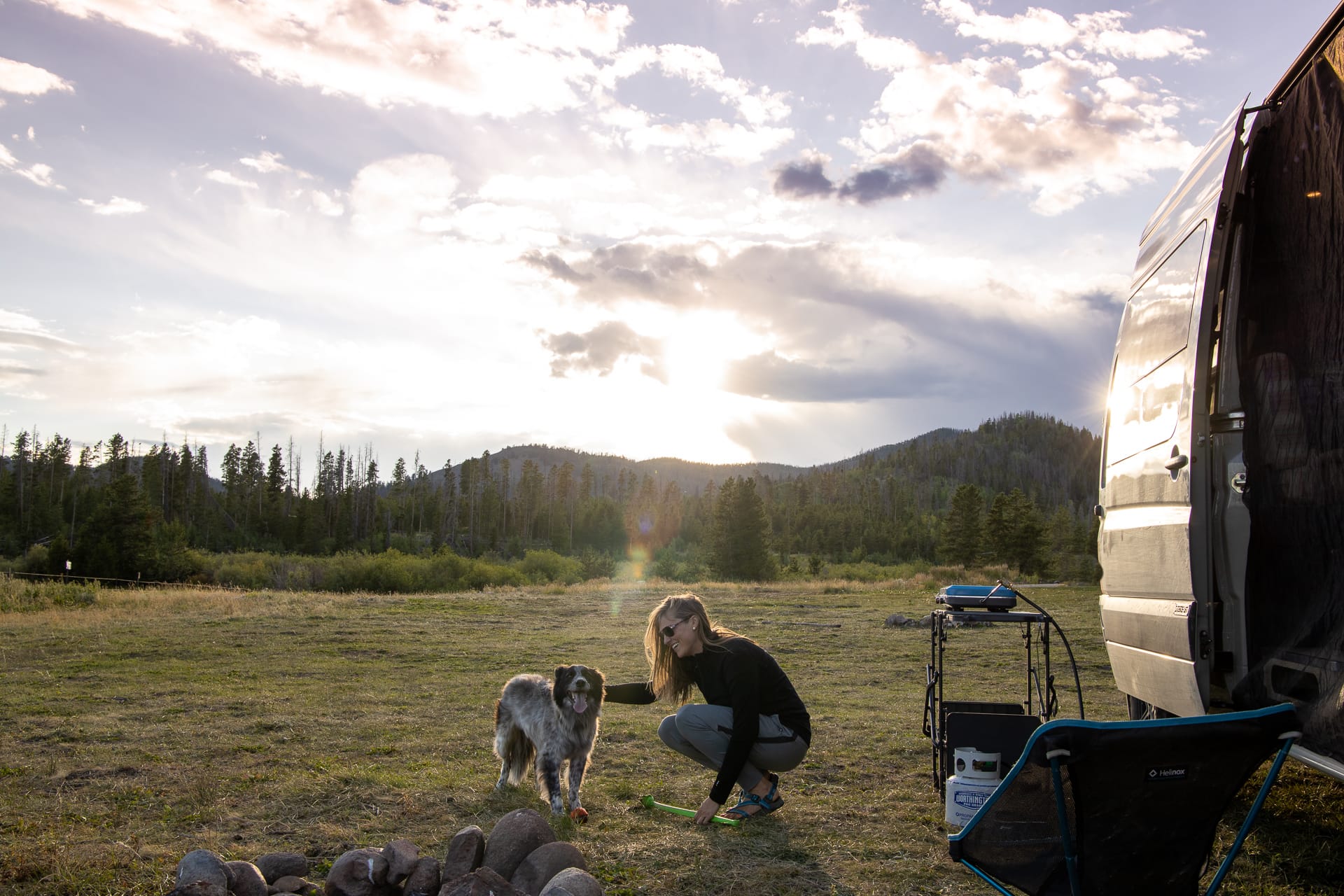
    I love camping at free dispersed campsites because my dogs get more freedom than in paid campgrounds

    Types of Public Lands Where You Can Camp for Free

    Understanding different public land designations will help you find free campsites. For example, BLM (Bureau of Land Management) lands with dispersed camping are very common out west, but are non-existent in the midwest and along the entire east coast.

    In those regions, National Forests, State Forests, and Wildlife Management Areas will be your best bet.

    As a starting point, here’s a breakdown of the most common types of public lands that allow for free dispersed camping. After, I’ll get into the apps and tools I use to find actual campsites in these areas.

    • Bureau of Land Management (BLM): Dispersed camping is allowed on a large amount of BLM land for up to 14 days, but always check the signs for limits and regulations. The BLM doesn’t have a comprehensive map on their website showing where all of the free BLM campsites are, but you can get a feel for what’s available by browsing their regional maps found here.
    • Forest Service (USFS) Lands: Similar to BLM lands, dispersed camping is allowed in over 175 national forests and grasslands in the United States, including the East Coast and Midwest. You can usually stay up to 14 days in one spot, but rules can vary.
    • State Forests: These can be a great (and often overlooked) option for free dispersed camping, especially in the Midwest and along the East Coast. We camped for free in State Forests while visiting Vermont and New Hampshire. The rules vary a lot by state—some allow dispersed camping almost anywhere within the forest, others restrict it to designated zones or require a free permit.
    • Wildlife Management Areas (WMA): These are state-managed lands that are set aside for hunting, but sometimes they also allow free dispersed camping.

    Note that the Forest Service and BLM also operate a ton of paid campgrounds, so not all camping on these lands is free.

    A man sits outside of a Sprinter van while free camping near Grand Lake in Colorado
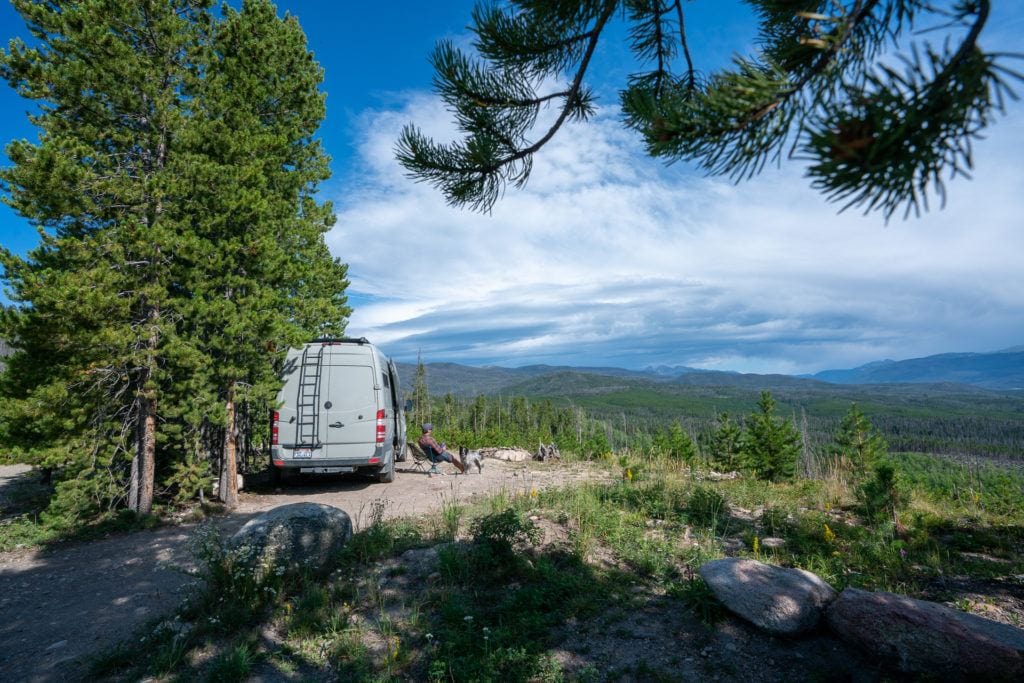
    Can’t beat the views at this dispersed forest service campsite near Grand Lake in Colorado

    My Step-by-Step Process for Finding Dispersed Campsites

    After nearly a decade of van life, I’ve figured out a reliable system for finding free campsites—without spending hours scrolling through apps or ending up at a crowded pull-off. There are so many tools out there now, and it’s easy to get overwhelmed thinking you need to download them all. You don’t.

    In this section, I’m breaking down the exact step-by-step process I use, including which apps and tools are actually worth your time (and money) and which ones you can skip.

    1. iOverlander app

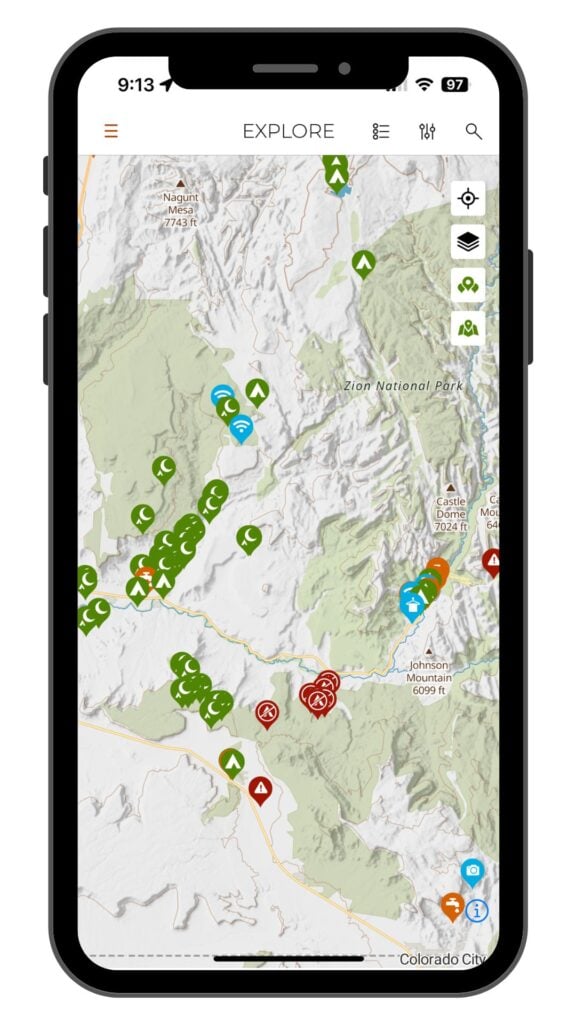
    iOverlander is an app that’s long been a favorite among van lifers—and it just got a major update with the release of iOverlander 2. The platform relies on user-submitted info about campsites, making it one of the most comprehensive crowdsourced databases of free camping across North and South America.

    ioverlander screenshot on iphone

    I’ve used iOverlander throughout my years of full-time travel, and it’s still the first app I open whenever I roll into a new area. While it doesn’t list every free campsite, it gives me a solid starting point. In my experience, if there’s one site on iOverlander, there are usually a few more unlisted spots nearby worth checking out—you just have to explore a bit (which leads to Step 2 down below).

    iOverlander has a free and paid version ($5.99/month). I think the paid version is 100% worth it, primarily because it allows you to download regions for offline access so you can search for campsites on the go. This is valuable because sometimes you arrive at a site, only to find it’s already occupied by someone else already. In this case, I can open the app (even when I don’t have service) and see what else is nearby. It also allows you to download multiple regions to your phone at once, with access to different map layers.
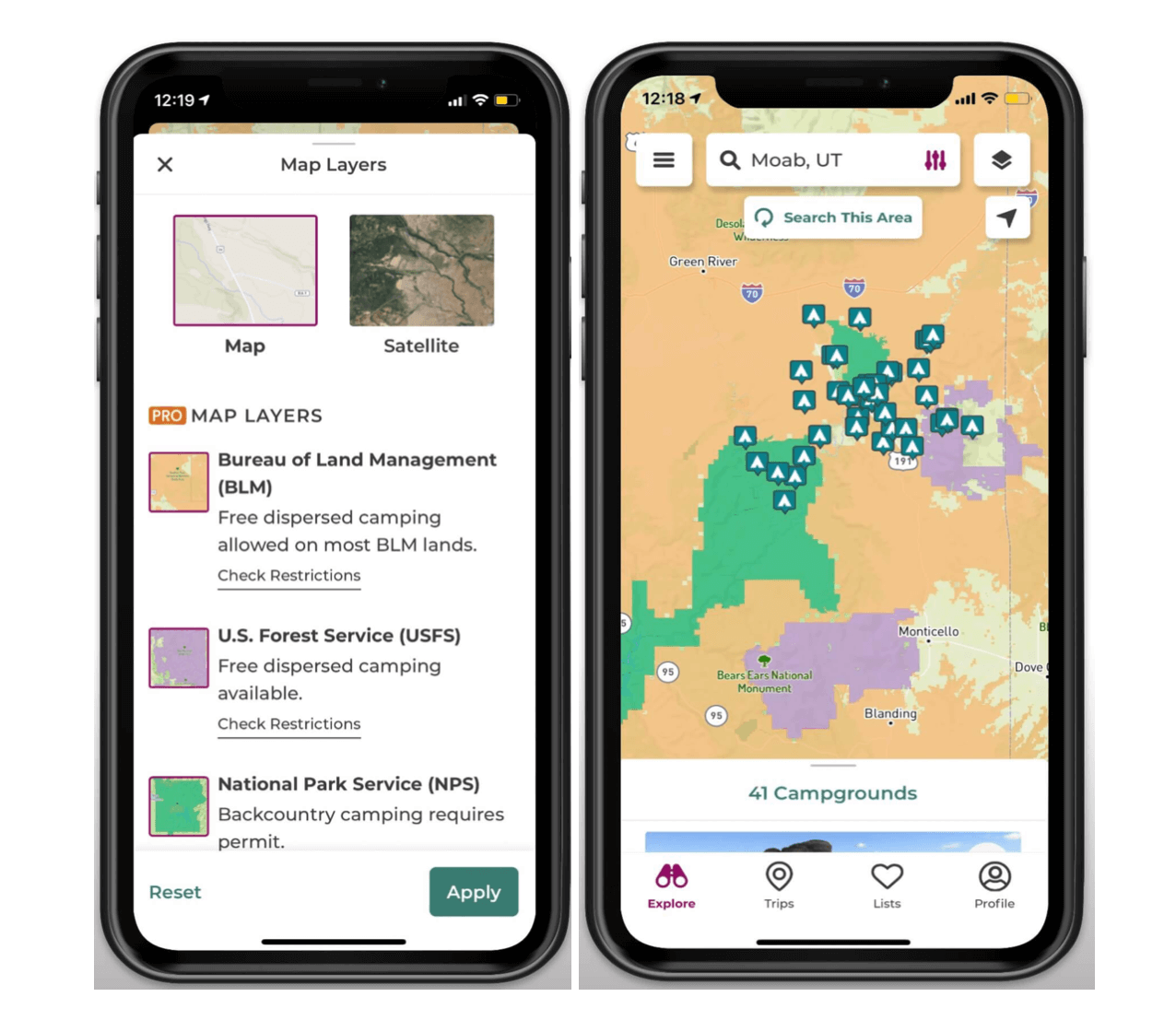
    Most recently, I used iOverlander extensively while traveling full-time in my Rossmonster adventure truck through Baja. It helped us find incredible beachfront campsites, along with places to fill water, do laundry and more —making it a go-to resource for full-time travelers.

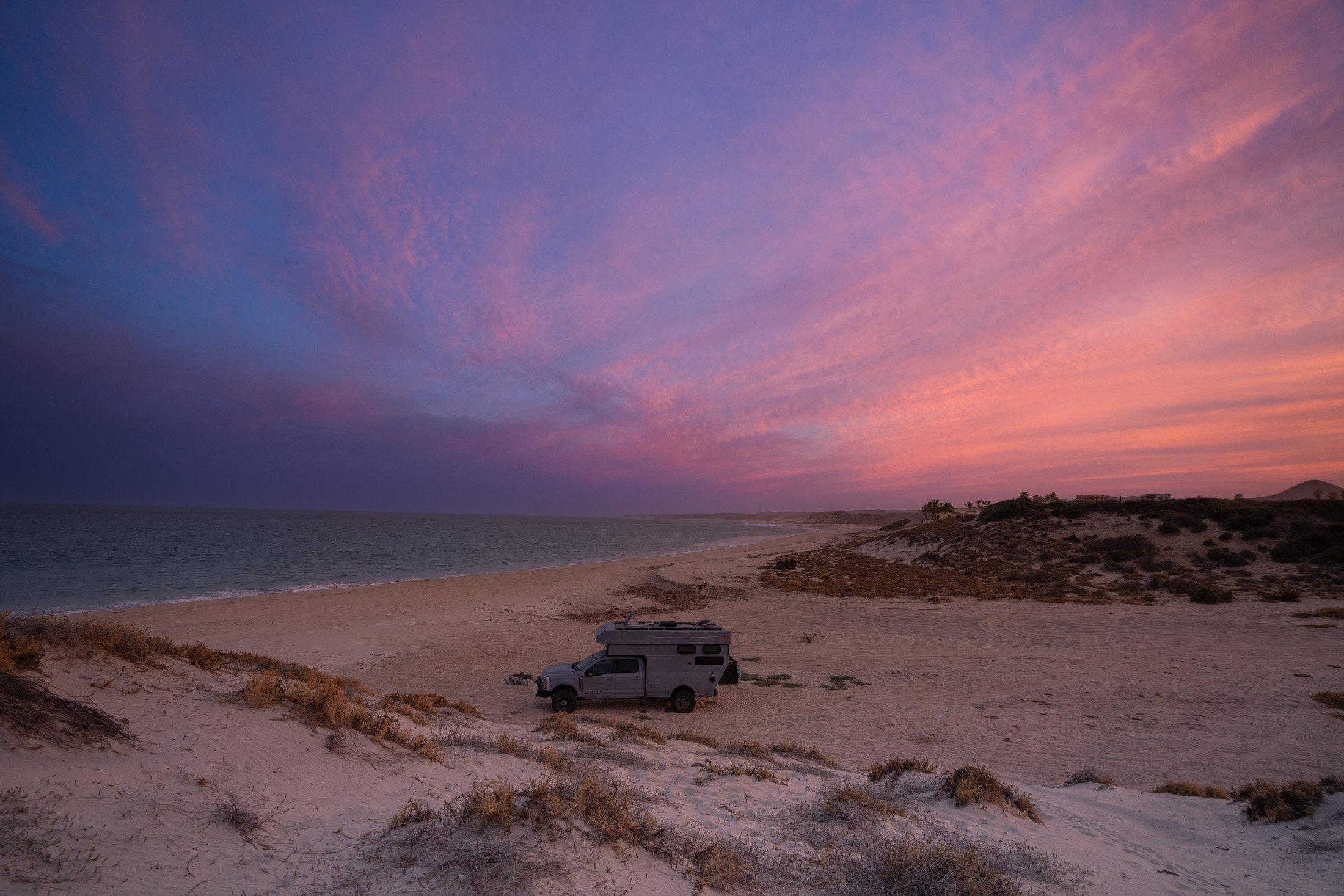
    Rossmonster adventure truck parked at a free beach campsite in Baja during sunset
    One of my favorite free campsites in Baja that I found on iOverlander

    One of the app’s best features are the user reviews and real-time updates. You’ll often find recent comments with road conditions, closures, safety notes, and tips that can save you from pulling into a site that’s no longer accessible. I also love how you can favorite campsites in the app, making it easy to return to places you love or bookmark spots that look promising as you’re planning.

    One of the biggest downsides of iOverlander is that its most popular campsites can be, well…too popular. As more people rely on the app, many of the easily accessible or scenic spots—especially near national parks or along major road trip routes—see heavy traffic.

    My advice? Use iOverlander as a starting point, but don’t stop there. If you find a marked site that looks crowded or worn down, drive a little farther down the road. Often, you’ll find lesser-used sites that offer more privacy and a better overall experience. The best campsites I’ve found rarely show up at the top of anyone’s list—they’re the ones I discovered by taking a detour or digging a little deeper.

    2. Google Maps app

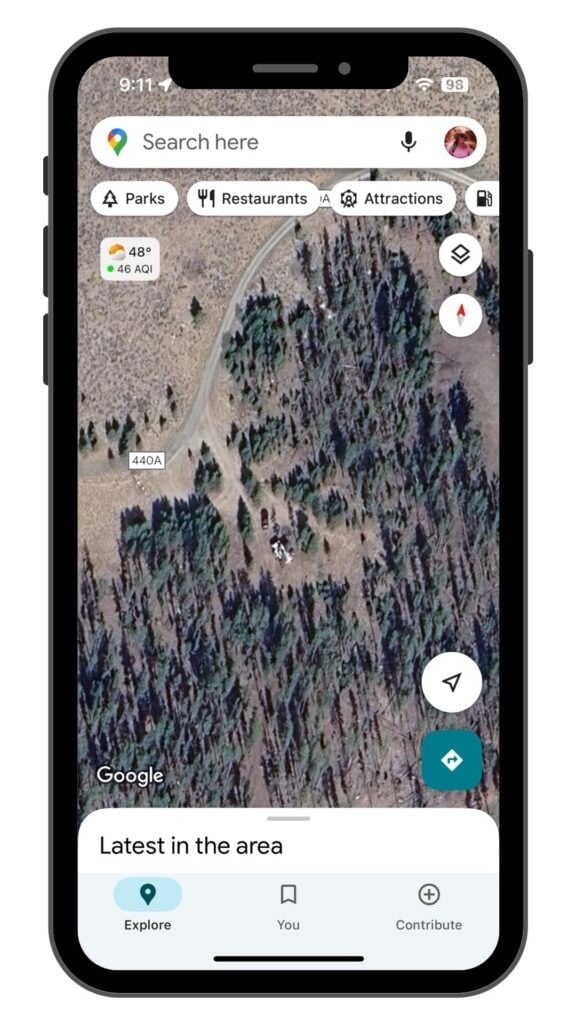
    Once I’ve narrowed down the general area I want to camp — usually using iOverlander — I switch over to Google Maps in satellite view. This is one of the most useful and underrated steps in my process for finding free campsites that aren’t already listed in every app.

    google satellite map screenshot on iphone

    In Google Maps, I zoom in and look for pullouts, clearings, or flat areas along forest roads or inside BLM land boundaries. You can usually tell the difference between a true campsite and just a random clearing by zooming in and looking for signs of use, like a fire ring, a vehicle-sized bare patch, or a short spur off a main road. Sometimes you can even see RVs and trailers, which is a pretty sure bet that camping is allowed there.

    Satellite view is especially helpful in areas where crowdsourced apps might only list one or two spots—but there are likely several more nearby. In case you didn’t know, you can also download Google Maps to your phone for offline use.

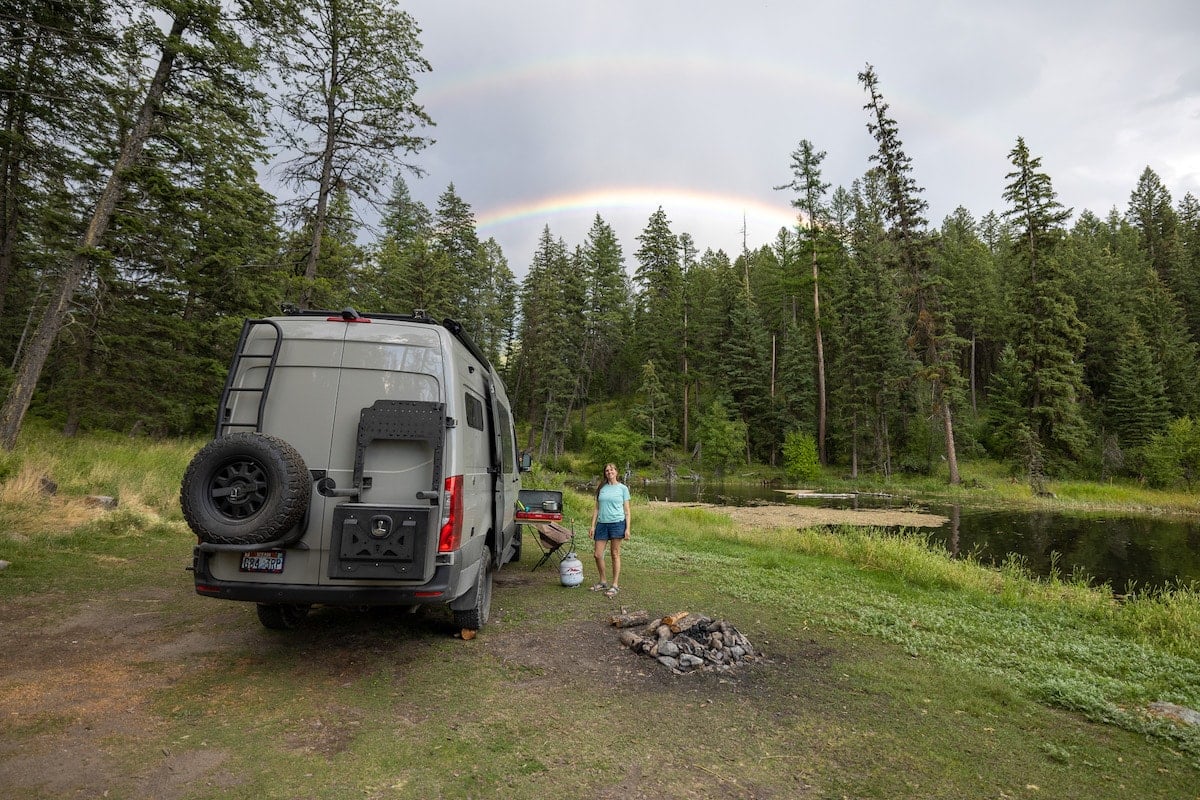
    Sprinter Van parked at free lakeside campsite
    I spotted this free campsite using the satellite view in Google maps

    3. OnX Offroad app

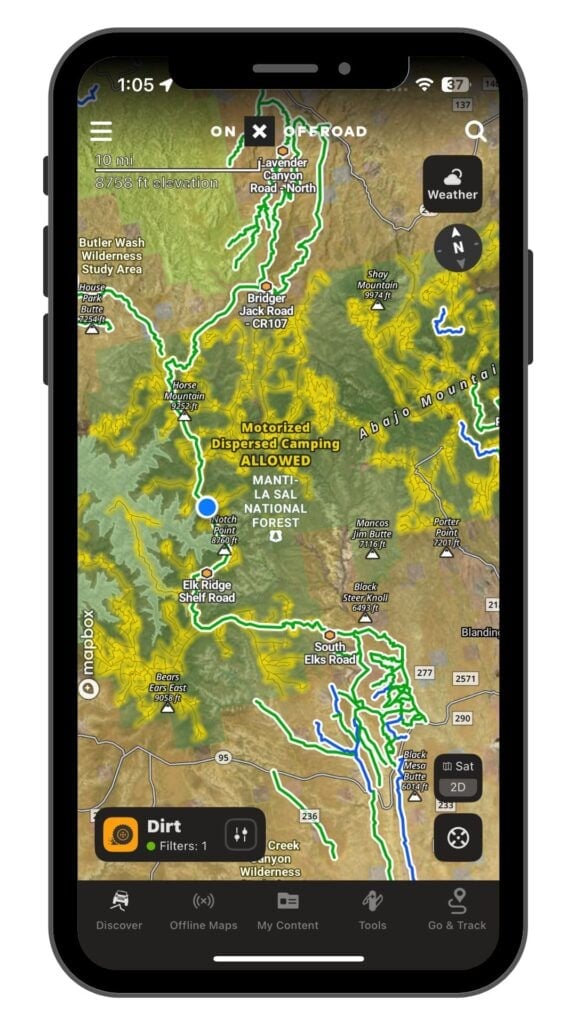
    After checking iOverlander and scouting with Google Maps, I’ll open onX Offroad. This is one of the most powerful tools I use to discover dirt roads so we can explore beyond the well-known campspots that are pinned in the popular apps.

    onx offroad screenshot on iphone

    What makes onX so helpful is its detailed trail and land use overlays. You can view dirt roads and trails color-coded by difficulty level, which helps me decide if I can safely access a spot with my rig. I can quickly tell whether a road is mellow and 2WD-friendly or if it’s going to require 4×4 and high clearance.

    But what really sets it apart is the land ownership overlay. I can see exactly where the boundaries are between public and private land, so I’m not accidentally pulling onto someone’s property. It shows federal land like BLM, National Forests, and state-owned parcels—and there’s a layer that shows (in yellow on the map above) where dispersed camping is allowed.

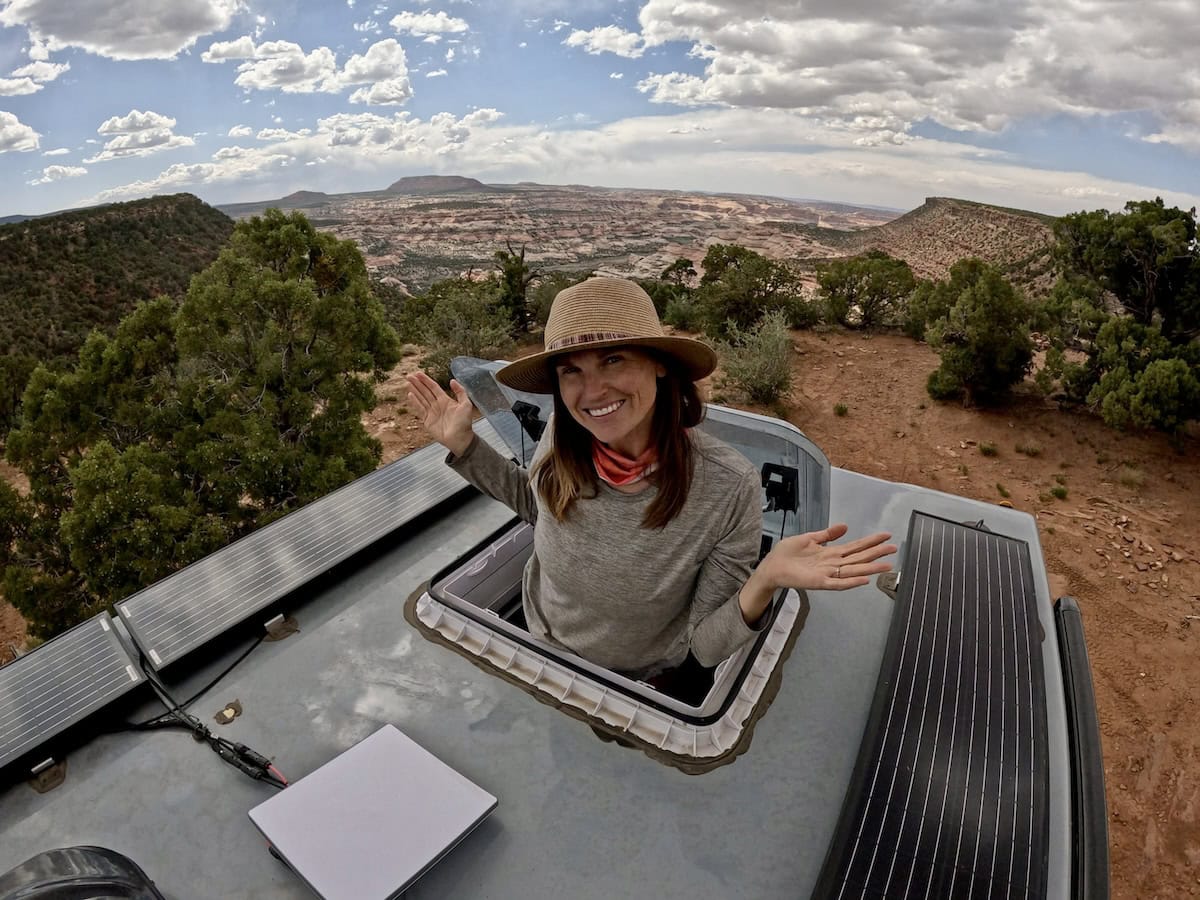
    Kristen Bor popping through the skylight on the roof of the Rossmonster Baja Trail adventure truck at a free desert campsite with an incredible view
    I found this free campsite in by navigating some dirt roads using onX Offroad in my Rossmonster Baja Trail

    onX also lets you save maps offline, drop custom pins, and track your route in real time even when you don’t have service. This means you don’t have to worry about accidentally turning down the wrong road and ending up lost…which I have done in the past, and it’s not fun!

    I don’t rely on onX alone for finding campsites, but when I want to be 100% sure I’m on legal ground, or I’m trying to get away from crowds and find something more remote, it’s one of my favorite tools. Memberships start at $34.99/year.

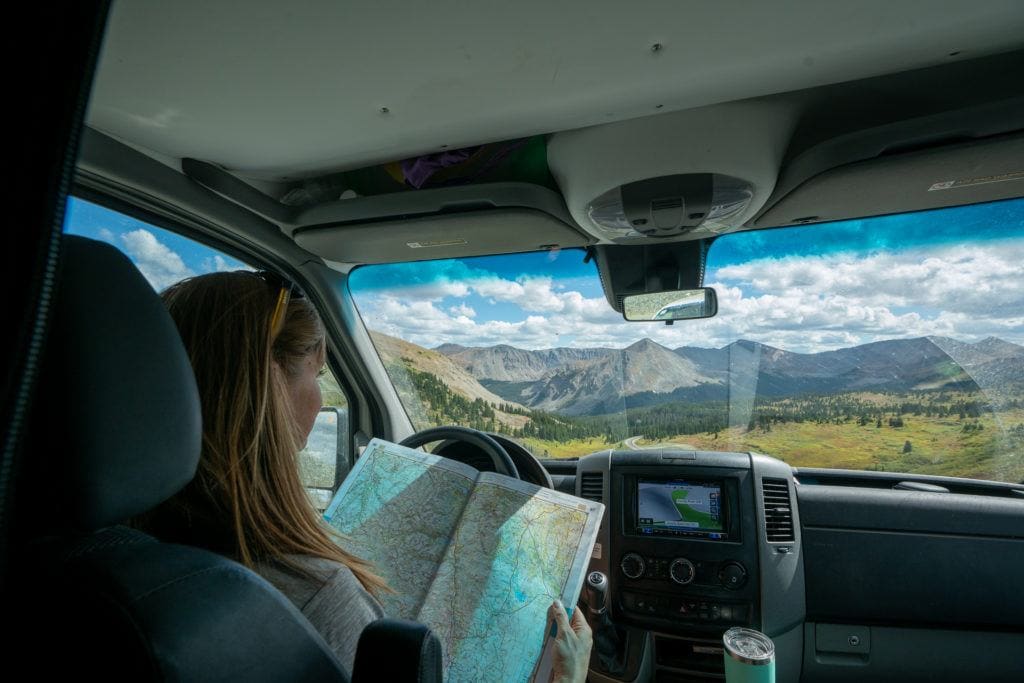
    4. Benchmark Road Atlases

    Since I now have Starlink on my roof of my truck camper and can always access the internet, I don’t rely on paper maps as much as I used to. Before I had a constant connection however, I was happy to have an old-school paper map to navigate with.

    Benchmark Road Atlases are my go-to paper maps that are very handy for discovering free campsites sans technology. I own one of these atlases for every state I’ve spent an extended amount of time in. They generally run about $20 each, and the maps show recreation activities, established campgrounds, and public land ownership lines so you know if you’re on public or private land.

    A woman uses a road atlas to find a free campsite
    I use paper maps to find cool dirt roads with free camping

    These maps also show dirt roads categorized by 2wd or 4×4, and in my experience, these indicators have been pretty accurate. When it says 4×4, the road really is rough. Just having a sense of the terrain and accessibility is a good place to start.

    The way you can use these maps to find free dispersed camping is by looking for nearby dirt roads on public lands that your van or camper can handle, and then driving down them to explore. You won’t always find campsites this way, but when you do, it’s extremely satisfying.

    Other Tools I use

    While iOverlander, Google Maps, and onX Offroad are my core tools, I also use a handful of other apps and resources depending on where I’m traveling. These aren’t always essential, but they’ve helped me find last-minute spots, check land boundaries, or confirm whether overnight parking is allowed. Here are a few other tools I keep on my phone or bookmark for trip planning.

    The Dyrt

    I actually prefer using The Dyrt when I’m looking for paid campgrounds—especially if I want to book ahead or know exactly what I’m getting. The app has a huge database of campgrounds across the U.S., and what sets it apart is the volume of user reviews and photos.

    Many reviewers even include specific site numbers, which makes it easier to avoid bad spots or snag one with shade, privacy, or a good view. You can also search by required amenities. Let’s say you need Wifi to get some work done or need a location with showers or even a pet-friendly location, you can narrow your search down using all types of parameters.

    The Dyrt does include information on dispersed camping, but you’ll need a Pro membership to access those listings. The Pro version also gives you offline access, map overlays for BLM and National Forest land, and a few discount perks at select campgrounds. But honestly, I find that other tools—like onX or iOverlander—do a better job for free camping.

    That said, if you’re planning a route that includes a mix of paid and free camping and you don’t want to go too remote, The Dyrt is definitely a solid planning tool. Check out my full Dyrt review for more thoughts.

    *The Dyrt is currently offering a FREE 30-day membership to The Dyrt PRO to Bearfoot Theory readers (use the code “Bearfoot” if signing up on mobile!). Try it out and see how you like it!*

    Dyrt Pro

    FreeCampsites.net

    If you don’t want to download a paid app or prefer to search on a computer or browser, Freecampsites.net is a desktop tool that allows you to zoom in on a map to locate campsites wherever you’re going. Additionally, it also has a trip planning option that will allow you to create a route using free dispersed camping options. You can even search by the type of access road to the sites.

    When you select a site, you’ll be given the GPS coordinates, elevation, and the local weather so you can pack accordingly. This isn’t my go-to, but I’ve found that freecampsites.net sometimes has free dispersed sites that aren’t found on iOverlander or other apps.

    Kristen Bor and another woman sitting in the back of a Sprinter Van in Moab Utah. Shot is taken with a drone
    A free campsite just outside Moab

    Harvest Hosts & Boondockers Welcome

    Another great option is Harvest Hosts and Boondockers Welcome. Memberships start at $99/year, and as a Member, you get to park overnight for free at a variety of wineries, breweries, farms, museums, golf courses, and other attractions. We’ve even “camped” at ski areas and church parking lots. It’s not true camping, but it’s a much better option than stealth camping when you need a safe, legal place to park overnight.

    Harvest Hosts is only for fully self-contained campers with a toilet, so if you are tent camping or sleeping in the back of your Subaru, you won’t be able to stay at Harvest Hosts sites. Use this link to get 30% off your first year with the code FRIENDS30.

    Boondocker’s Welcome, their sister website, connects you with private property owners who welcome overnight campers. These are often in driveways, fields, or backyards and some allow multiple-night stays. You can add Boondockers Welcome to your Harvest Hosts plan for 30% off the first year as well. (Note: You also must be self-contained to use Boondocker’s Welcome).

    Multiple vans and RVs are parked in a field at a Harvest Host location at sunset
    A Harvest Host campground at a ski area in Michigan we stayed at

    Helpful Tips for Finding Free Campsites

    When you’re first starting out, finding free campsites might feel intimidating (I know it was for me). Here are some ways to ease into your first free camping trip:

    • Finding a campsite is much easier when you are still in service. So, if you know the general region you want to stay in, do your research before you get out of cell range and make sure you download offline maps in whatever apps you’re using.
    • Searching for campsites is easier and less stressful during daylight. If at all possible, try to be settled before it gets dark.
    • Ranger stations can be a great resource for information. If you are unsure about where you are allowed to camp, swing into the local ranger station for maps and advice.

    Remember, it’s ok if you don’t have to have an Instagram-worthy campsite every night. Adopting this mindset will reduce the pressure to find the perfect free campsite. Some nights you might be in the forest with no view or you might be parked in a big open area near a lot of other campers.

    Kristen Bor lying in the back of a Sprinter van on the bed with red rocks background
    Free campsites won’t always look like this, but that’s ok

    When you end up staying at free campsites that are less than stellar, just remember that you can always pack up in the morning and move on to somewhere better. All you really need is a flat spot with enough space, and the biggest thing is that you feel safe at your dispersed campsite and you aren’t blatantly breaking the law.

    Things to Know Before Camping at Dispersed Sites

    One of the reasons I love dispersed camping is that it’s so much more peaceful and private than paid campgrounds. Plus, many free sites have even better views.

    The sad thing is that many public lands that are at risk of being shut down due to overuse and because campers are trashing campsites, pooping and leaving toilet paper all over the place, and driving over vegetation to create new campsites. Basically there’s too may campers that have no respect for the environment that we are all out here to enjoy.

    If you want free campsites to remain free, please follow Leave No Trace principles and keep the following in mind:

    • Fire Regulations: Fire bans are becoming more common at dispersed campsites due to increased fire risk. It’s up to you to know the current fire restrictions and come prepared with basic backcountry fire safety skills. This means drenching the fire completely until it’s cold to the touch before you go to bed. You should also use existing fire rings rather than building new ones.
    • Pack it in, pack it out: You need to take EVERYTHING with you when you leave a dispersed campsite, including your camping gear, trash, and personal items. Bonus if you pick up any trash that was left behind from previous campers. I keep one of these handy trash pickers in my rig.
    • Road Conditions: Before heading out, you’ll want to find out what the road conditions are like, whether you need 4-wheel drive, and whether there are any road closures. Be sure to check the weather in advance too, which can change road conditions.
    • Water Availability: Dispersed sites typically don’t have any potable water available. This means you’ll need to pack enough for your trip or bring a water filter if you’ll be camping near a river or lake.
    • Dump facilities: Unlike established campgrounds, dispersed campgrounds won’t have a dump station on-site. Be prepared to drive to a dump station if your black water tank gets full and certainly don’t drain it at the campsite.
    • Campsite Amenities: Generally there are no amenities such as picnic tables, trash receptacles, sinks, electrical hookups, camp hosts, or restrooms at free dispersed campsites.
    • Going to the bathroom: These days I recommend all van lifers and frequent campers travel with a camp toilet in order to keep dispersed campsites as clea as possible. However, if you plan to go the bathroom outside, know how to Leave No Trace and always pack out your toilet paper.
    • Cell Service: A lot of dispersed free campsites are in remote areas where you may not have cell service to access maps on your phone. If you don’t have Starlink, you should bring a paper map, and tell someone where you are going beforehand .
    • Only camp on bare dirt: Don’t create new campsites by driving over or setting up camp on top of vegetation. Try to choose obvious campsites on hard-packed bare dirt at least 100 feet from water sources in order to reduce your impact.
    • Wildlife: Make sure to respect the local wildlife. Give them space and don’t leave trash or food out unattended.
    A drone shot of a Sprinter van driving down a dirt road near Buena Vista, Colorado
    Most roads leading to dispersed campsites are not paved (looking for free campsite near Buena Vista, Colorado)
    A Sprinter van boondocking near Twin Lakes in Colorado
    Free camping at a dispersed campsite near Leadville, Colorado

    Is Dispersed Camping Safe?

    Taking extra safety precautions when you’re camping is an important consideration, especially when free camping when you may be far away from other people and without cell signal. With that said, in my 9 years of van life, I’ve never encountered any issues while dispersed camping. However, here are a few ways to keep safety top of mind:

    • Trust your gut: If you have a bad feeling about a campsite or other nearby campers, leave. Never second guess your instincts – you can always find another campsite.
    • Be aware of your surroundings: Pay attention to who and what are around you.
    • Download offline maps: Don’t put yourself in a position to get lost or stranded. Download maps ahead of time or grab a paper map as backup.
    • Tell someone your plans: Let someone know where you plan to camp and when you expect to return. Check in often, especially if your plans change.
    • Have an exit plan: Always keep the driver’s seat clear and have a designated spot for your keys. If possible, park where you can’t be blocked in and don’t need to reverse to get out of a spot.
    • Keep your doors locked if you’re sleeping inside your vehicle
    • Travel with a satellite communicator so you can call for help even if you don’t have service.
    • Consider whether you want some sort of self-defense tool and if you are comfortable using it.
    A Sprinter van dispersed camping for free near Moab, Utah
    Dispersed camping in Moab

    Options for Stealth Camping

    I mentioned stealth camping at the beginning of this post, so I want to briefly touch on where you can stealth camp and sleep inside your vehicle. For more info, check out my post on how to stealth camp.

    Here are some places you can stealth camp if you find yourself caught in town refueling on supplies and need a place to sleep for the night. Each location will have different rules, so your best bet is to look for signs or go inside and talk to the manager.

    • Walmart
    • Cabela’s
    • Cracker Barrel (most have dedicated overnight parking spots in the back)
    • Camping World (sometimes have free water, dump stations, and electrical hook-ups)
    • Planet Fitness/Anytime Fitness/24-Hour Fitness
    • Lowe’s/Home Depot/Menards
    • Costco/Sam’s Club
    • Casinos
    • Rest Stops
    • Truck Stops
    Two Sprinter vans are parked outside of a Walmart in North Carolina
    Free overnight parking at Walmart in North Carolina

    What questions do you have about how to find free campsites? Do you have favorite tools to find dispersed camping that I didn’t mention? Share your experiences and tips with boondocking below in the comments!

    Save this post to Pinterest

    The post My Exact Process for Finding Free Dispersed Campsites Away from Crowds appeared first on Bearfoot Theory.