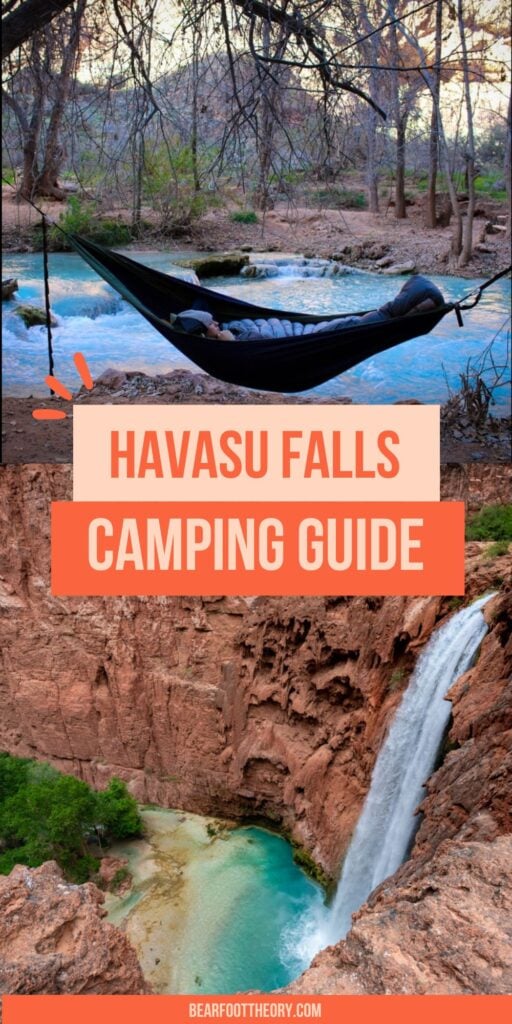
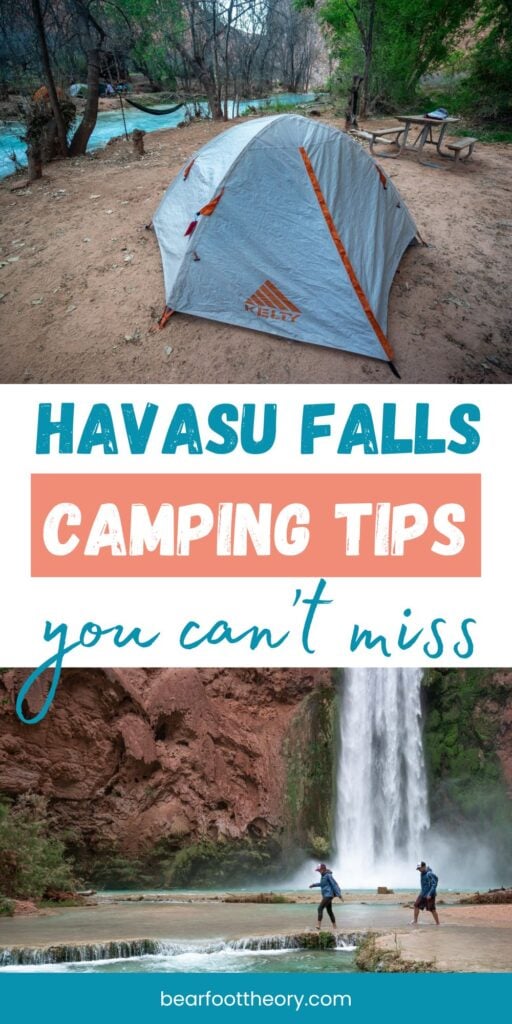
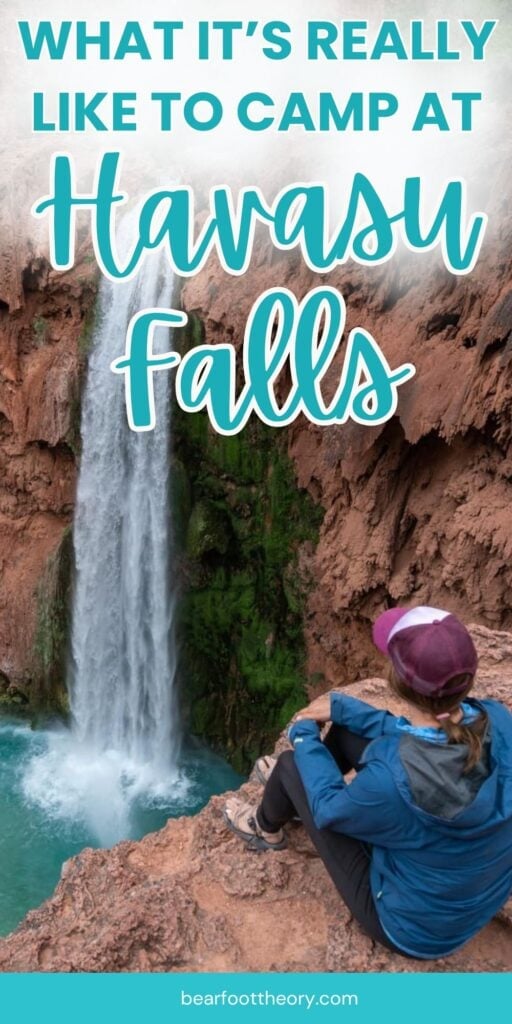
Havasu Falls Hike: Your Complete Trail Guide (with map!)

I’ve been lucky enough to hike to Havasu Falls twice, and each trip was an unforgettable adventure. The waterfalls are absolutely magical and worth every ounce of effort it takes to get there.

This iconic Havasu Falls hike, located on Havasupai tribal land, is a bucket list destination for many outdoor lovers. The trail is 10 miles each way, departing from Hualapai Hilltop in Arizona where you descend into a steep canyon and travel through a dry sandy wash all the way to paradise.

It’s a long hike carrying your backpacking gear, but once you arrive and take off your pack, you’ll be rewarded with turquoise swimming holes, gorgeous waterfalls, and relaxing creekside camping.

In this post, I’ll share how to prepare and what to expect on your Havasu Falls hike so you are ready for an epic adventure!

Havasu Falls Hiking Map

Below is the trail map that I created for my Havasu Falls hike. If you have a GPS, you can download the Havasu Falls GPS file here for free and upload it to your GPS. If you don’t have a GPS, Gaia premium is $4.99 a month and will allow you to access this map on your phone when you are offline.

Havasu Falls Trail Description

Trail Stats

  • Distance: 20 miles round trip (not including day hikes to lower falls)
  • Type: Out-and-back
  • Elevation Gain: +/- 2,200 feet
  • Time: 4-7 hours
  • Difficulty: Moderate-Hard
  • Trailhead: Hualapai Hilltop

Hiking from Hualapai Hilltop to Havasu Falls

The total distance to the Havasu Falls campground is approximately 10 miles one way. The trail begins at the Hualapai Hilltop parking lot at an elevation of 5,200 feet.

I recommend getting an early start for two reasons. First, the trail has NO SHADE. So starting earlier means your hike to Havasu Falls will be a lot more comfortable. Second, the earlier you arrive, the more campsites you’ll have to choose from since you’ll be ahead of many other hikers.

Note: There is no water available at the trailhead or anywhere on the trail, so make sure you pack enough to make it all 10 miles to the campground. There are bathrooms at the trailhead.

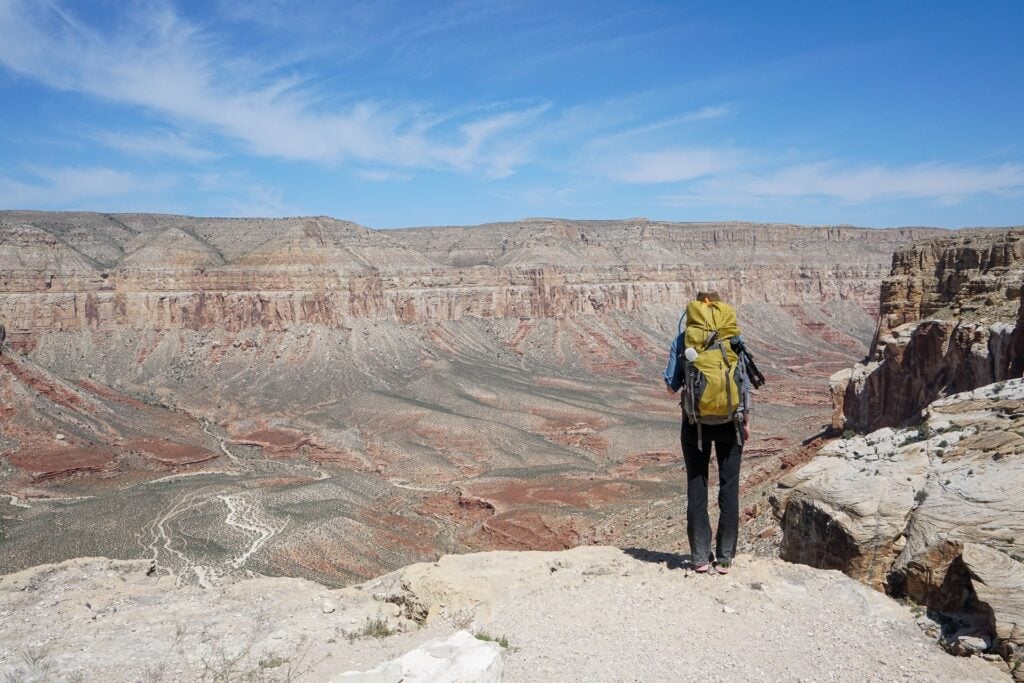
From the Hualapai Hilltop trailhead, the trail begins an immediate 800-foot descent over the first mile, dropping you into Havasu Canyon which you can see below.
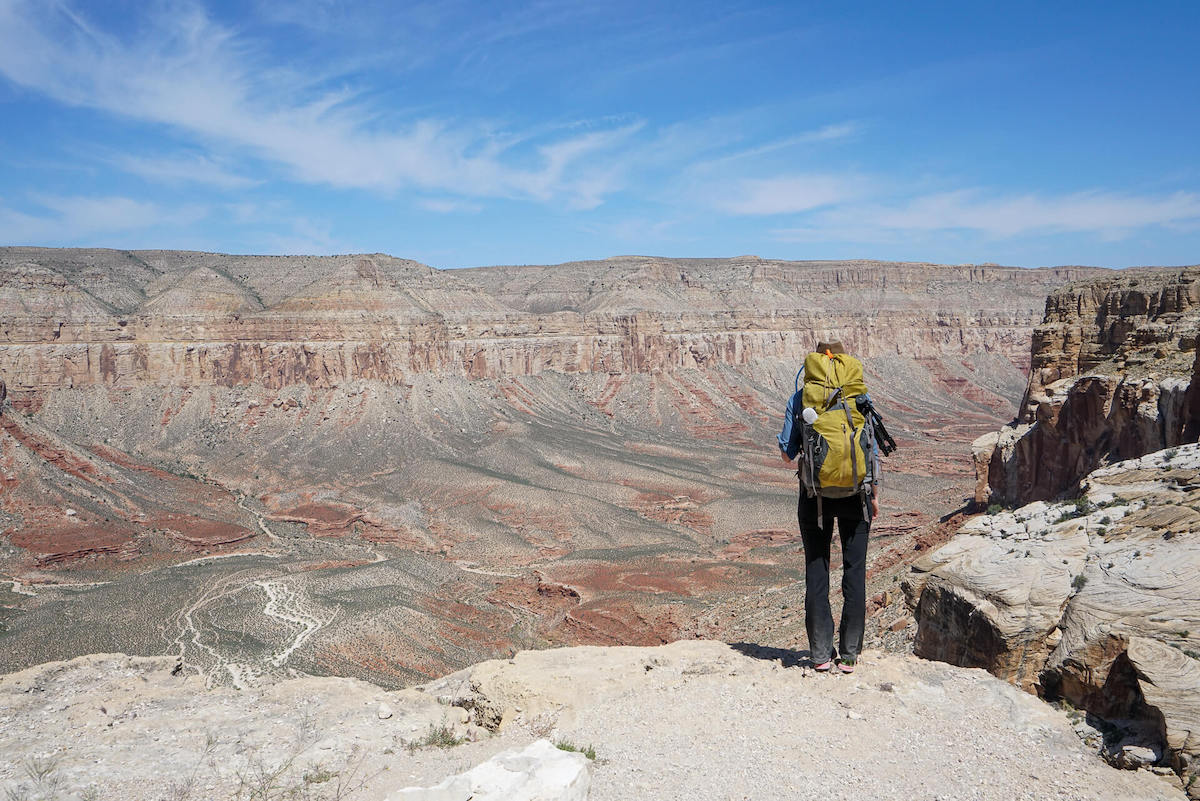
Woman standing with back to camera looking out over Arizona desert canyon carrying backpacking backpack
The view from the trailhead

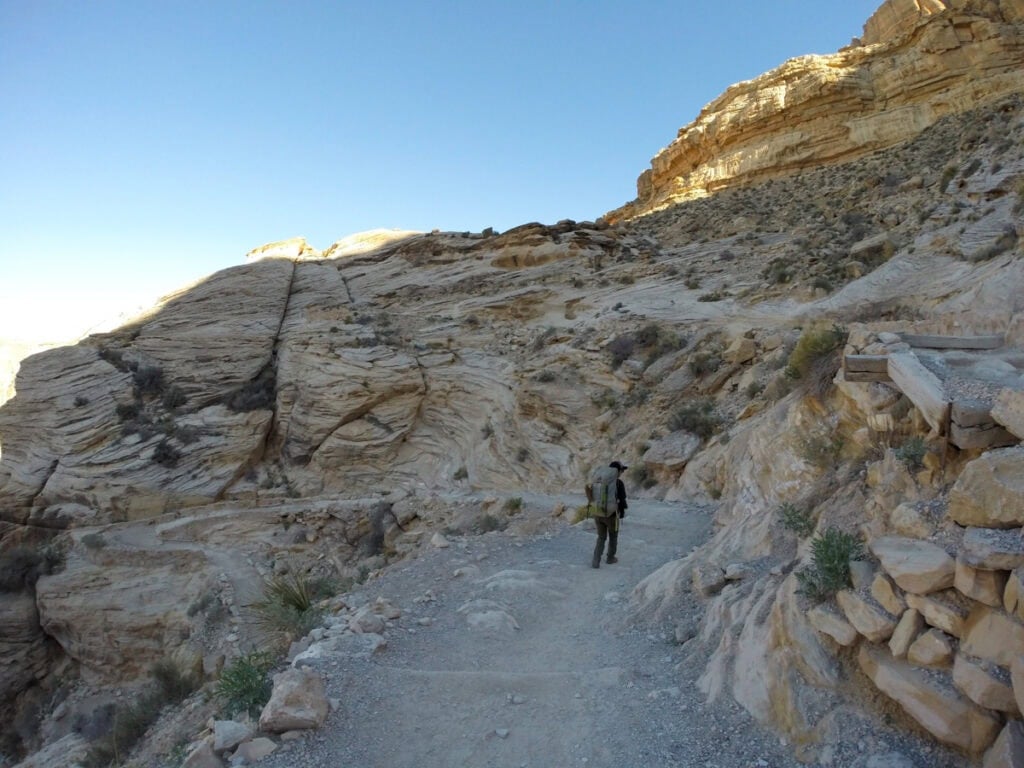
The hike on the way in is long but not too difficult and the initial descent is on a well-maintained series of switchbacks.
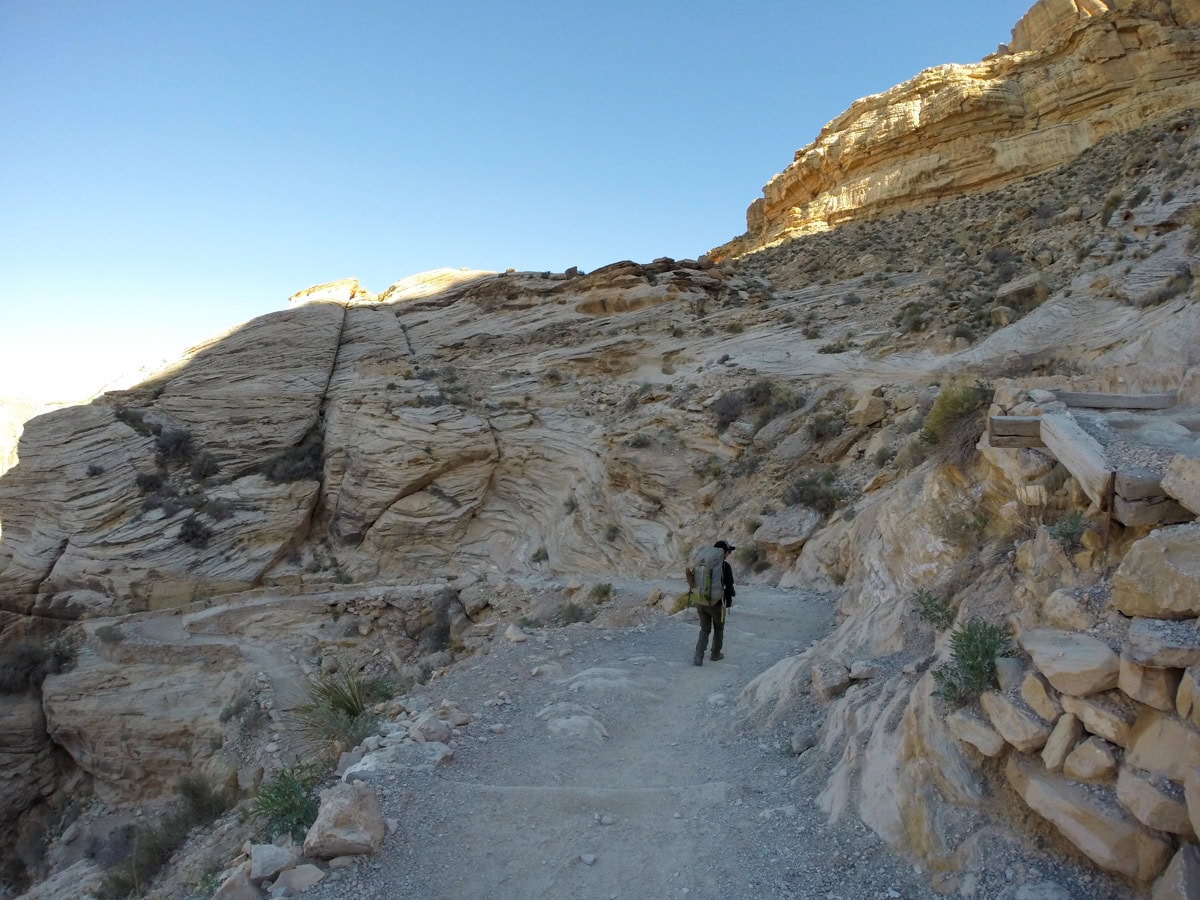
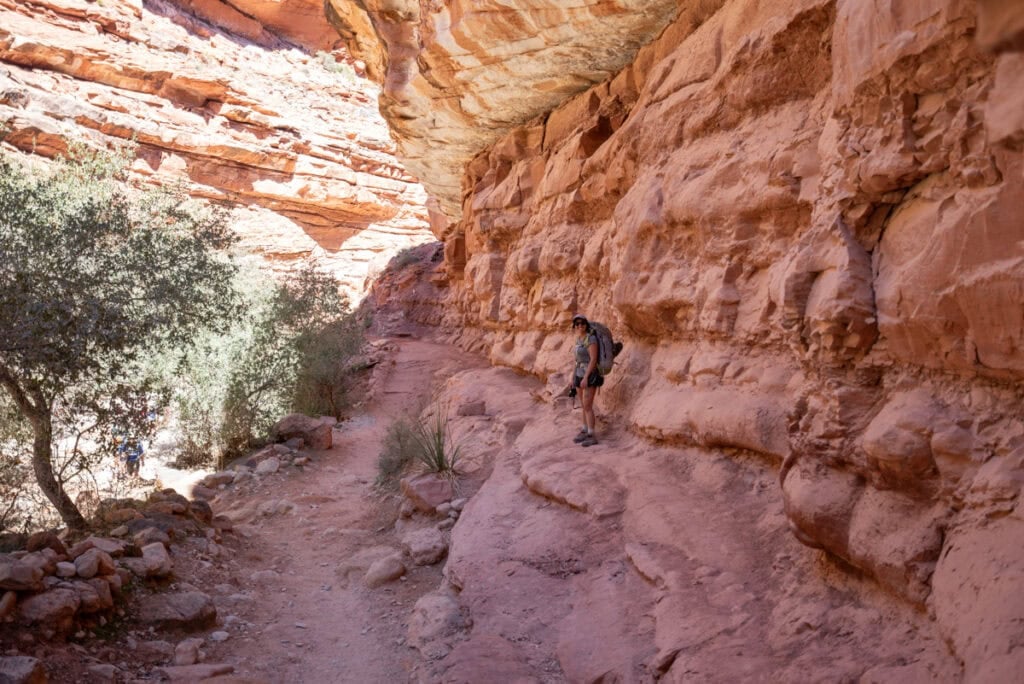
Hiker on a desert trail to Havasu Falls

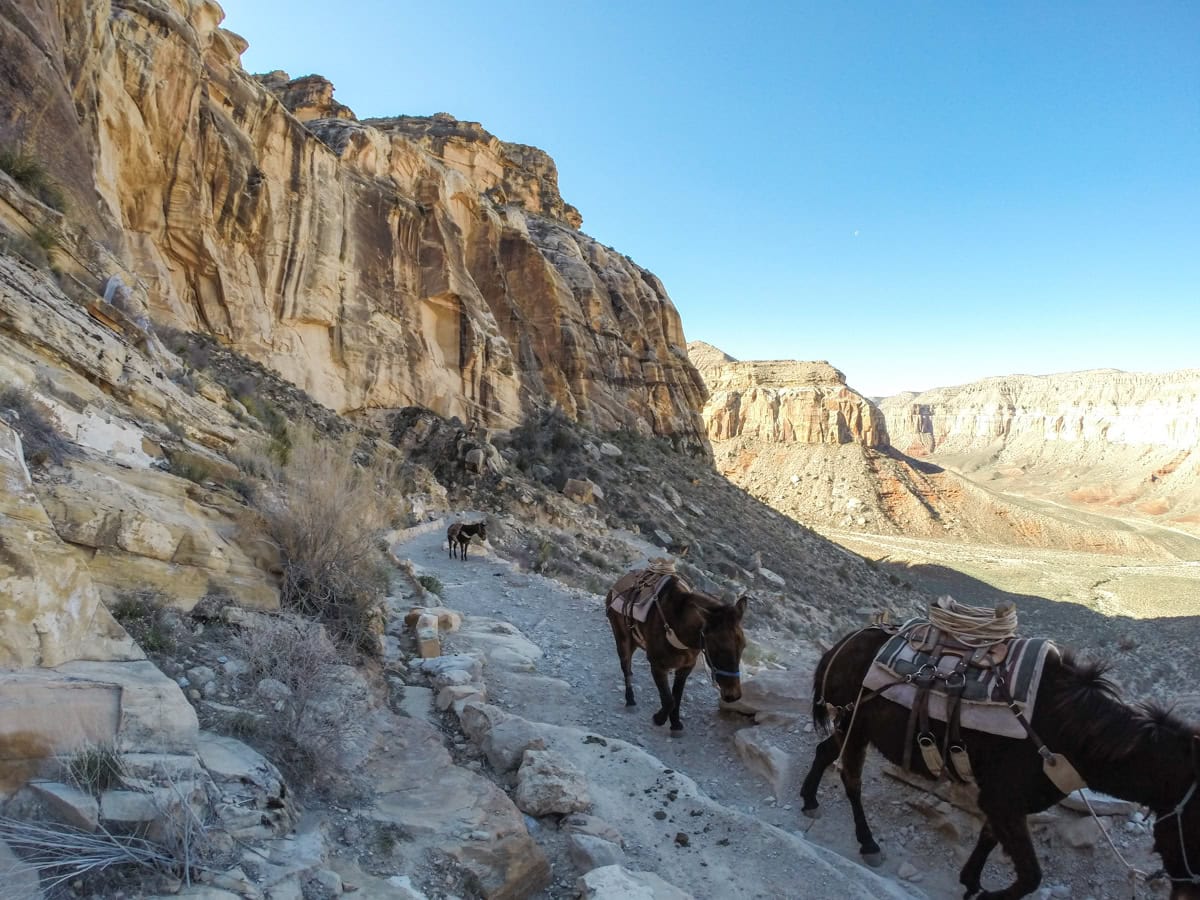
During your hike, you’ll likely encounter packs of horses/mules being led by local tribe members. These mules are carrying gear for campers who paid for the service.

Horses/mules have right of way on the trail so please step off the trail when you see them. Be alert and if you hike with earbuds in, consider leaving one out so you can hear them approaching. There’s no reason to make them work harder than they already are.
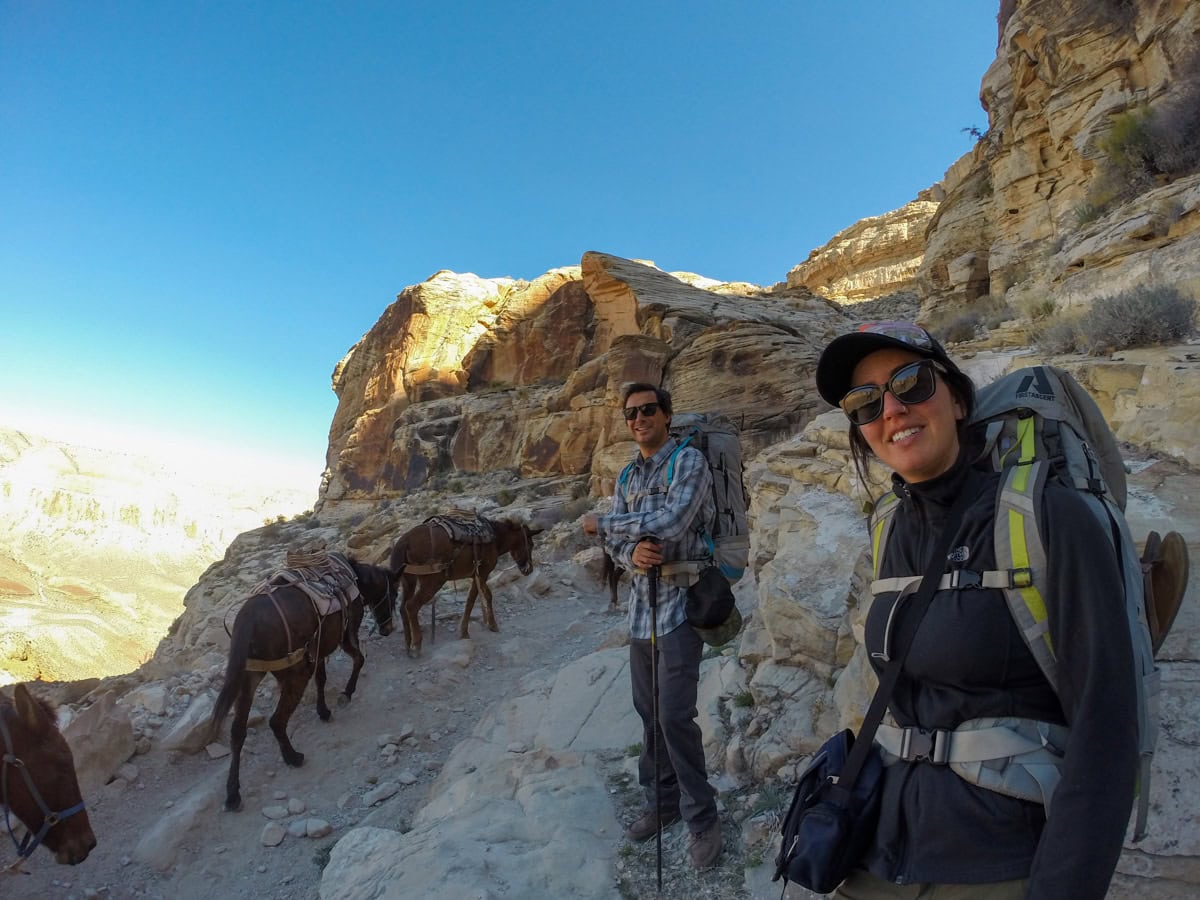
Group of hikers on a trail next to pack mules

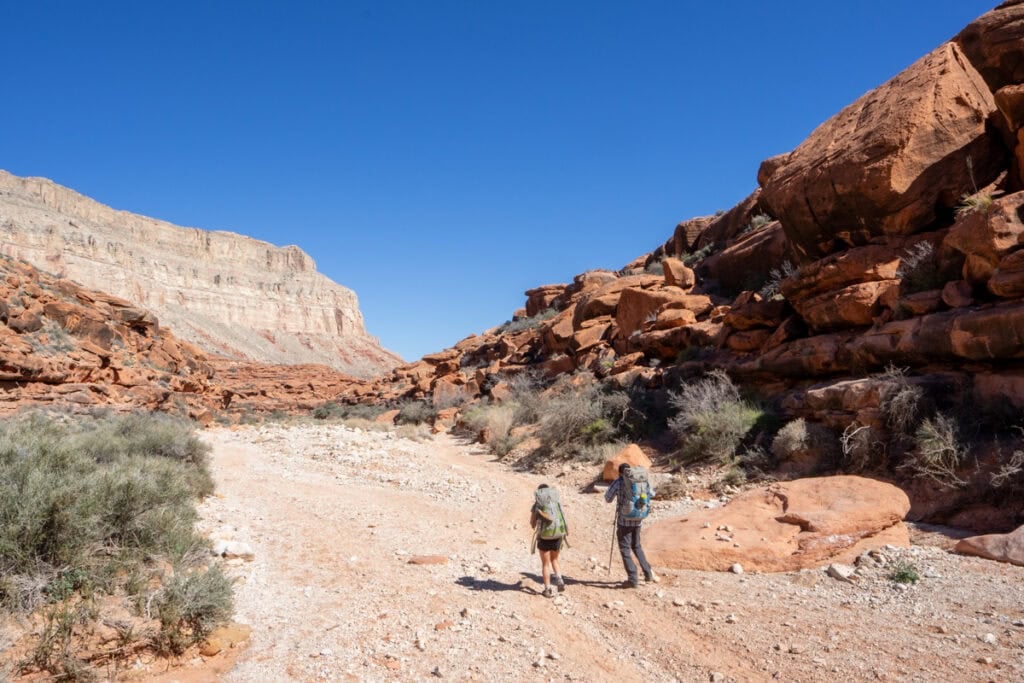
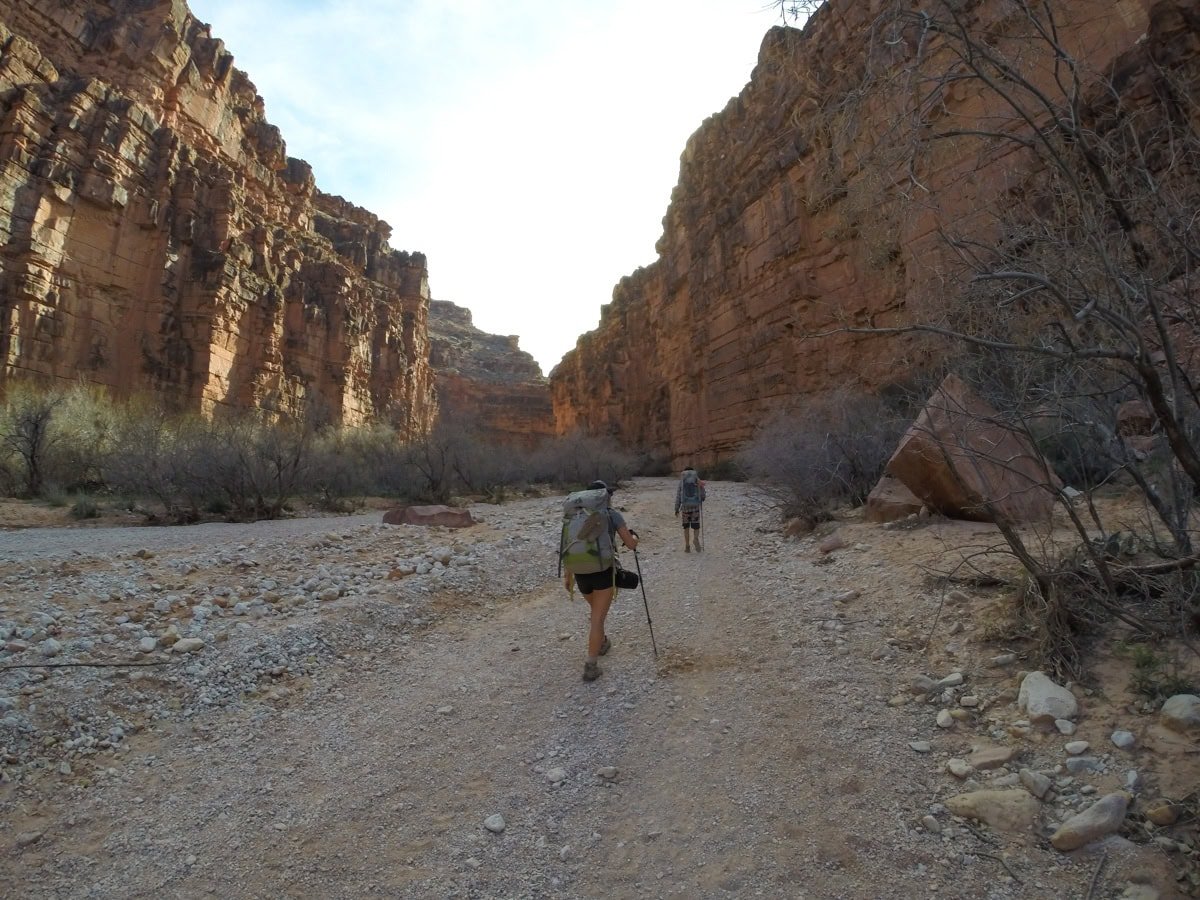
Once you reach the wash, the trail follows a dry river bed for the next 6.5 miles, gradually dropping another 1,200 feet. Here, the hiking can be a bit slow due to the sandy gravel, but the trail is very easy to follow.
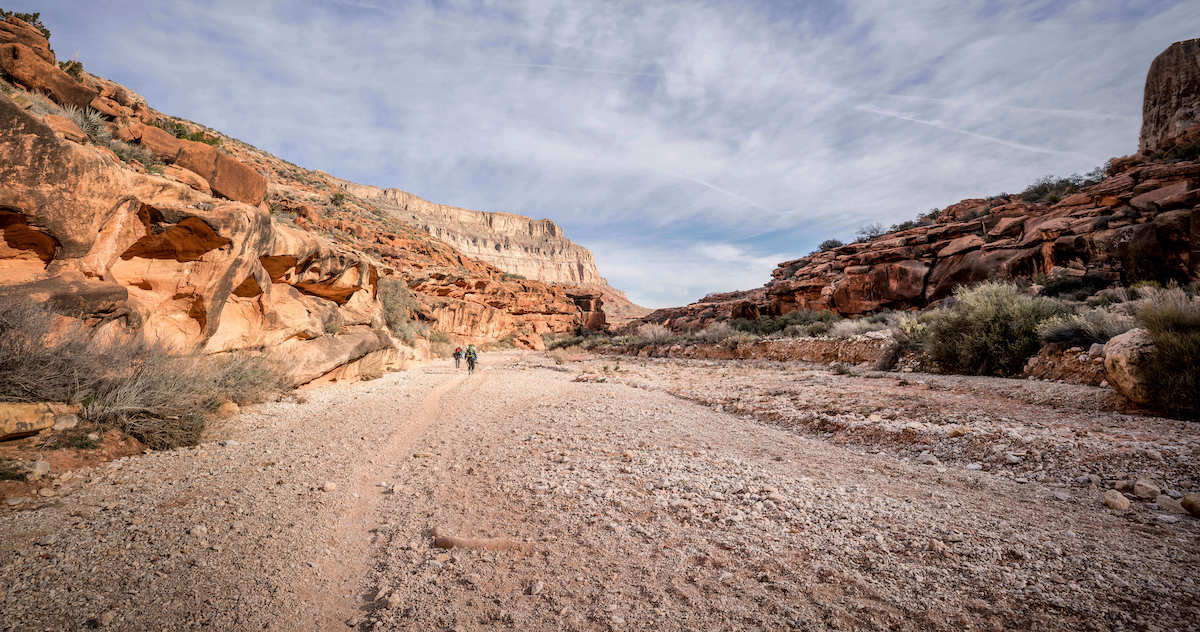
Sandy Havasu Falls trail through canyon in Arizona
The trail into Havasupai is easy to follow and not overly challenging (although long and exposed)

If at any point you think you’ve lost the trail, just keep following the river bed until you meet back up with the worn path.

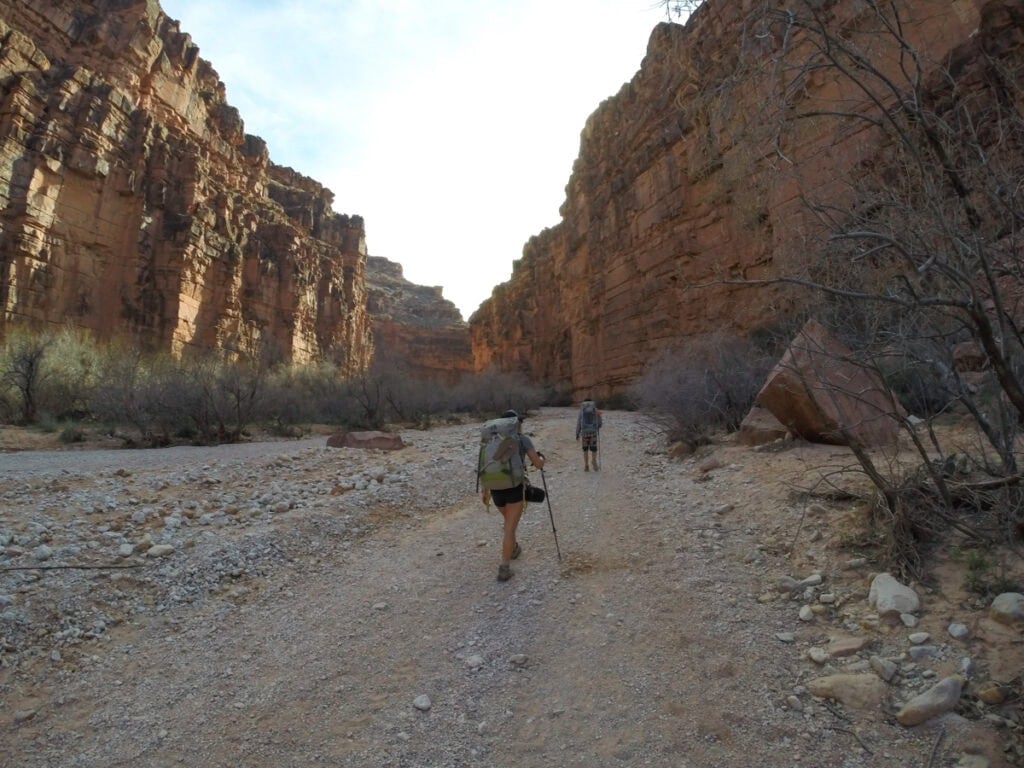
As you get closer to the Supai Village, the canyon chokes up and gets narrower. Here we were able to get some reprieve from the sun.
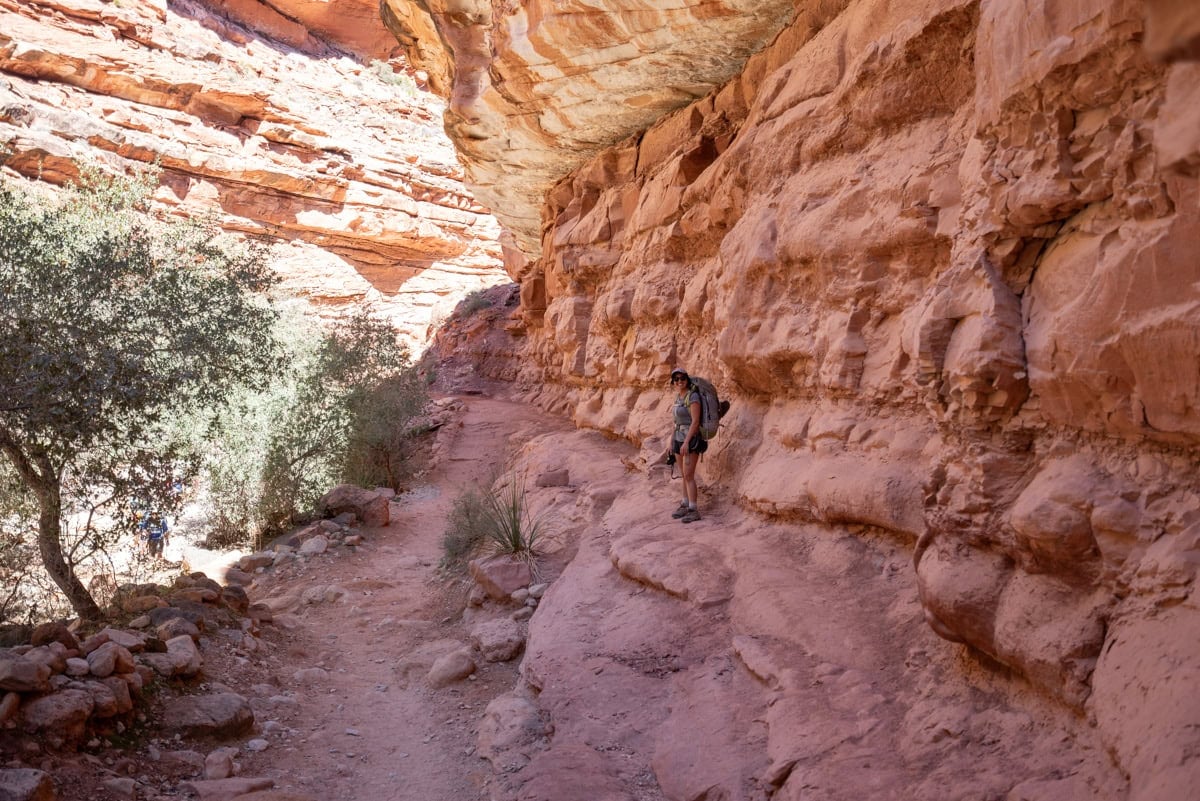
Hiker on a desert trail to Havasu Falls

At 6.2 miles, you’ll reach an intersection with the Supai Trail and Havasu Creek. Here you’ll turn left. Soon you’ll start to see homes belonging to the Havasupai people. Stay on the trail and follow the signs to the village.
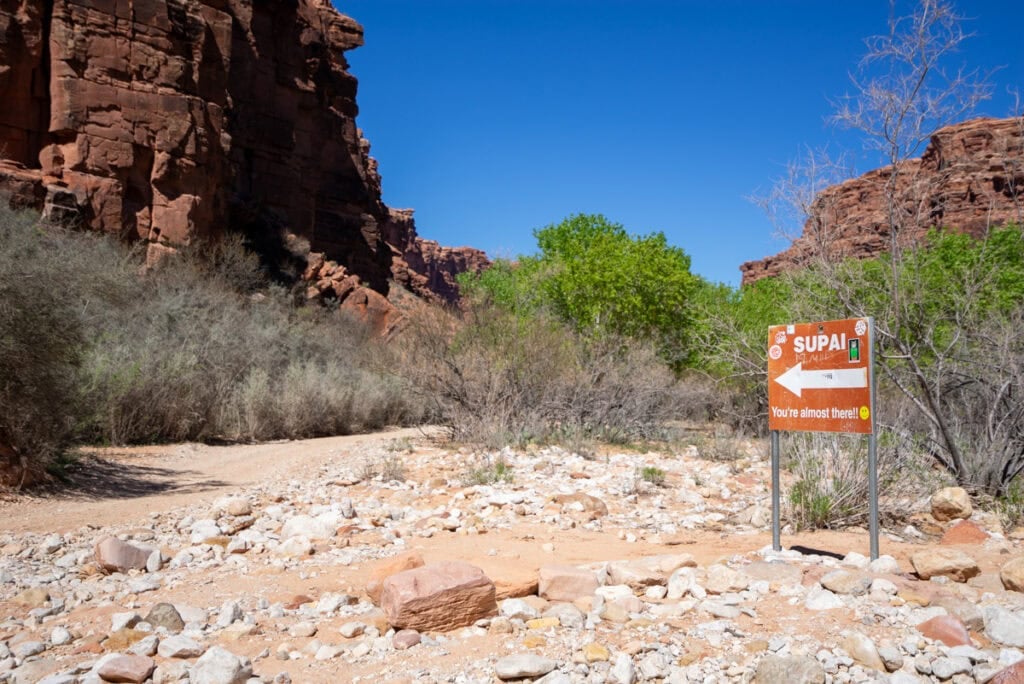
Sign to Supai Village

At mile 7.5, you’ll enter Supai village. No photos or videos are allowed in this area, and there may be signs asking you to wear a face mask as you walk through the village. Please be respectful and obey the current wishes of the Havasupai Tribe.

In the village, once you get to the Village Market, the road turns left. Continue on here and follow any signs pointing you towards the campground.

Once you pass through the Supai village, it’s another 2 miles and 150 feet of elevation loss down to the Havasupai campground.

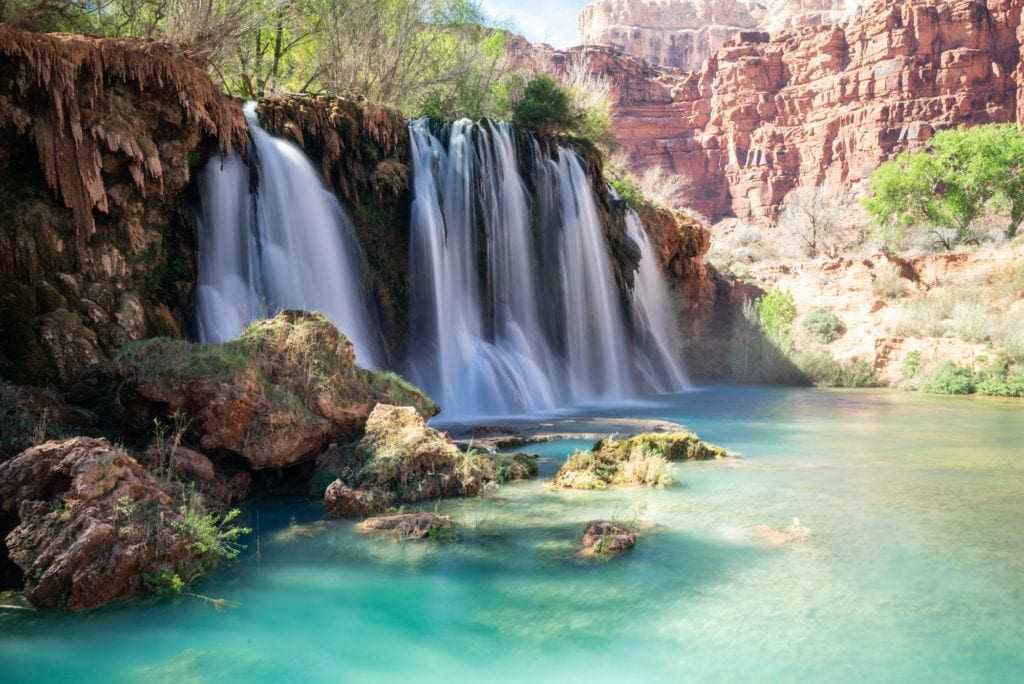
Before you get to Havasu Falls, you’ll pass two other waterfalls at the halfway point – Fifty Foot Falls and Navajo Falls. These are located one mile from the Supai Village and one mile from the Havasu Falls campground.

Depending on the time of day, you might consider stopping to explore. If it’s getting late, you can skip these and come back to enjoy them on another day of your trip.
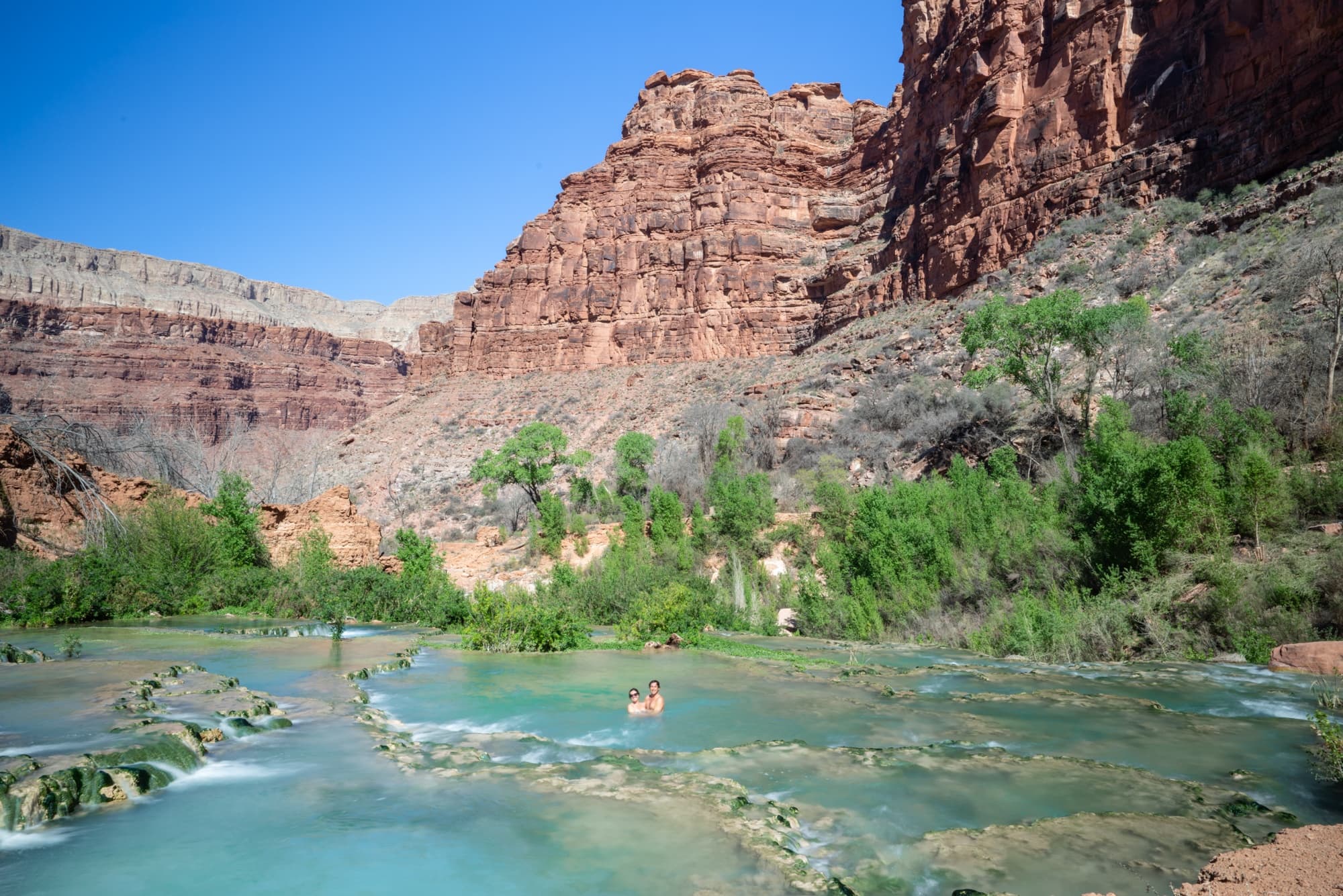
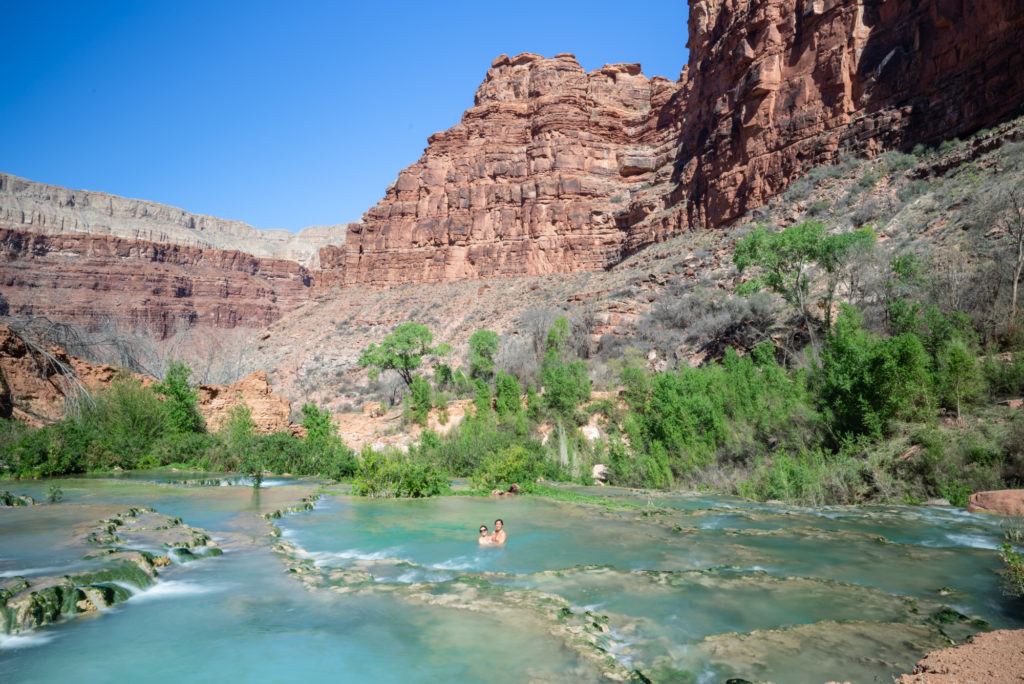
Swimming at Navajo Falls on the havasupai reservation
Just below Fifty Foot Falls.

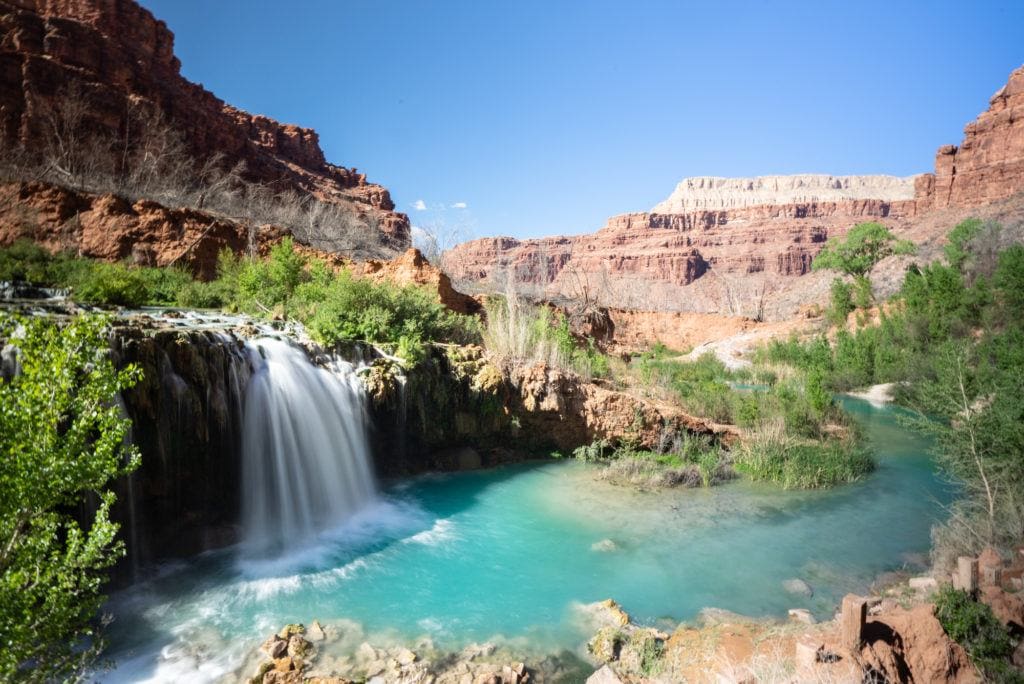
The different waterfalls on the Havasupai Reservation may look different than the photos here. Flash floods can dramatically alter the landscapes from year to year. The color of the water can even change depending on the time of day and whether it’s sunny out.
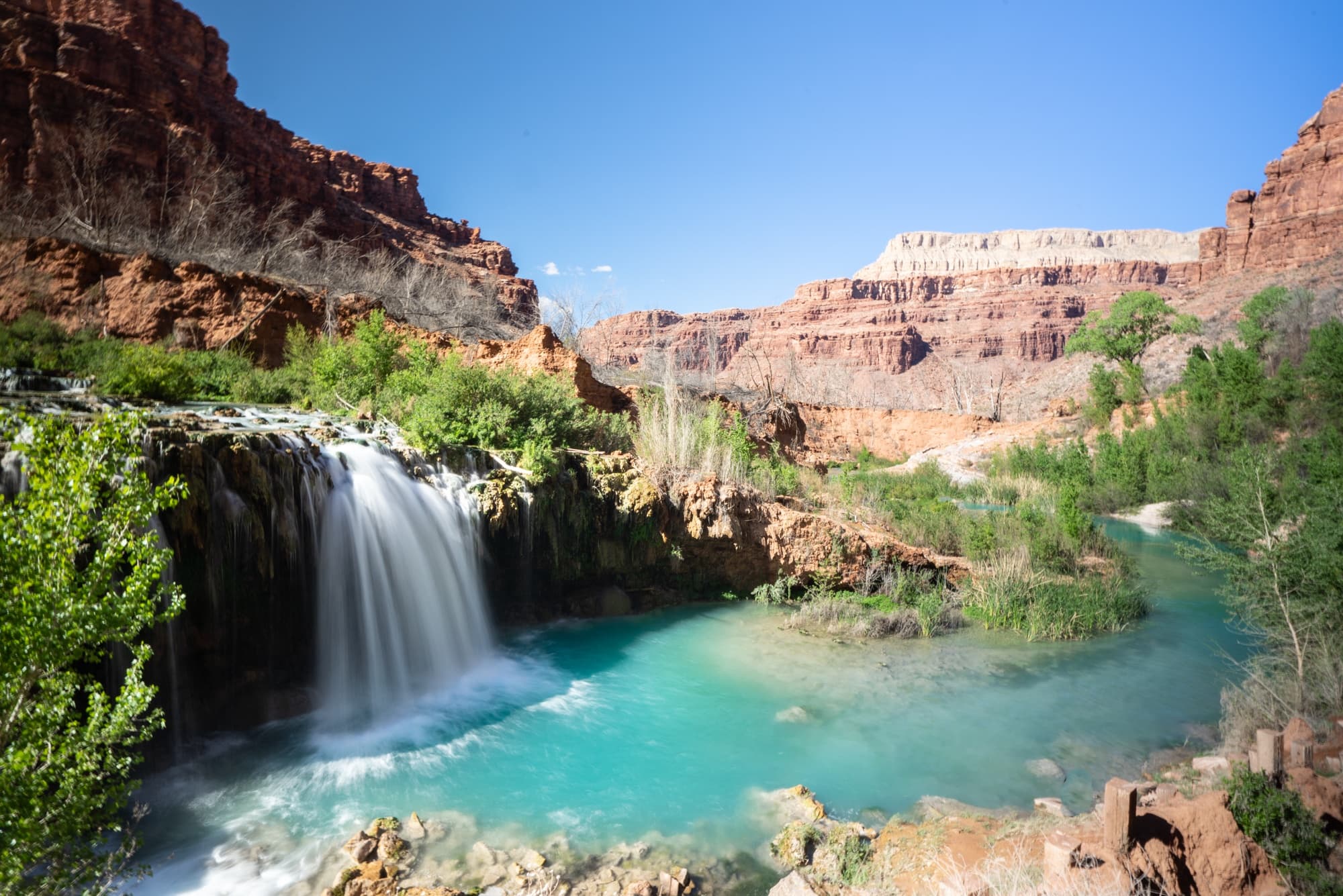
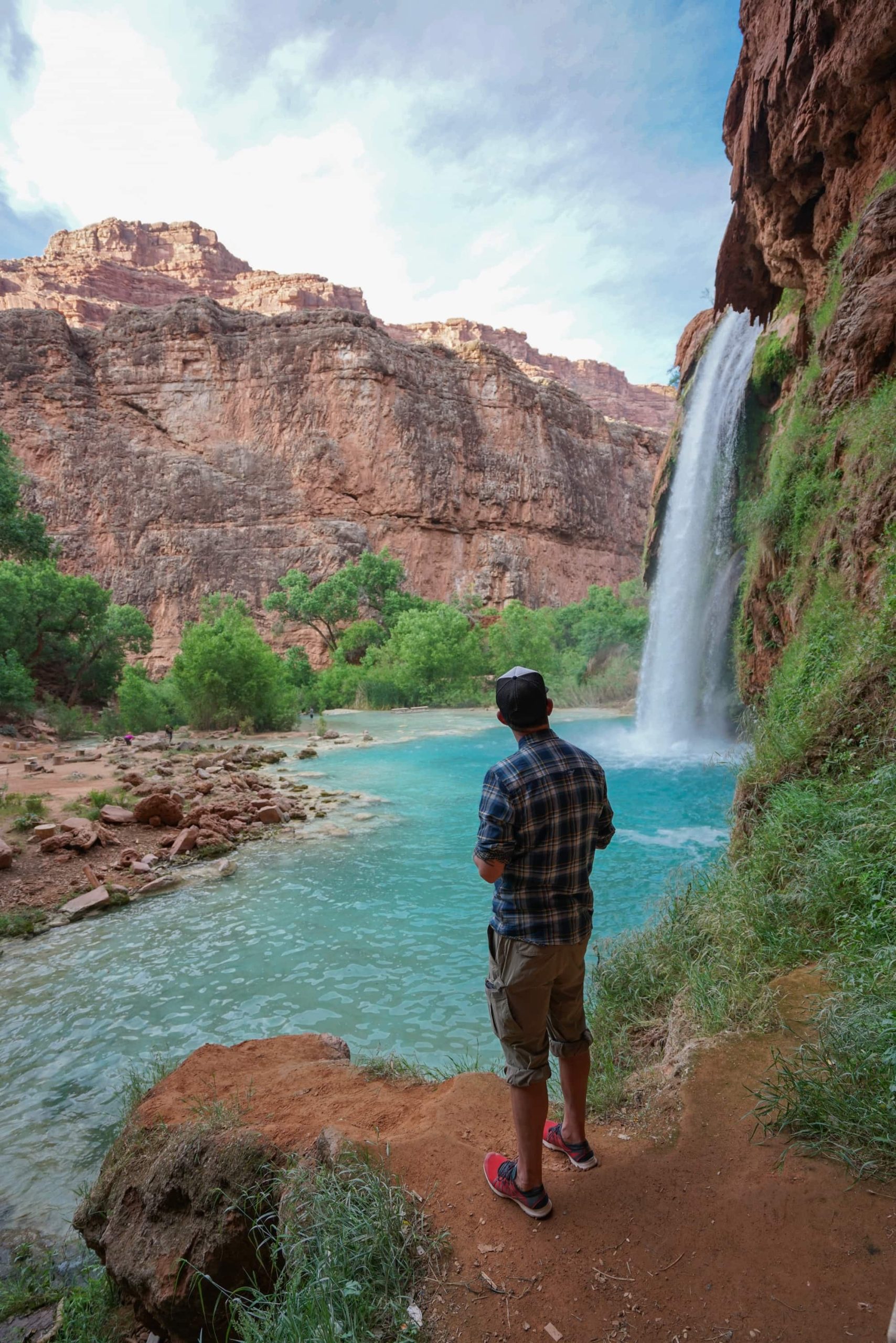
Havasu Falls Arizona
Navajo Falls

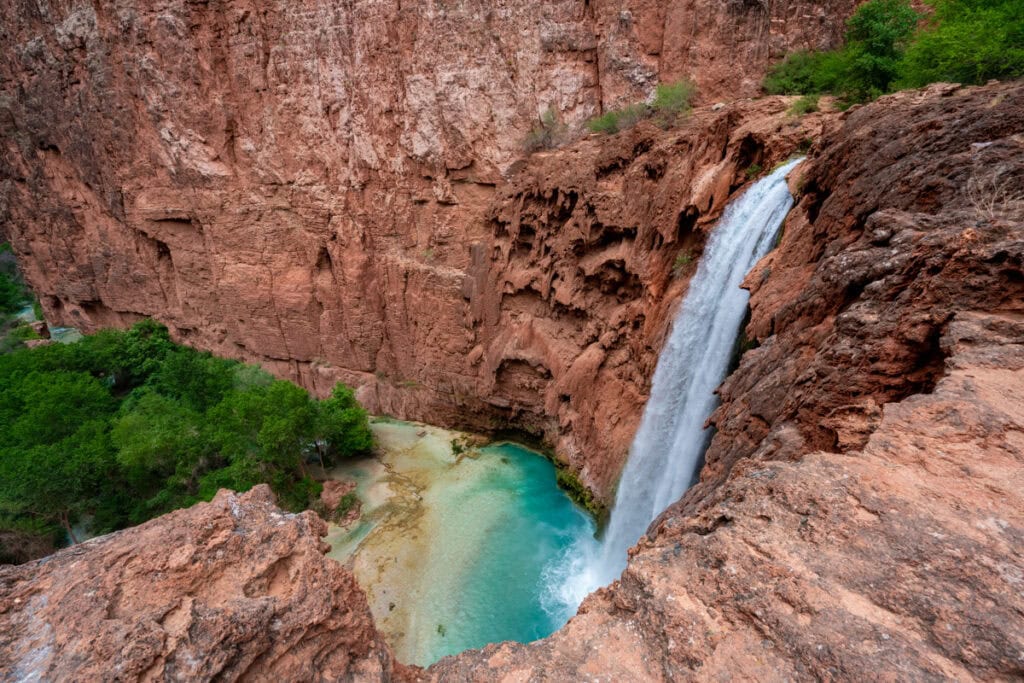
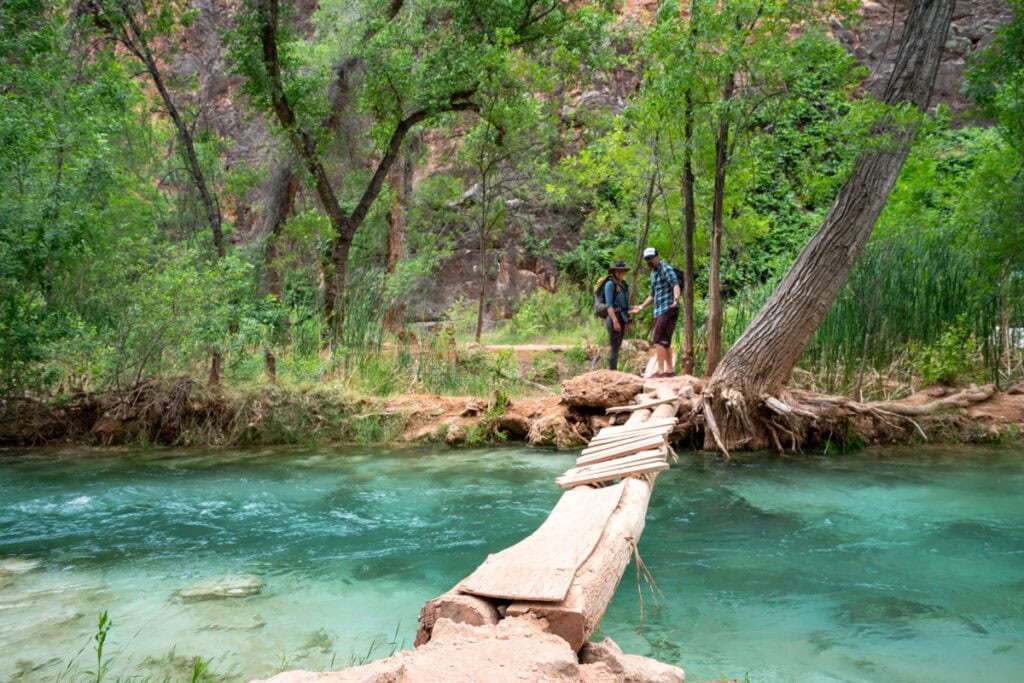
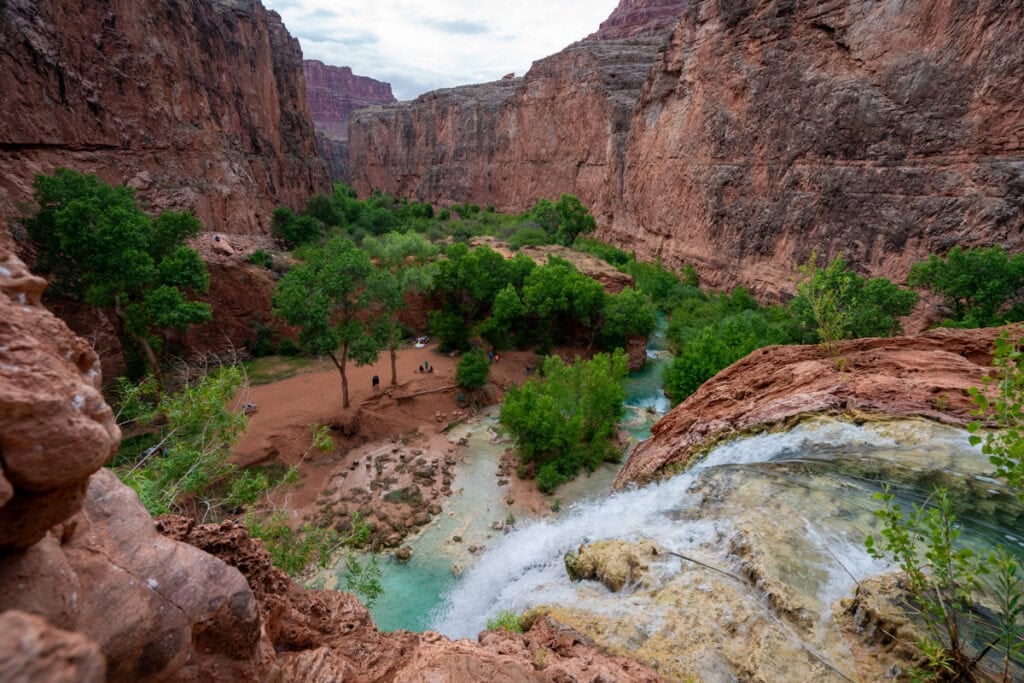
From Navajo Falls, it’s one more mile to the campground. First you’ll cross Havasu Creek on a bridge. Then as you approach the campground, the trail hugs the left side of Havasu Creek where it spills over Havasu Falls. This is a great vantage point of the waterfall and the pools below.
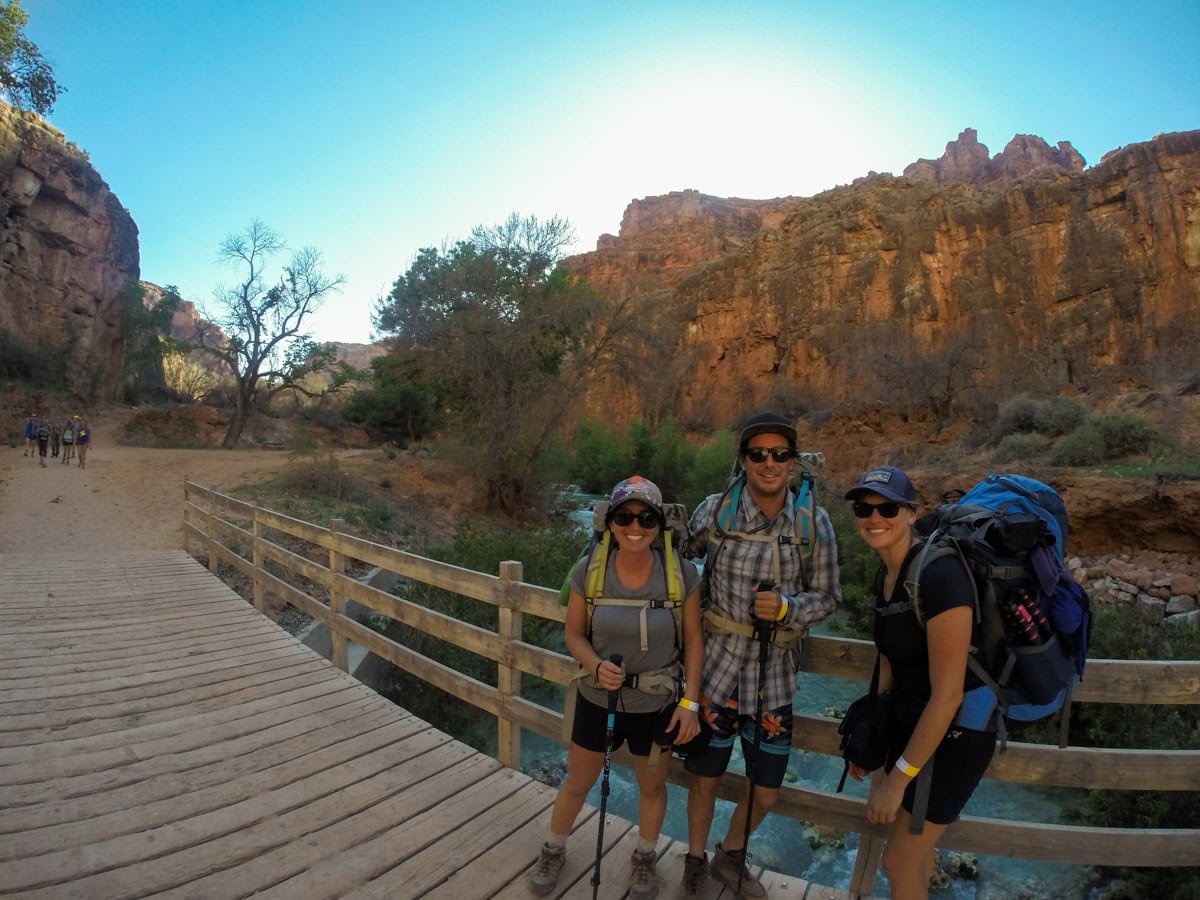
Group of hikers standing on a bridge over Havasu Creek
Crossing Havasu Creek

Here, I suggest taking a couple of photos but rather than stopping, continue another quarter mile to the entrance to Havasu Campground.
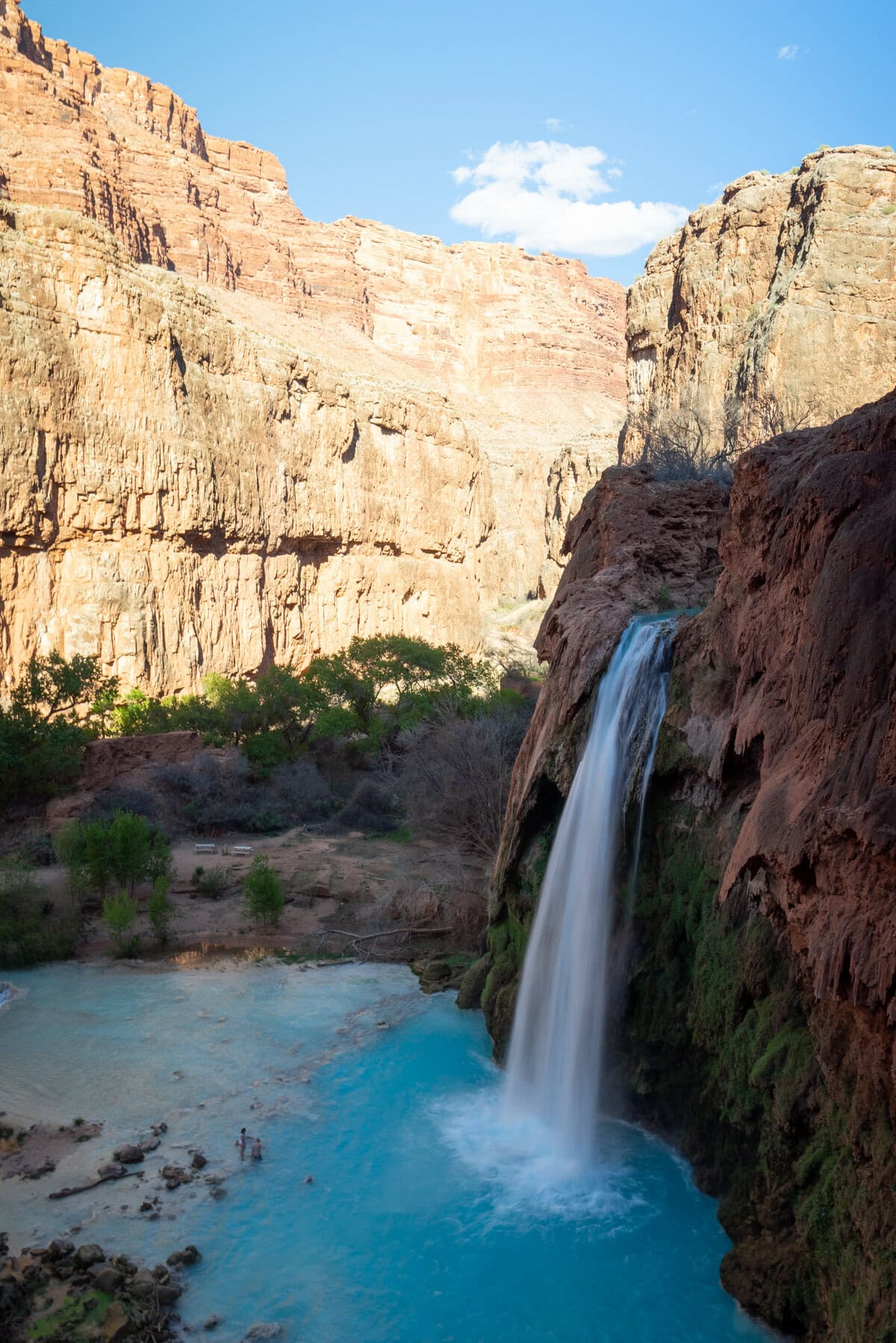
Havasu Falls
The view of Havasu Falls as you descend towards the campground

The campground is quite big and runs along more than half a mile of the trail between Havasu and Mooney Falls below. There are spots on both sides of the creek, so I when I was there, I really poked around before settling on a spot.

See my post on Havasu Falls camping tips for choosing a site and what to expect.
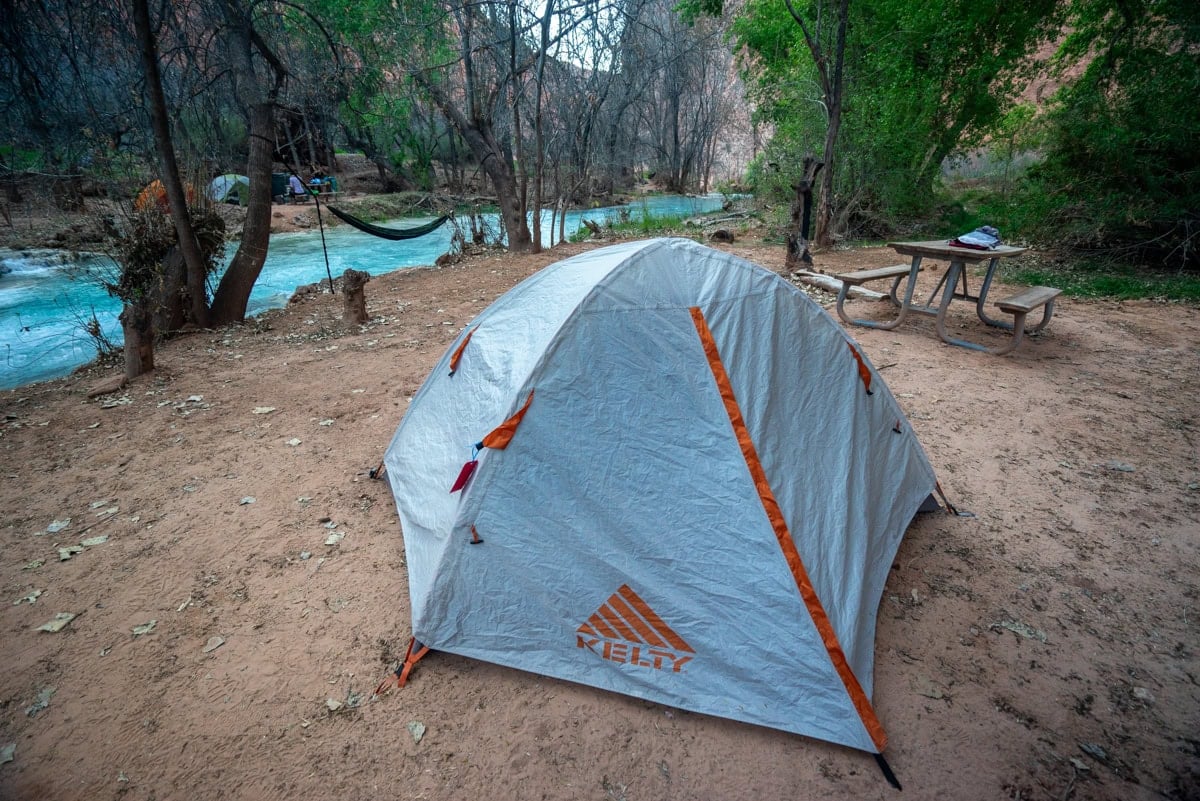
Tent at campsite next to turquoise Havasu Creek

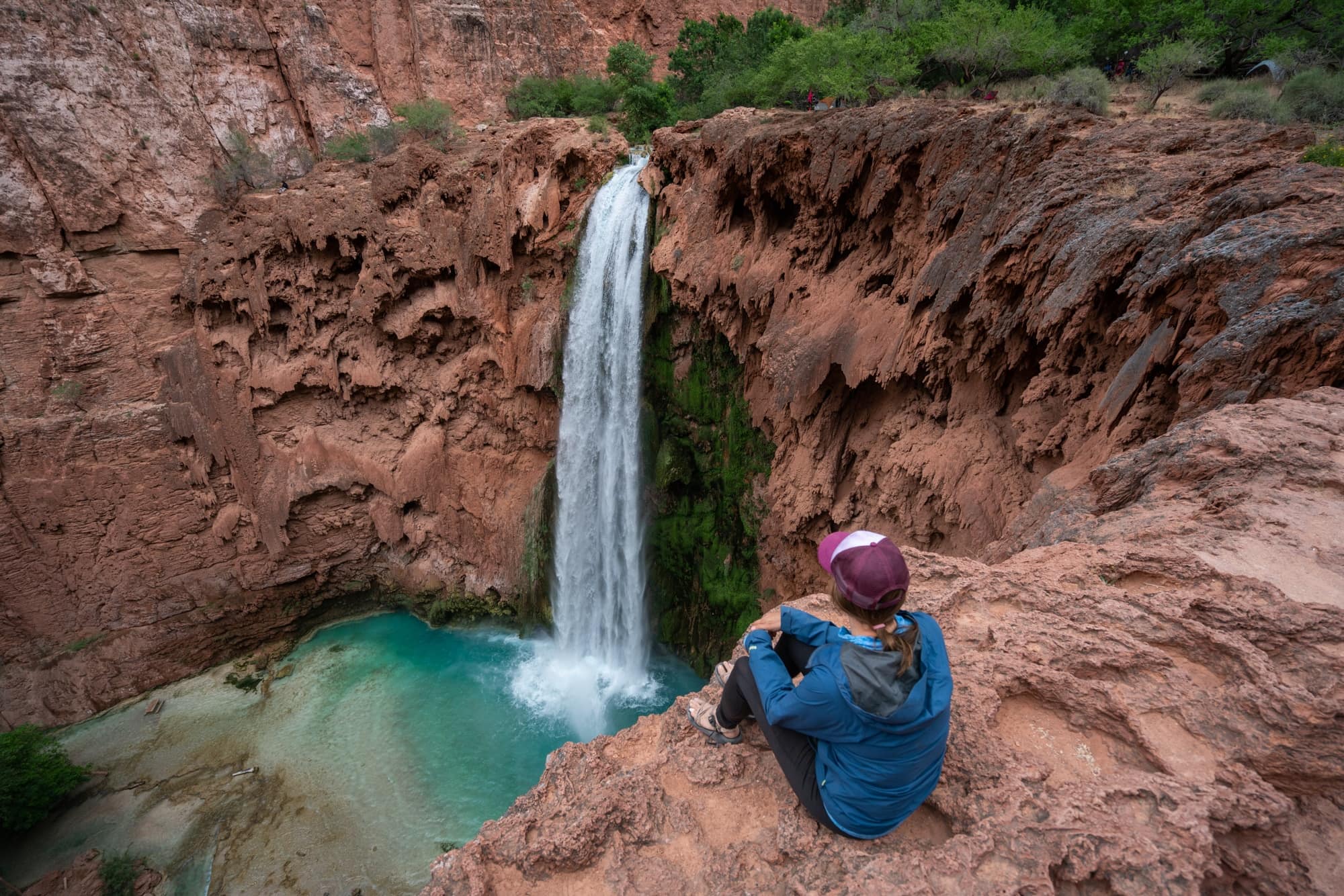
You’ll have plenty of time to explore the other Havasupai waterfalls over the next couple of days, but if you’re eager to see what you’re in for, the view point looking down on Mooney Falls is just a few minutes hike from the campsites.
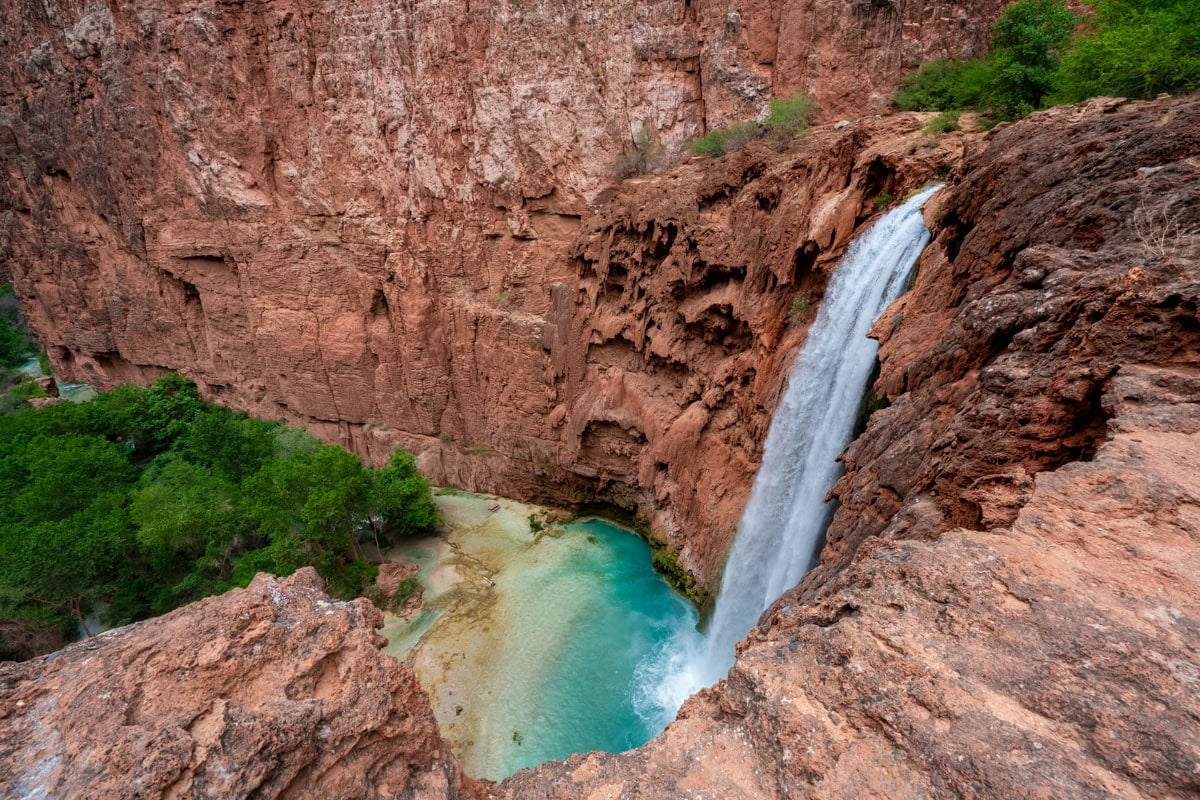
Top of Mooney Falls in Havasupai pouring into turquoise pool of water
The top of Mooney Falls

Hiking back from Havasu Falls to Hualapai Hilltop

I highly recommend staying all 3 nights/4 days that your Havasu Falls permit allows since there is plenty to do and explore on days 2 and 3 (my Havasu Falls camping guide also has an itinerary)!

When the time comes to hike from Havasu Falls back to Hualapai Hilltop, there are two strategies, and it really depends on what time of year you are hiking.

Remember it’s a long 10-mile hike with 2,200 feet of elevation gain. It took my hiking buddies and I around 6.5 hours to hike out, which is a pace of 40 minutes per mile.
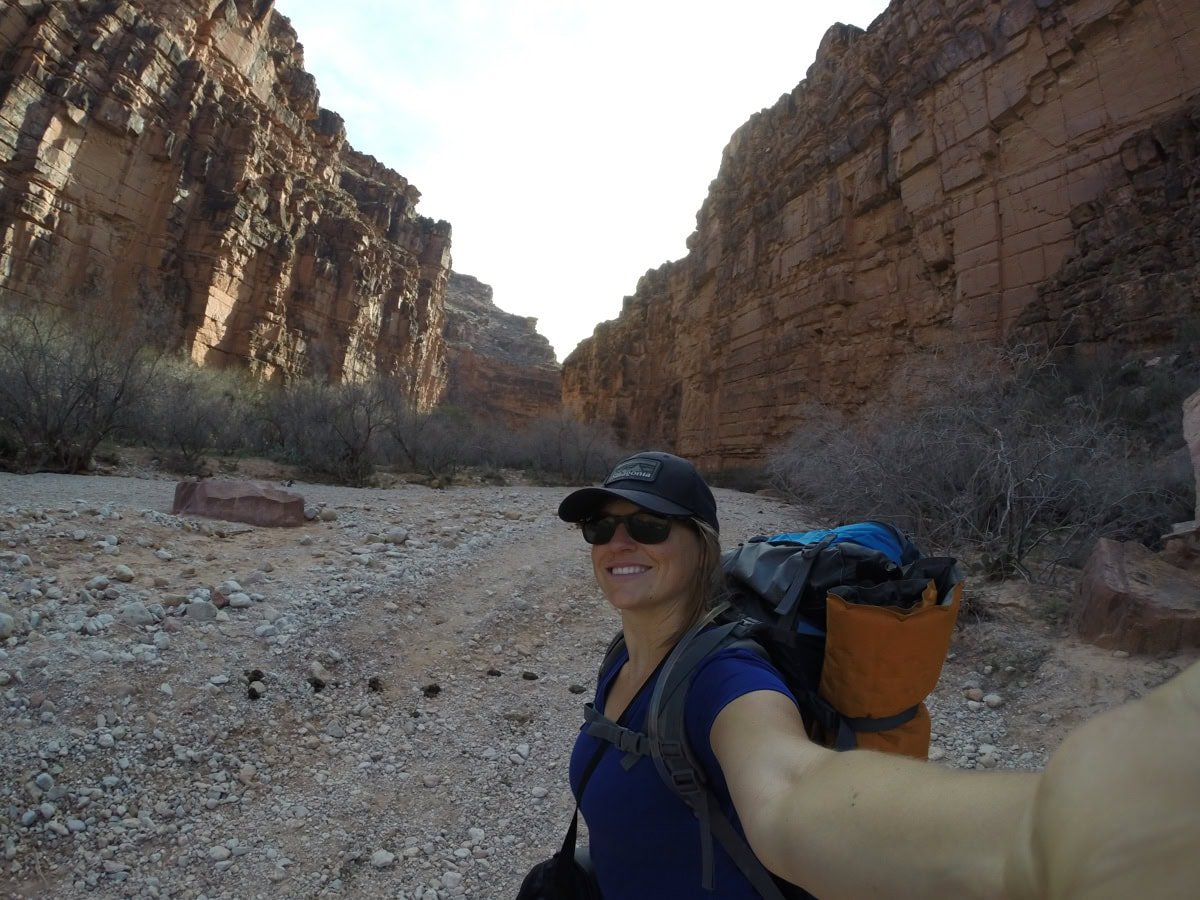
Kristen Bor hiking in a desert canyon from Havasu Falls
There is very little shade on the hike out apart from the beginning where the canyon is more narrow

If your trip is in the summer, I suggest starting your hike no later than 6am. If you can manage to be packed up even earlier, that’s even better. As you noticed on the way down, there is very little shade on the trail, so depending on the time of year, the hike out from Havasu Falls can be deathly hot. That extreme dry heat can suck the life right out of you, and even in March on my first trip, the temps were in the mid-80s, and it was quite hot hiking out.

A 6am departure should put you back at your car around noon, avoiding the hottest part of the day on the steepest part of the trail (which also happens to be west facing).

If you aren’t an early riser, the second option is to have a relaxing morning, spend some more time enjoying the falls, and then start your hike later in the day. My trips were in March and May and it stifling hot, so this was the approach I took.

I took a refreshing morning swim in Havasu Creek before reaching Supai Village, and then I started my hike in the afternoon.

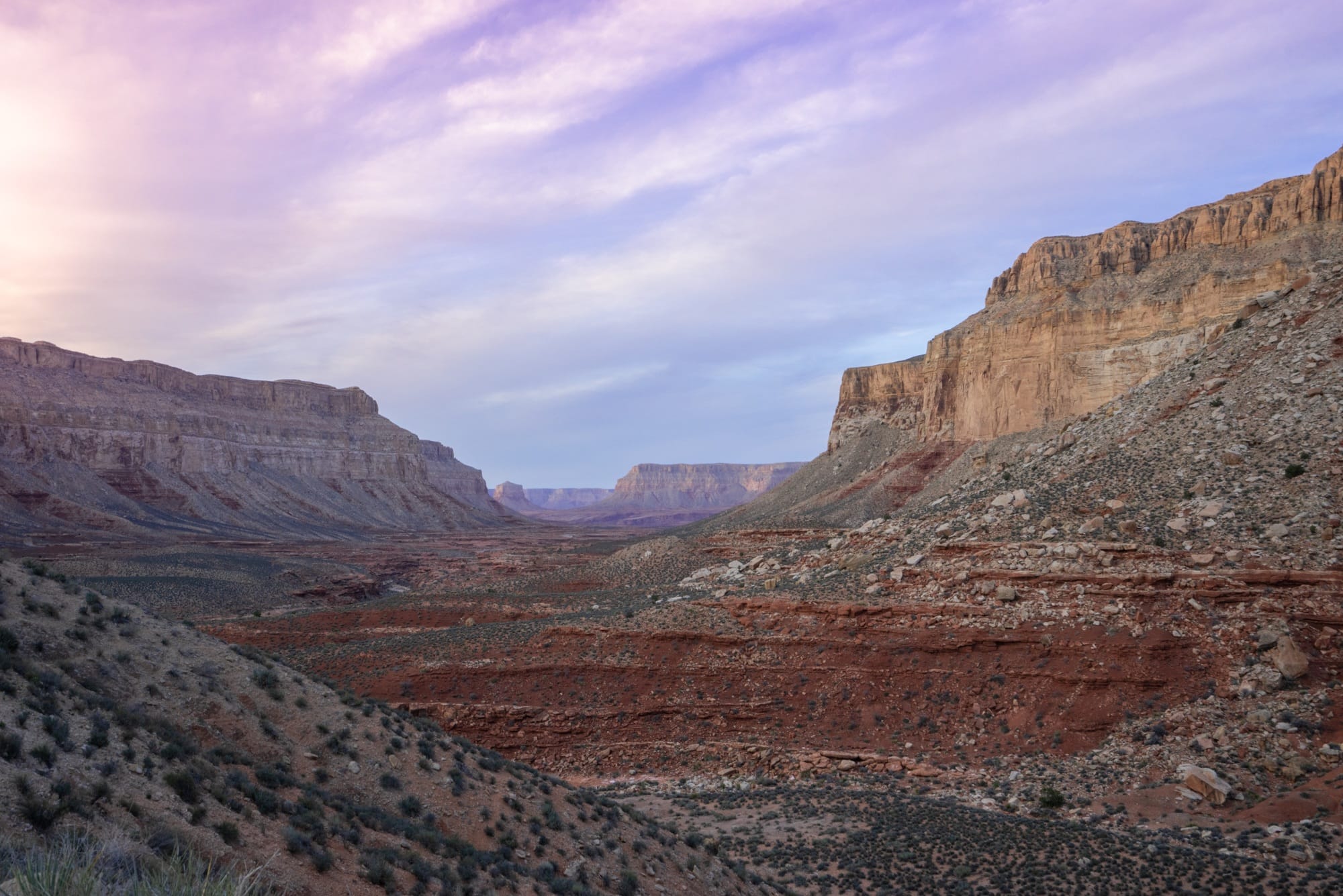
By the time I reached the steep ascent back to my car, the sun had gone down and the trail was in the shade. I got to enjoy the colorful sunset right as I finished the trail, and it was a great way to cap off the day. I’m not sure I’d suggest this in June-September, but for the cooler months, it was a great way to hike out.
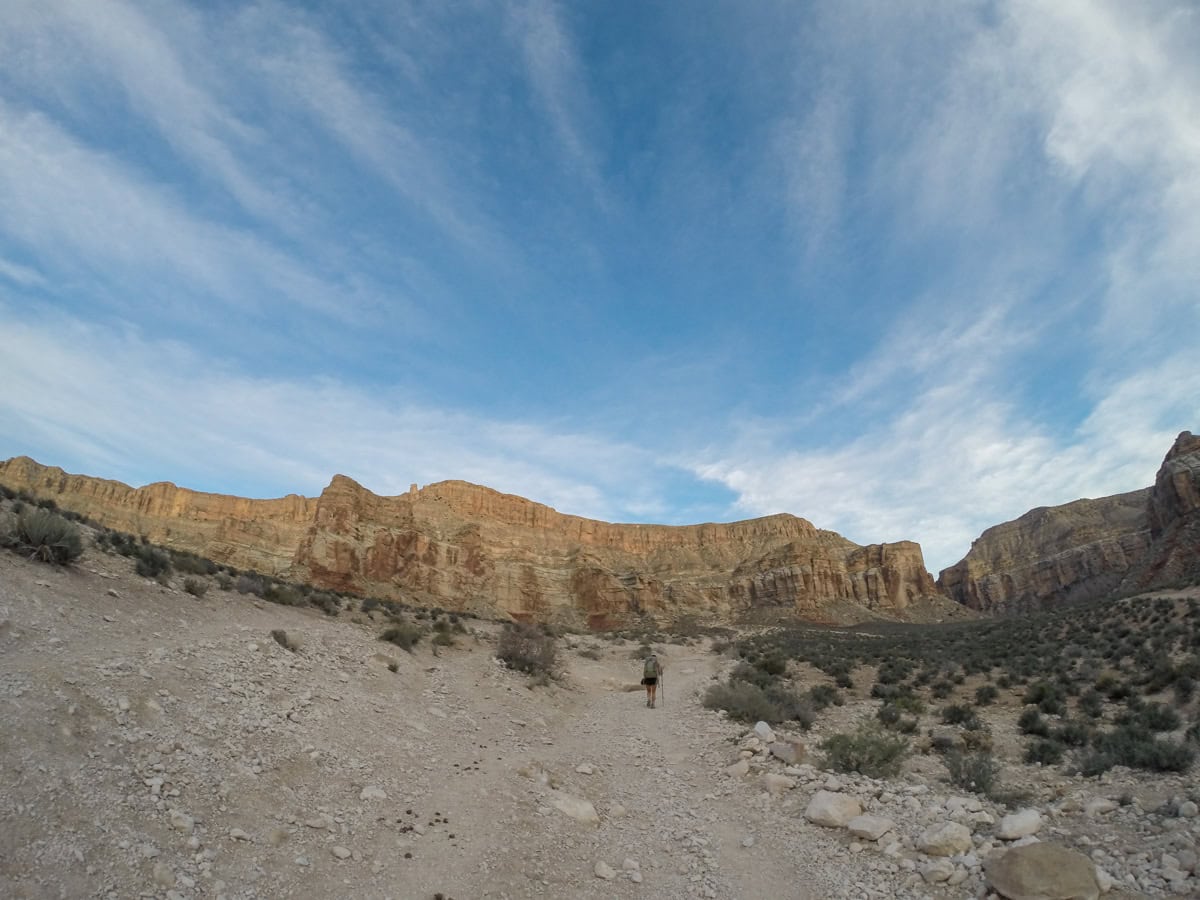
Hiker on a desert trail to Havasu Falls
Havasu Falls trailhead looking over desert canyon at sunset

Unlike previous years, the trail is now open 24 hours a day, so if your Havasu Falls hike is during the hot summer, than you can also hike out in the dark. Just make sure your headlamp is fully charged if you choose this route.

Regardless of what time you leave, make sure to save some food for your hike out as you’ll need fuel for the long day. Also, fill up all of your water so you have 4 liters for the hike out.

Gear for Hiking to Havasu Falls

Here I’ll focus on what clothing and gear you need for the Havasu Falls hike. If you’re looking for info on what camping gear to bring, see my detailed Havasu Falls Packing List.

  • Sun Protective Clothing: Cover up your arms with a lightweight hiking shirt with UPF protection and a wide-brimmed hiking hat. My post on what to wear hiking in the desert has some specific clothing recommendations that would work great for the Havasu Falls hike.
  • Backpacking Pack: If you’ve never backpacked before, check out my post on the Best Women’s Backpacking Packs or go to your local outdoor store and try some on in person.
  • Additional Sun Protection: you’ll want to have sunscreen, sunglasses, and I’d even consider a hiking umbrella, especially if you’re hiking during the summer. A hiking umbrella provides instant shade and reduces the temperature you feel by at least 10 degrees – both really helpful benefits for this hot hike that has no shade. See my sun protection tips for hikers for more considerations.
  • Trekking Poles: I consider trekking poles a must on any backpacking trip where there is significant elevation gain like the Havasu Falls hike. They will really help on that final steep push back to the parking lot.
  • Breathable Hiking Shoes: You don’t need a heavy-duty pair of leather hiking boots. These are heavy and will make your feet hot when hiking through the sandy wash. I recommend a lightweight, breathable, closed toe hiking shoe that offers ankle support such as the Oboz Katabatic Mid (non-waterproof) paired with Darn Tough socks.
  • Food and Water: Make sure you pack enough food for your hike in and out, in addition to what you will need at your campsite. I really like these ultralight Platypus Soft Bottles for backpacking.
  • First-Aid Kit: Keep a first aid kit handy during your hike. You can make your own first aid kit or buy a pre-made first aid kit that has basic supplies. I also recommend carrying a Garmin InReach Mini in case of an emergency.

Havasu Falls Hiking Permits

Advanced permits and reservations are required for hiking to Havasu Falls.

Don’t plan on sneaking in—permits at Havasupai are strictly enforced. A guard is stationed about 5 miles from the trailhead to check permits, and every vehicle must display a copy of their reservation in the window.

I go over step-by-step instructions for how to get a Havasu Falls permit here. Permits go on sale and typically sell out for the year on February 1st, so in most cases, you’ll need to plan ahead.
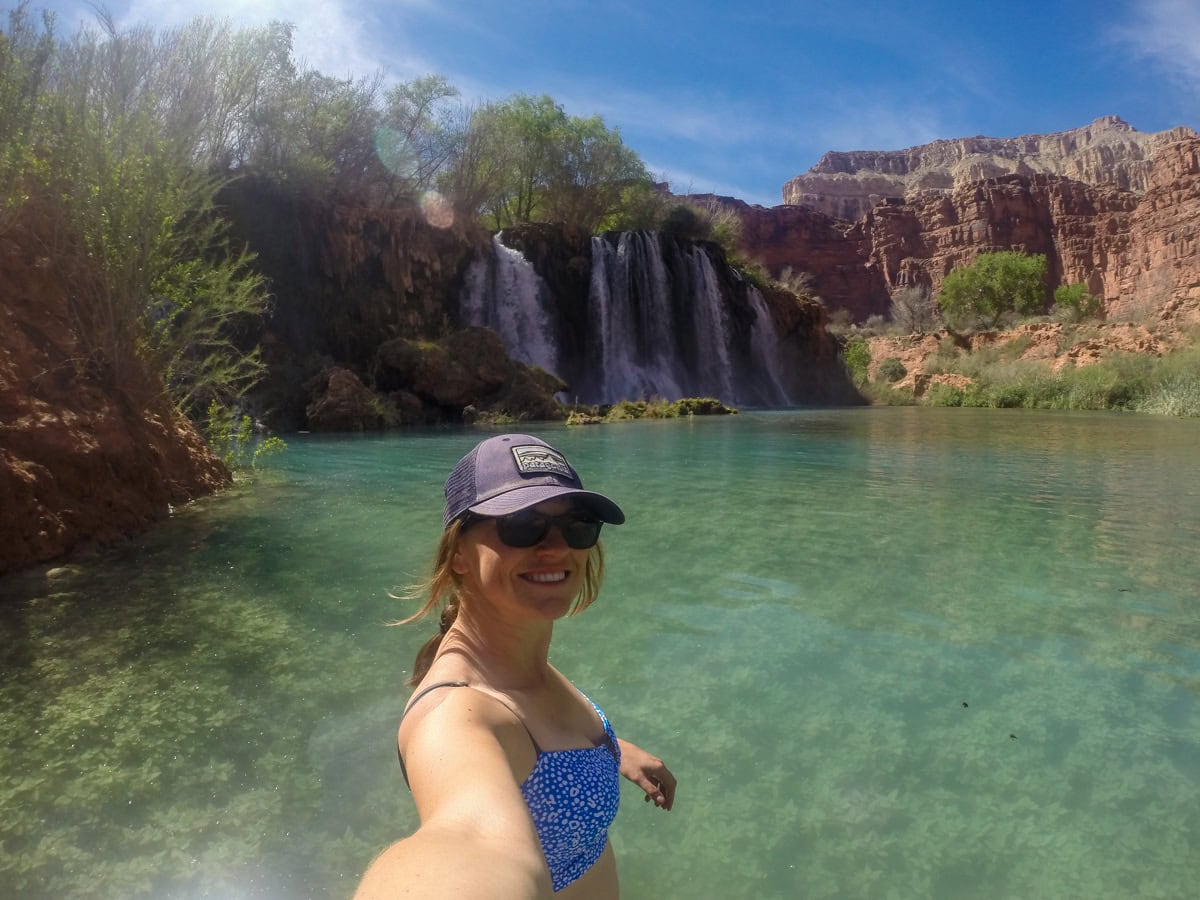
Kristen Bor swimming in a waterfall called Fifty Foot Falls

Where to Stay the Night Before your Hike

There is no camping or sleeping in your car allowed at the trailhead parking area. There is a guard on the road to the trailhead who will check your permits, and they will not let you proceed to the Trailhead the day before your permit starts. So you’ll need to make other plans for the night before your hike.

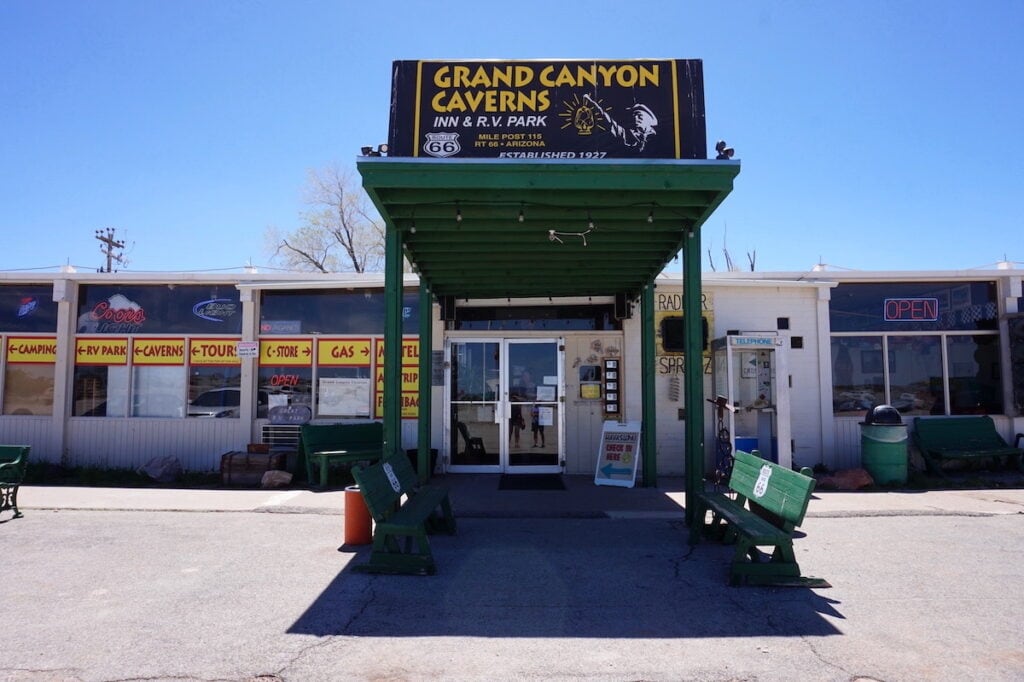
The most logical place to stay the night before is the Grand Canyon Caverns Inn which is between Seligman and Peach Springs. This is where you will where you check in for your Havasupai trip and pick up your permit. The have a small number of hotel rooms available, as well as a decent campground. There is a small restaurant on site, but if you have dietary restrictions, there won’t be much for you to eat.

Another good option is the The Aztec Motel and Creative Space in the town Seligman.

While there are a few paid campgrounds nearby, there isn’t any dispersed camping between Seligman and the trailhead due to much of the land being Tribal Land. So you should definitely plan ahead and make a reservation somewhere.

Frequently Asked Questions

Can I day hike to Havasu Falls?

Day hiking to Havasu Falls is not allowed. There are signs everywhere stating day hiking is prohibited. Not only is day hiking not allowed, the hike to Havasu Falls is 10 miles each way which is way too far to hike there and back in a day while still being able to enjoy the falls.

Can I get to Havasu Falls without hiking?

The only way to get to Havasu Falls without hiking is by flying with Airwest helicopters. You must have a Havasu Falls permit or lodging reservation to be eligible to fly. From March 15 to October 15, Airwest Helicopters flies on Sundays, Mondays, Thursdays, and Fridays, and the rest of the year it only flies Sundays and Fridays. It costs $100/person. There are no reservations, and no guarantees that you will get a spot, so you should be prepared to hike. Check-in for flights begins at 10am either at the Hilltop Trailhead for flying to Havasu Falls or at the Supai Village Landing Pad for flying back to the parking lot. However, hikers looking to fly out often line up as early as 5am in order to secure a spot. You can call Airwest at (623) 516-2790 for the latest info.

How hard is the hike to Havasu Falls?

I would classify the hike to Havasu Falls as moderate, and the hike from Havasu Falls back to the trailhead as challenging due to length, elevation gain, and sun exposure. However, I still consider this to be a beginner-friendly backpacking trip. The trail is easy to follow, you only have to set up and take down your campsite one time, there are toilets at the campground and a grocery store in the village, and there are plenty of fellow backpackers in case you need a hand.

How much water should I carry on my Havasu Falls hike?

The Tribe recommends you carry a gallon (nearly 4 liters) per person hiking to and from Havasu Falls. I personally brought three liters, but the temperatures were mild. In the hot summer months, dehydration is a real risk, so 4 full liters would be smart. There is no water at the trailhead, so fill up before you drive to the Trailhead.

When is the best time to hike to Havasu Falls?

I think the best time to visit Havasu Falls is mid-March through mid-May or mid-September to mid-October. During these months, the daytime temperatures are more comfortable for hiking. However, during these months, it may be too cold to swim. Even though summer is prime for swimming, I’d personally avoid summer due to the extreme heat which makes the hike less pleasant. Summer is also monsoon season with dangerous flash floods being most likely from mid-June to late September. The trail and campground are closed in December and January.

Can I hire a pack mule to carry my stuff to Havasu Falls?

When you reserve your permit, you will be given the option to hire a pack mule to carry your camping gear to the Havasu Falls campground. A pack mule is $400 round trip and can carry 4 bags (max weight per bag is 32 pounds). While I didn’t see this personally, you should be aware that there have been a lot of reports of pack mules being malnourished and overworked. If you’d like to learn more, check out SAVE, a volunteer-based organization trying to end the abuse and improve the lives of these pack animals.

Save this post to Pinterest

What questions do you still have hiking to Havasu Falls? Leave a comment below!

The post Havasu Falls Hike: Your Complete Trail Guide (with map!) appeared first on Bearfoot Theory.
How to Get a Havasu Falls Permit: My Step-by-Step Guide

I’ve been to Havasu Falls (formally known as Havasupai Falls) twice now, so I know how difficult it can be to get a Havasu Falls permit.

While it may not be as tough as Taylor Swift tickets, Havasu Falls permits sell out immediately for the entire year, so you need to do your research on how to get a permit ahead of time. That way when they go on sale, you’re ready to go and will have the best chance of success.

So in this post, I’m going to walk you through step-by-step instructions for everything you need to do to get ready to score a Havasu Falls permit in 2025.

Three Ways to Get a Havasu Falls Permit

You MUST obtain a permit before your trip. The permit process helps to preserve the natural beauty of Havasupai Reservation and provides the Havasu Tribe with an income. The Tribe will check your permit along the road to the Hilltop trailhead, so don’t think you’ll be able to sneak onto the trail.

There are three different ways to obtain a permit or reservation for Havasu Falls.

  • Presale Reservation Process – This is a presale reservation process that works kind of like a lottery.
  • General on-Sale – If you are unsuccessful in the presale reservation process, you will need to try to get a permit when they go on sale to the public on February 1st. This is similar to a Ticketmaster sale where you’ll need to have an account and be online right when they go on sale since these will sell out for the year within a few hours. These are offered on a first-come-first-served basis.
  • Permit via Cancellation – If you are also unsuccessful in the general on-sale, permits that have been canceled become available through the Havasupai online system.

Your first step, regardless of how you try to get a reservation is to make an online account at HavasupaiReservations.com.

I’ll go into more details on each of these ways of obtaining a Havasu Falls permit below.

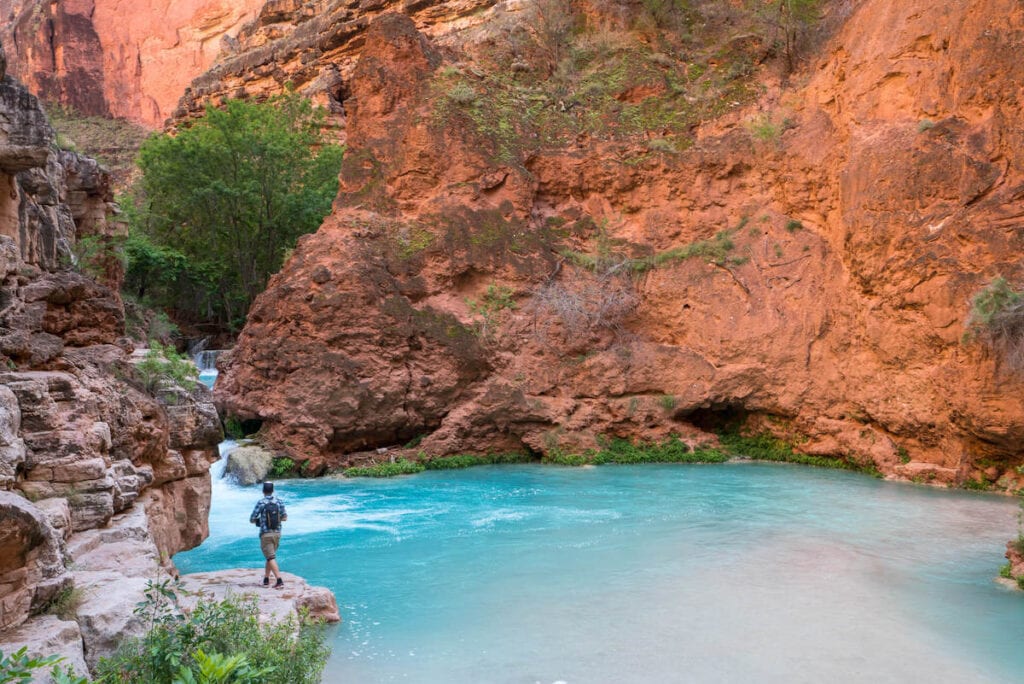
Man standing on ledge above turquoise blue waters surrounded by red rock cliffs in Havasu Canyon in Arizona
The milky turquoise blue waters of Havasu Creek are a unique characteristic of Havasupai

1. Presale Reservation Entry

The first option for getting a Havasu Falls permit is the presale reservation system operated by the Havasupai Tribe Tourism Office.

The Presale Reservation Entry grants you the opportunity to enter a Havasu Falls permit lottery, prior to the general on-sale. You enter the dates you want and then permits are randomly granted to a limited number of people who enter. Purchasing a presale entry does not guarantee a Havasu Falls Permit.

Basically, you’ll be competing with a smaller pool of permit-seekers instead of the wider general public.

Here are a few things to know about the Havasu Falls Presale Reservation System. This information here is for the 2025 presale.

  • Presale Dates: In 2025, the presale period runs from December 16, 2024 (8 a.m. Arizona time) to January 2, 2025 (5 p.m. Arizona time). They have not announced the dates yet for 2025.
  • Presale Cost: The cost for a presale ticket is $20 per person and is non-refundable. This presale fee is also not applied to the cost of your reservation. So if you have a group of 4 people, the cost to participate in the presale would be $80, in addition to the reservation fee (which I talk about below)
  • Reservation Dates: You can select three reservation start dates.
  • How it Works: A limited number of pre-sale reservations will be granted via a randomized lottery.
  • Presale Notifications: Entrants are notified whether they got a permit or not via email no later than January 6, 2025.
  • Payment: If you are successful and want to confirm the reservation, you must pay the full reservation fee by January 24, at 5 pm. If you don’t pay by then, your reservation will be canceled, and you will not be charged beyond the presale fee.
  • Leftover Permits: The remaining permits become available to the general public on a first-come-first-serve basis on February 1 at 8 a.m. Arizona time.

My thoughts? I think the presale fee is expensive, and it’s not guaranteed you will get a Havasu Falls permit through this presale process. If you’re unsuccessful, you’ve just wasted $20/person, which really adds up for larger groups. Even if you are awarded a permit through the presale process, it jacks up your total permit cost by $20/person. Unless this is a one-in-a-lifetime opportunity to go on the trip and you can only go on a specific date, I’d probably wait for the regular on-sale.

Man standing at base of Havasu Falls

2. General On-Sale

If you don’t get a permit during the presale, you’re next opportunity to get a permit is during the general on-sale which takes place on February 1st at 8 AM Arizona Time. This is personally how how I’ve gotten both of my permits for Havasu Falls.

Before the sale, you’ll want to make sure you’ve created an online account at HavasupaiReservations.com.

Your will need to be online and ready the minute the sale starts. Treat the process as if you were trying to get tickets for a popular concert. On February 1st, log into your account before 8 am Arizona time and refresh your browser the second it turns to 8am.

Getting a Havasu camping permit is very competitive, and permits will sell out quickly. To increase your chances, follow these tips:

  • Create your online account before February 1st. You don’t want to waste precious time creating your account the day reservations open.
  • Be somewhere you have a fast connection. Make sure you have strong internet. Don’t try to do this from some remote campsite where you only have 3G on your phone.
  • Have flexible dates. Mid-summer is when everyone is on summer vacation, so it’s also going to be the most competitive time. If you can go mid-week in March or late November, then you’ll have a better chance of getting a permit.
  • Remember that Arizona doesn’t do daylight savings time. Double-check what that means for your time zone. It would be a bummer to log in an hour late!
  • Create your Potential Alternate Trip Leader (PATL) list in advance. The PATLs ithat you designate are the only people you can transfer your permit to at no cost if you can’t make your trip. If you don’t designate a PATL, you risk forfeiting the trip for everyone in your group. You can choose up to 10 Potential Alternate Trip Leaders.
  • Check out quickly. Once you have the permits in your cart, have your credit card information on hand and breeze through the check out process as quickly as you can.

Hopefully, you luck out here and get the dates you want. If permits sell out before you are able to get one, the final way you can try to get a permit is via a cancellation.

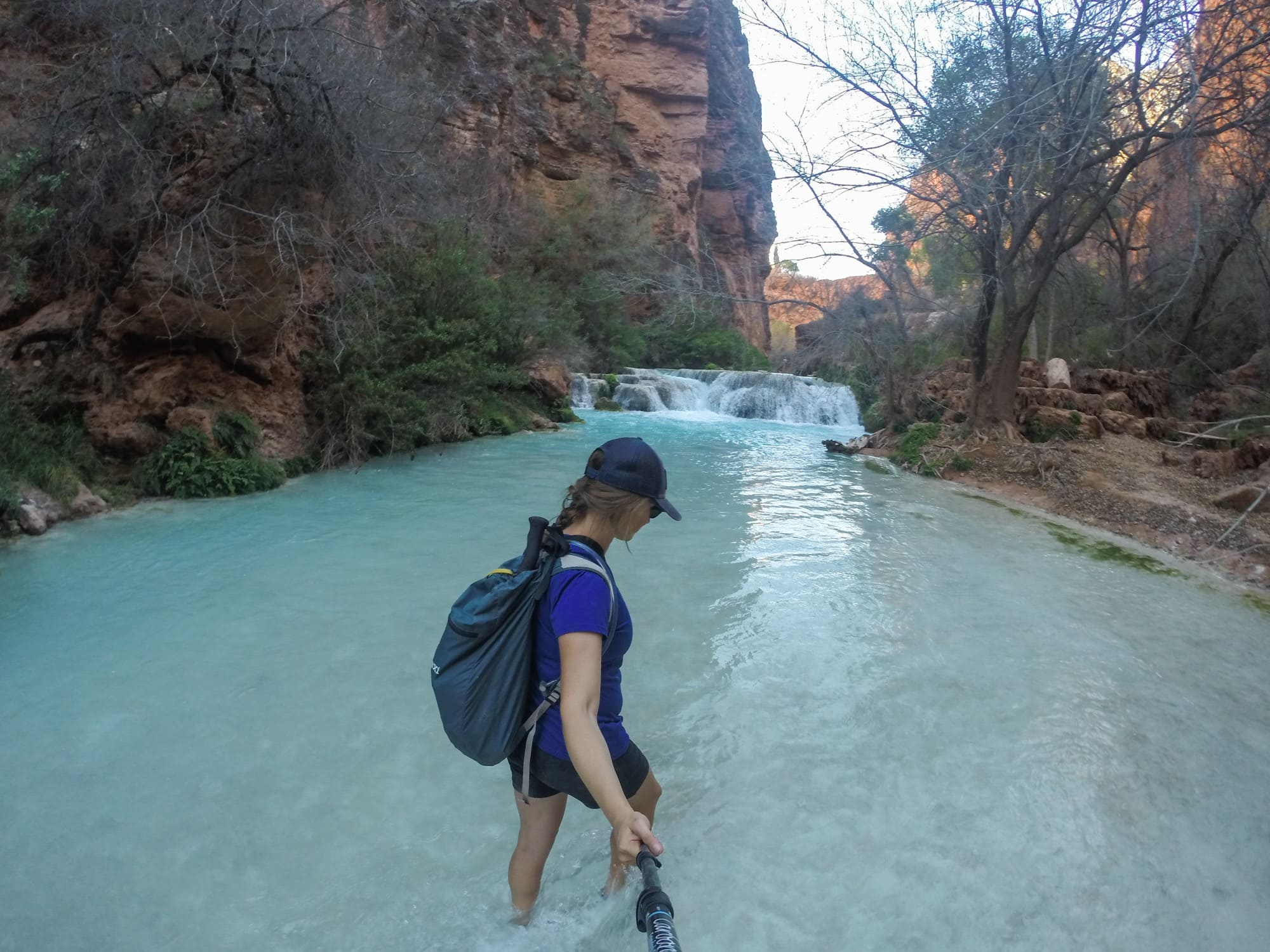
Kristen Bor holding a selfie stick while crossing Havasu Creek

3. Getting a permit through a cancellation

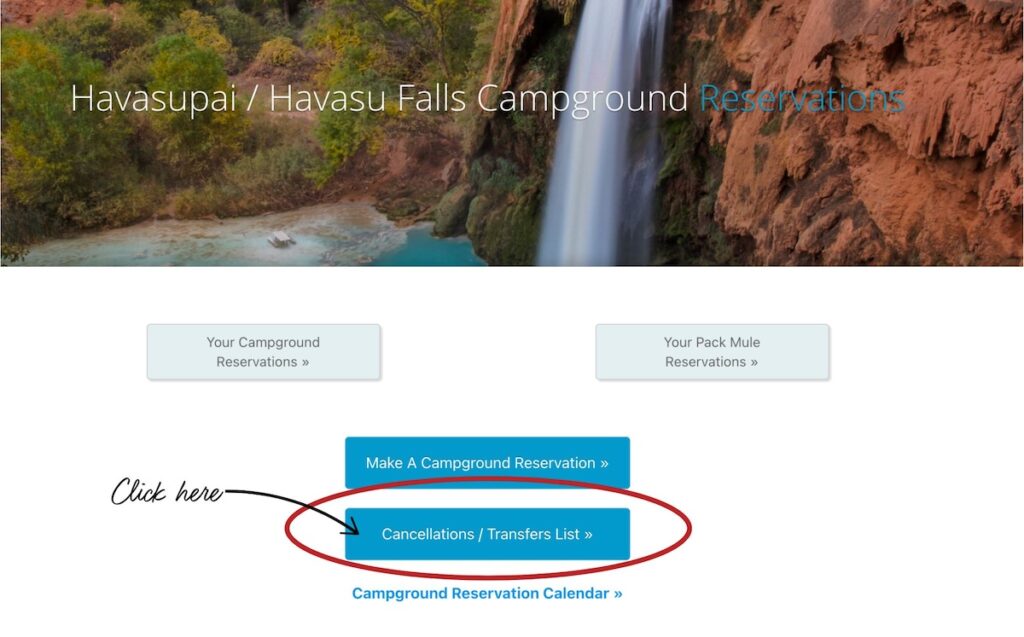
If you don’t score a Havasu Falls permit before they sell out for the year, you may still be in luck. The online Havasupai Reservation System has a Cancellation/Transfers Page where you can purchase canceled trips. Not only is this a great option if you aren’t able to get a permit when they go on sale, it’s also perfect for those of who (like me) who have trouble planning that far ahead.

Log in to your account on the Havsupai Reservations site and go to your Dashboard. You’ll see a button that says Cancellations/Transfers List. Click that.

This list is updated daily at 8am Arizona Time, so be online every morning for your best chance at getting a permit. Right now I’m looking at the cancellation list for the upcoming month, and there are TONS of cancelled permits available for almost every day. I’m sure late spring, summer, and early fall it’s a bit tough, but if you can be flexible, you will likely be able to get a permit this way.

Ideally you want to find a date that works for you and is for the number of people in your group. If you find the right date, but the permit is for more people than you need, you can sell those extra spots on the official transfer system for a 10% fee after you purchase the canceled trip.

Once the extra spot that you cancel is snatched up by someone else, the fee for that extra spot will be refunded into your account.

Havasu Falls Permit Frequently Asked Questions

How many people can be on my Havasu Falls reservation?

You can have up to 12 people on your Havasu Falls camping reservation. However, there is only ONE reservation holder/trip leader on each reservation, and that person MUST be present with a valid photo ID at the time of check-in. When you make your reservation, you can desginate an Potential Aternate Trip Leader (PATL) if you think you may have to bail. ALL visitors in your group must make an online account and agree to the Reservation Rules and Regulations prior to arrival.

How many days can I get a Havasu Falls permit for?

All permits to Havasupai are for 4 days and 3 nights, which is the perfect amount of time to explore all of the waterfalls. However, If you don’t want to be out there for 3 nights, you are allowed to start your hike after the first day of your permit, but you must exit the trail on the last day of your permit.

Can Havasu Falls permits be transferred?

Yes, you can transfer your permit for no cost if you are transferring it to someone on your Potential Alternate Trip Leader list (which can include up to ten names). Your PATL will not be able to check in for the reservation until you’ve officially transferred your permit to them through the official transfer system, so make sure you actually do that before the trip. For a 10% service charge, you can also transfer all or part of your permit reservation via the official Transfer System at HavasupaiReservations.com.

Are Havasu Falls permits refundable?

Permits are not refundable or changeable but can be transferred to someone on your PATL list if you can’t make your trip dates. You can ‘sell’ your permit via the official transfer system located on the Havasupai Reservations website for a 10% fee. The Havsuapi Tribe does not offer refunds or exchanges under any other circumstances.

How much do Havasu Falls permits cost?

In 2025, a permit for 3 nights is $455 per person. Native American discounts are honored at check-in with a valid reservation and identification.

Can I go to Havasu Falls without a permit?

No. Per the official Havasupai Tribe website, all visits to Havasupai and Havasu Falls require a reservation made PRIOR to arrival.

Can I day hike to Havasu Falls if I can’t get a permit?

No day hiking from Hualapai Hilltop is allowed and even if it was, I assure you the waterfalls are much too far to hike there and back in one day.

Person standing at the base of Mooney Falls

Pack mule reservations

If you would like your gear carried in by a pack mule, you can add your name to a waitlist after you’ve secured your campground reservation. You’ll be notified if the Havasupai Tribe has approved your Pack Mule request. All mule requests must be made BEFORE your trip.

Here’s a rundown of pack mule reservations. You should double check this information on the Havasupai Reservation system to make sure it’s current.

  • Cost: Pack mules cost $400 round-trip and can carry up to 4 bags with a maximum weight of 32 pounds per bag and a maximum size of 36 inches long, 19 inches wide, and 19 inches tall.
  • Baggage allowances: Ice chests/coolers are NOT permitted. All baggage must be soft-sided with nothing hanging off the outside. If you don’t have a backpacking pack, I saw several people using blue IKEA bags to haul their stuff
  • Bags Going from Hilltop to Campground: You must pick up your pack mule tags no later than 9am from the permit pickup location (more on that below). Then you must drop your bags off at Hilltop Trailhead no later than 10am. If you are late, you will have to carry your bag yourself. The Tribe website says you should expect your bags to arrive around 5pm, but I saw people still waiting for their bags at 6pm and having to set up camp in the dark. So you’ll need to be patient.
  • Getting your bags to the campground: You still must carry your gear from the dropoff point to the campground and back, which includes a bridge and a steep hill by Havasu Falls. There are wheelbarrows you can borrow, but we saw many people struggling with too much gear. This is another reason to pack light.
  • Bags Going from Campground to Hilltop: For going from the campground back to Hilltop, you must drop your bag off by 6am. If you miss the cut-off you can carry your bag yourself or pay a $300 late fee. The Tribe says most bags arrive by 12pm, but I saw people waiting for several hours in the parking lot waiting for their bags.

Personally, I recommend packing lightweight backpacking gear and backpacking food like you would for any other backpacking trip and carrying your own gear. If you’ve never been backpacking before, check out my Backpacking 101 Guide.

Don’t bring coolers, float toys (which aren’t permitted), or other excessive gear that is going to be uncomfortable for you to carry yourself. That way you’ll save money and won’t be waiting on your bags.

And while I didn’t observe this personally, people have emailed me saying the mules they saw on the trail looked undernourished.

Pack mules on the Havasu Falls trail

Picking up your Havasu Falls Permit

Once you’ve successfully gotten your Havasu Falls permit through the online system, here is what you’ll need to do in order to pick up your permit to be able to hike to the Havasu Falls campground.

1. Everyone in your group needs to make their own online account

While only one name is on the camping reservation, all members of the group must make an account at havasupaireservations.com to confirm that they have read and understood the Havasupai Rules and Laws.

A summary of these Havasu Falls Camping Rules and Laws includes:

  • NO cliff jumping
  • NO rock climbing
  • NO littering
  • NO amplified music
  • NO feeding animals
  • NO fishing
  • NO kayaks, standup paddleboards, pool floats, or other watercraft
  • NO alcohol/drugs/smoking (including marijuana)
  • NO fires (aside from gas cooking canisters)
  • NO drones
  • NO nudity or inappropriate clothing
  • NO photos allowed in the village or of Havasupai tribes members

You can read the complete list of rules here (under “Permits”). There are fines ranging from $200 to $5000 if you get caught doing any of these things or even jail time. Please be a kind, respectful visitor and don’t break these rules. It’s disrespectful of the Tribe and their sacred land and has potential to ruin things for other visitors too.

2. Bring these documents

Everyone in your group will need to bring the following printed documents:

  • Printout of Proof of Account page – When you’re logged into the Havasupai reservations website, hover on “account” in the top right corner and click proof of account. Print this. A screenshot on your phone will also work.
  • Printout of the campground reservation – The trip leader can access this from the Dashboard page. Print 2 copies of this. Leave one on your vehicle dashboard at the trailhead. Bring the other one with you on the hike.
  • Photo ID – You will need this to check in
  • Photo of your license plate – You will need this to check in
  • Health insurance card – The Tribe asks you to bring this in case of an emergency

3. Pick up your permit wristbands before driving to the Trailhead

You will need to pick up your official permit and wristbands for your entire group at a hotel that’s 90 miles from the trailhead BEFORE you head to the trailhead or start your hike down.

Check-in for all permit reservations takes place at Grand Canyon Caverns Inn, located at mile marker 115 near Seligman. The trip leader must be present and check-in for all members of your group.

The trip leader will be given a wristband for each person in the group, as well as bag tags, and an entrance form that the trip leader will need to fill out before driving to the trailhead.

Check-in hours vary by the season (you can double check current hours on the Havasupai Campground Reservations website). You can pick up your permit the day before or the day off your hike.

I highly recommend checking in the day before your reservation starts so you can get an early start on your first day. This is especially the case if you plan to use the pack mules since bags must be dropped off at the trailhead no later than 10am.

Before you start driving to the trailhead, the trip leader should give everyone in the group their wristbands and bag tags.

I recommend filling up with gas before you drive to the trailhead so you have a full tank. There are no services between Peach Springs and Hilltop.

Grand Canyon Caverns Inn checkin for Havasupai backpacking reservations
Grand Canyon Caverns Inn is the check-in location where you will pick up your permit & wristbands

4. Stop at checkpoint on the way to the trailhead

After all of your group members have their wristbands, you can drive to the trailhead. Make sure everyone has their documents handy as you will be asked to show them at the Havasupai Reservation boundary checkpoint which is on the road to the trailhead.

If anyone in your group doesn’t have their wristband or paperwork at this checkpoint, you will be turned around and not allowed to drive to the trailhead for your hike.

Once you are passed this check-point, keep your wristband on at all times, and you’ll be good to go!

Save this post to Pinterest

The post How to Get a Havasu Falls Permit: My Step-by-Step Guide appeared first on Bearfoot Theory.
Planning a Camping Trip to Havasu Falls? This Is the Only Guide You’ll Need

I’ve been lucky enough to backpack to Havasu Falls twice, and each trip was an unforgettable adventure.

This iconic Havasu Falls hike, located on Havasupai tribal land, is a bucket list destination for many outdoor lovers. The trail is 10 miles each way, departing from Hualapai Hilltop in Arizona where you descend into a steep canyon and travel through a dry sandy wash all the way to paradise.

It’s a long hike carrying your backpacking gear, but once you arrive and take off your pack, you’ll be rewarded with five incredible waterfalls, turquoise swimming holes around every corner, and relaxing creekside camping.

If Havasu Falls camping is on your bucketlist, there are some important things to know before you go. In this post I cover:

  • Trail map (with GPS file) and details and how to prepare for the 10-mile hike to the campground
  • My suggested itinerary for making the most of your backpacking trip
  • How to get a Havasu Falls permit with the process being so competitive
  • The backpacking gear you need for the actual hike, exploring the waterfalls, and for an enjoyable camping experience
  • Everything you should know about the campground and tips for getting a good campsite
  • The best time to visit Havasu Falls
  • How to Leave No Trace and be a responsible and respectful visitor to the Havasupai Reservation
  • How to get to Havasu Falls without hiking

This post is a lengthy one, but by the time you’re done reading, you’ll feel confident, excited, and prepared for a once-in-a-lifetime backpacking trip to Havasu Falls!

Havasu Falls Hiking Map and GPS File

Below is the trail map that I created for my Havasu Falls hike. If you have a GPS, you can download the Havasu Falls GPS file here for free and upload it to your GPS. If you don’t have a GPS, Gaia premium is $4.99 a month and will allow you to access this map on your phone when you are offline.

Havasu Falls Itinerary

Permits for camping at Havasu Falls are good for 3 nights / 4 days. So how should you spend your time? Luckily there is so much more to do than visiting Havasu Falls. There are a total of 5 waterfalls in Havasu Canyon that are worth exploring on your camping trip.

Here is my suggested itinerary for a perfect Havasu Falls camping trip:

  • Day 1 – Hike from Hilltop to Havasu Falls Campground
  • Day 2 – Day hike to Mooney and Beaver Falls: This is a 7-mile round-trip hike and is a must!
  • Day 3 – Explore Havasu, Navajo and Fifty Foot Falls:
  • Day 4 – Hike from Havasu Falls Campground back to Hilltop
Beaver Falls
Beaver Falls

Havasu Falls Trail Description

Trail Stats

  • Distance: 20 miles round trip (not including day hikes to lower falls)
  • Type: Out-and-back
  • Elevation Gain: +/- 2,200 feet
  • Time: 4-7 hours
  • Difficulty: Moderate-Hard
  • Trailhead: Hualapai Hilltop

The total distance to the Havasu Falls campground is approximately 10 miles one way. The trail begins at the Hualapai Hilltop parking lot at an elevation of 5,200 feet.

From the Hualapai Hilltop trailhead, the trail begins an immediate 800-foot descent over the first mile, dropping you into Havasu Canyon which you can see below.

The hike on the way in is long but not too difficult and the initial descent is on a well-maintained series of switchbacks.

Once you reach the wash, the trail follows a dry river bed for the next 6.5 miles, gradually dropping another 1,200 feet. Here, the hiking can be a bit slow due to the sandy gravel, but the trail is very easy to follow.

If at any point you think you’ve lost the trail, just keep following the river bed until you meet back up with the worn path.

As you get closer to the Supai Village, the canyon chokes up and gets narrower. Here we were able to get some reprieve from the sun.

At 6.2 miles, you’ll reach an intersection with the Supai Trail and Havasu Creek. Here you’ll turn left. Soon you’ll start to see homes belonging to the Havasupai people. Stay on the trail and follow the signs to the village.

At mile 7.5, you’ll enter Supai village. No photos or videos are allowed in this area, and there may be signs asking you to wear a face mask as you walk through the village. Please be respectful and obey the current wishes of the Havasupai Tribe.

In the village, once you get to the Village Market, the road turns left. Continue on here and follow any signs pointing you towards the campground.

Once you pass through the Supai village, it’s another 2 miles and 150 feet of elevation loss down to the Havasupai campground.

Before you get to Havasu Falls, you’ll pass two other waterfalls at the halfway point – Fifty Foot Falls and Navajo Falls. These are located one mile from the Supai Village and one mile from the Havasu Falls campground.

Depending on the time of day, you might consider stopping to explore. If it’s getting late, you can skip these and come back to enjoy them on another day of your trip.

From Navajo Falls, it’s one more mile to the campground. First you’ll cross Havasu Creek on a bridge. Then as you approach the campground, the trail hugs the left side of Havasu Creek where it spills over Havasu Falls. This is a great vantage point of the waterfall and the pools below.

Here, I suggest taking a couple of photos but rather than stopping, continue another quarter mile to the entrance to Havasu Campground so you find a good campsite and drop your pack.

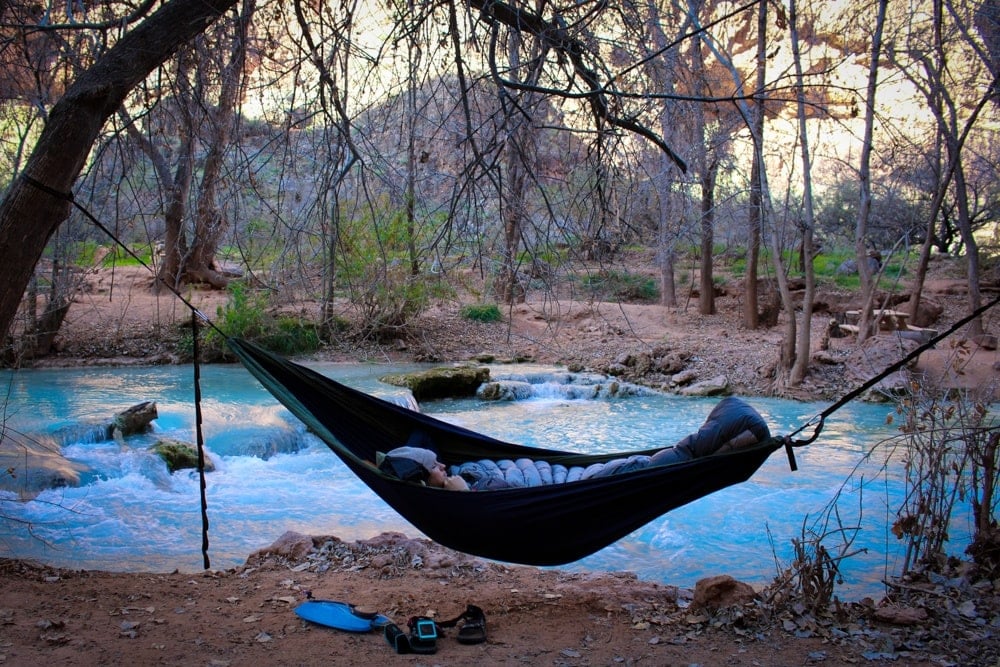
Hammock set up between two trees at Havasupai in Arizona next to blue water pool

You’ll have plenty of time to explore the other Havasupai waterfalls over the next couple of days, but if you’re eager to see what you’re in for, the view point looking down on Mooney Falls is just a few minutes hike from the campsites.

Top of Mooney Falls in Havasupai pouring into turquoise pool of water
The top of Mooney Falls

Havasu Falls Hiking Tips

Here are a few important tips that will help you have a more enjoyable hike to and from the Havasu Falls campground.

  • Water availability: There is no water available at the trailhead or anywhere on the trail, so make sure you pack enough to make it all 10 miles to the campground. Same goes for the way out. There are bathrooms at the trailhead.
  • Start early: The trail has no shade, and the earlier you arrive to the Havasu Falls campground, the more campsites you’ll have to choose from. On the way back out, I suggest starting before sunrise to avoid hiking up the steepest part in the mid-day heat. For reference, the hike out took my hiking buddies and I around 6.5 hours (40 minutes per mile). Alternatively, the trail is open 24 hours a day, so if you are there in summer, you can also hike out in the dark when it’s much cooler. Just make sure your headlamp is fully charged if you choose this route.
  • Pack horses: Horses/mules have right of way on the trail so please step off the trail when you see them. Be alert and if you hike with earbuds in, consider leaving one out so you can hear them approaching.
  • Waterfall appearance: The different waterfalls on the Havasupai Reservation may look different than the photos here. Flash floods can dramatically alter the landscapes from year to year. The color of the water can even change depending on the time of day and whether it’s sunny out.
  • Sun Protection: With the lack of shade, make sure you have adequate sun protection. I always backpack in a long-sleeved sun shirt and a wide-brimmed hat.
Group of hikers on a trail next to pack mules

What to Expect at the Havasu Falls Campground

The Havasu Falls campground is quite big and runs more than half a mile along the trail between Havasu and Mooney Falls below. There are spots on both sides of the creek, so I when I was there, I really poked around before settling on a spot.

Do not expect solitude at the campground. The Havasu Falls campground can accommodate 300 campers, so you will have neighbors and some of them may be close.

Tent at campsite next to turquoise Havasu Creek

Here is what you should expect:

  • Campsites: There are no assigned sites, and while there’s really no bad sites…but some are better than others. Start your hike as early as possible to have more options. I thought the best sites required crossing Havasu Creek. This side is quieter and has less food traffic. The crowds also seemed thinner closer to Mooney Falls, which is further from the drinking water spigot. Most of the campsites have picnic tables, but not all of them.
  • Bathrooms: There are four composting toilet facilities evenly spaced throughout the campground, and they were surprisingly clean during both of my visits. They also had toilet paper, but it’s not a bad idea to pack some just in case. There are NO showers.
  • Campfires: Campfires are not allowed.
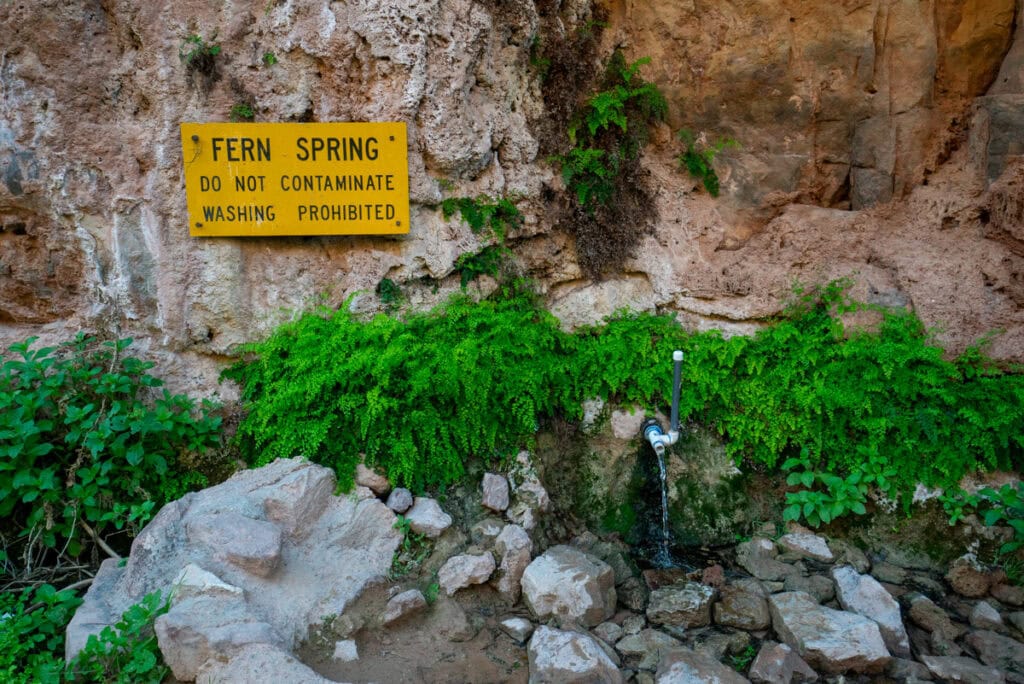
  • Drinking water: There is potable water available in the Havasupai campground. You will need to bring water containers to transport your water back to your campsite. If you don’t want to constantly walk back and forth to the spigot, I recommend bringing a water storage bag. Don’t do dishes or use soap here.
  • Wildlife: The marmots and squirrels will get into any food that’s left out. I’ve seen them chew right through people’s backpacks, and they will even chew through your tent to get to your food. As a result, bear canisters are now required for storing all of your food and scented items anytime you aren’t at your campsite.
  • Trash: There are no trash cans. Bring a trash bag and be prepared to pack out all of your trash.

Rules and How to be a Responsible Visitor

Havasu Falls is located on the western edge of the Grand Canyon and has been occupied by the Havasupai people for more than 800 years. This is their home, the land and waterfalls are sacred, and it’s important to remember what a privilege it is to be a visitor there.

With that in mind, please educate yourself on the current rules and follow them during your visit. Also, be kind and respectful to any Tribe members you encounter.

Here’s an overview of the Tribe’s rules and tips for being a responsible visitor on your Havasu Falls camping trip:

  • Follow Leave No Trace: Practice Leave No Trace in order to keep the campground and the falls clean for everyone to enjoy.
  • Noise: Be respectful of other campers and watch your noise at night. Loud banter or music travels fast in the canyon and is an easy way ruin your neighbor’s trip. Quiet hours are from 8pm to 5am. When I was there, people were soooo loud and inconsiderate of others. Don’t be like those people.
  • No alcohol or drugs are allowed on the Havasupai Reservation (even for Tribal Members). It’s not only disrespectful, but it’s also a Federal crime. So leave that whisky and weed at home.
  • No dogs or pets are allowed
  • No drones allowed. Also, the Tribe asks that you don’t take photos of the locals or while in the village. So you can leave your camera in your pack while you’re passing through.
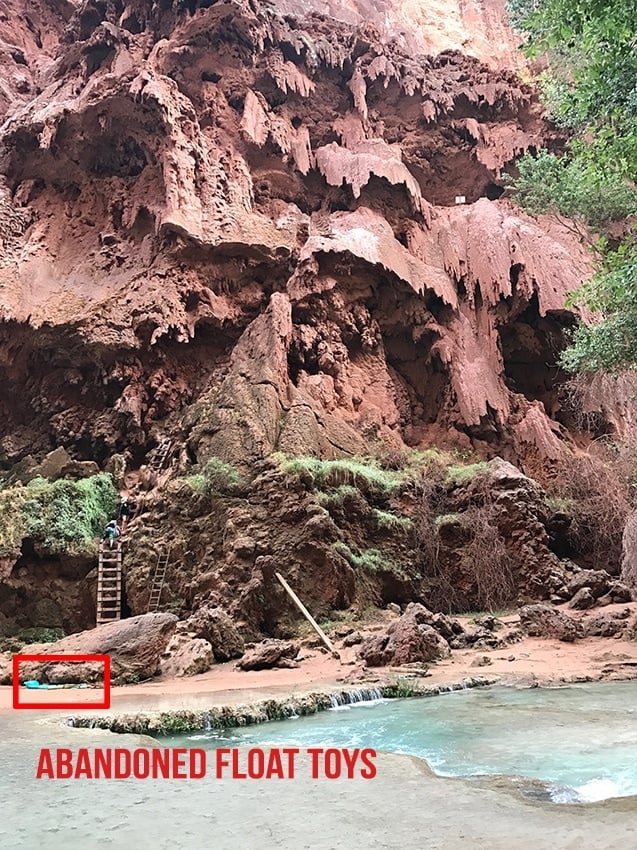
  • No pool floaties are allowed. During my two camping trips to Havasupai, I was horrified at the number of pool floaties left behind – there were at least 5 damaged float toys sitting at the base of Mooney Falls. Due to the number of abandoned floaties, the Tribe has now banned the use of floats, noodles, and other pool toys at any of the Havasupai Falls.
  • Don’t pee at your campsite: If you have to pee in the middle of the night, please make the trek to the toilets rather than peeing outside your tent. With all of the people who are camping here, if everyone did that, the campsites would be smelly and gross. If this is going to be an issue for you, bring a jug to pee in and dump it in the toilet in the morning.
  • Pack out everything: There are signs everywhere throughout Havasu Falls that ask you to pack out your trash. I was disgusted to see people leaving garbage bags of trash by the bathrooms and piled by the ranger station despite all this signage. There are also people leaving camping gear, nearly empty fuel canisters, and discarded water shoes at the ranger station. This behavior is not okay — please be respectful and pack out ALL of your trash and camping supplies. Anything left behind has to be flown out by helicopter.
  • No cliff jumping: I recently saw a video of people jumping off the top of the falls. This is CLEARLY against the Tribe’s rules, not to mention dangerous.
    Due to its remote location, this is not a place you want to get hurt, so do everyone a favor and don’t go cliff jumping. There are signs EVERYWHERE reminding people of this rule.
Abandoned pool floats at Havasu Falls in Arizona. Pool floats are not allowed in Havasupai
Due to the number of abandoned pool floaties, pool toys are no longer allowed at Havasupai.

Havasu Falls Permits

Advanced permits are required in order to camp at Havasu Falls. You must secure one online through the Havasupai Reservations website and pick up your permit in person at the Grand Canyon Caverns Inn near Seligman, which is 90 miles from the Trailhead.

The permit process is a bit confusing, so I wrote up an entire blog post with step-by-step instructions for getting a permit. Permits become available on February 1 for the entire year.

For more details, see my Havasu Falls Permit Guide.

Don’t think you’ll be able to sneak in – permits are highly regulated at Havasupai. There is a guard stationed on the road about 5 miles from the trailhead who checks permits for every person in your group. Additionally, each vehicle must have a copy of its reservation displayed in its window.

Kristen Bor sitting on the edge of Mooney Falls next to the camping at Havasu Falls
The edge of Mooney Falls

How to Get to the Havasu Falls Campground

There are two ways to get to the Havasu Falls Campground. A majority of people hike since helicopter rides are not guaranteed. I would suggest that you should plan a trip to the Havasu Falls campground unless you are willing and able to hike.

Hiking

The main way that most people get to the Havasu Falls campground is by hiking. It’s 10 miles each way. The hike in is long, but fairly easy as it’s all downhill. The hike back to the car is more challenging due to the 2,200 feet of elevation gain and the sun exposure.

Check out my Havasu Falls Hiking Guide for everything you need to know to prepare for the hike to the campground.

Hiker on a desert trail to Havasu Falls
The top of Havasu Falls pouring down into a turquoise pool
The top of Havasu Falls right before the entrance to the campground

Helicopter

If you’d rather not hike to or from Havasu Falls, there’s a first-come, first-serve helicopter that leaves from both the Hilltop Trailhead and the landing pad in Supai Village.

It’s operated by a private company called Airwest Helicopters. It flies from March 15 to October 15 on Thursdays, Fridays, Sundays, and Mondays, and the rest of the year it only flies Sundays and Fridays. Call  (623) 516-2790 for the latest info.

In the past, it cost $100/person (tack on a $10 fee if paying by credit card), and you are allowed to bring one bag on the helicopter up to 40lbs.

The thing is they don’t take reservations, and it’s not guaranteed you will be able to use it. Locals and Tribe Members get first priority, and the helicopter doesn’t fly in bad weather. This means that you shouldn’t rely on the helicopter, and you should always be prepared to get to the campground by foot if you don’t make it on the chopper.

While I’ve personally never taken the helicopter, when BFT contributor Courtney Stephenson visited, she took the helicopter out to save time and energy for the drive home. She started the hike from the campground to the village at 5:30am and was #9 in line for a ride out.

Flights begin around 10am so be prepared to arrive early and wait around. The helicopter takes 6 passengers at the time, and based on the number of locals, she ended up on the 3rd ride out of the day, arriving back to her car by 11am.

I imagine if you’re trying to fly out in peak summer heat, you need to arrive even earlier and be prepared to wait for hours. They will continue flying until everyone is accommodated or until it gets dark.

Courtney said that taking the helicopter was a unique experience (what other backpacking trip can you take a helicopter out of?!) with stunning views of the canyon.

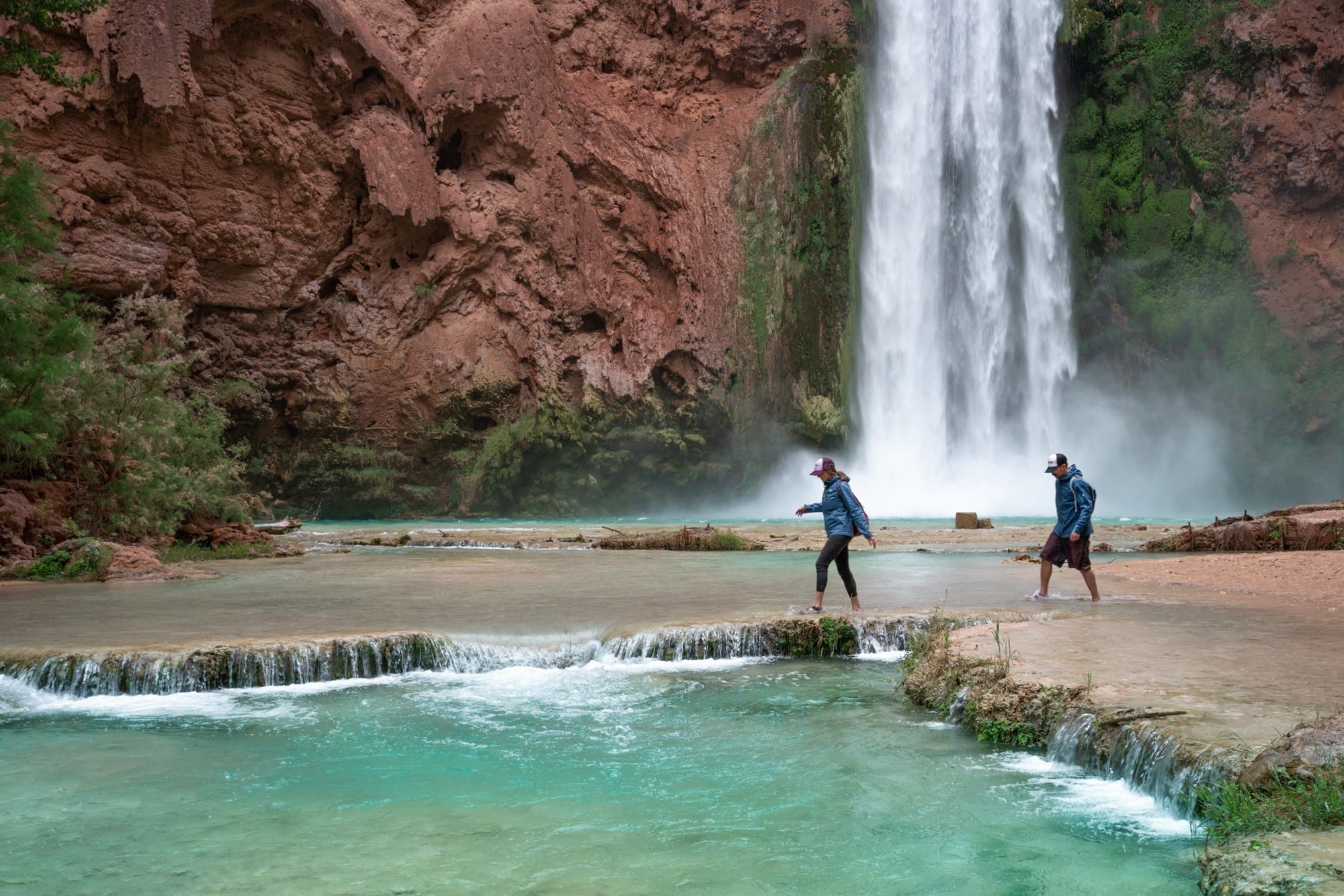
Two people walking in the turqoise water in front of Mooney Falls
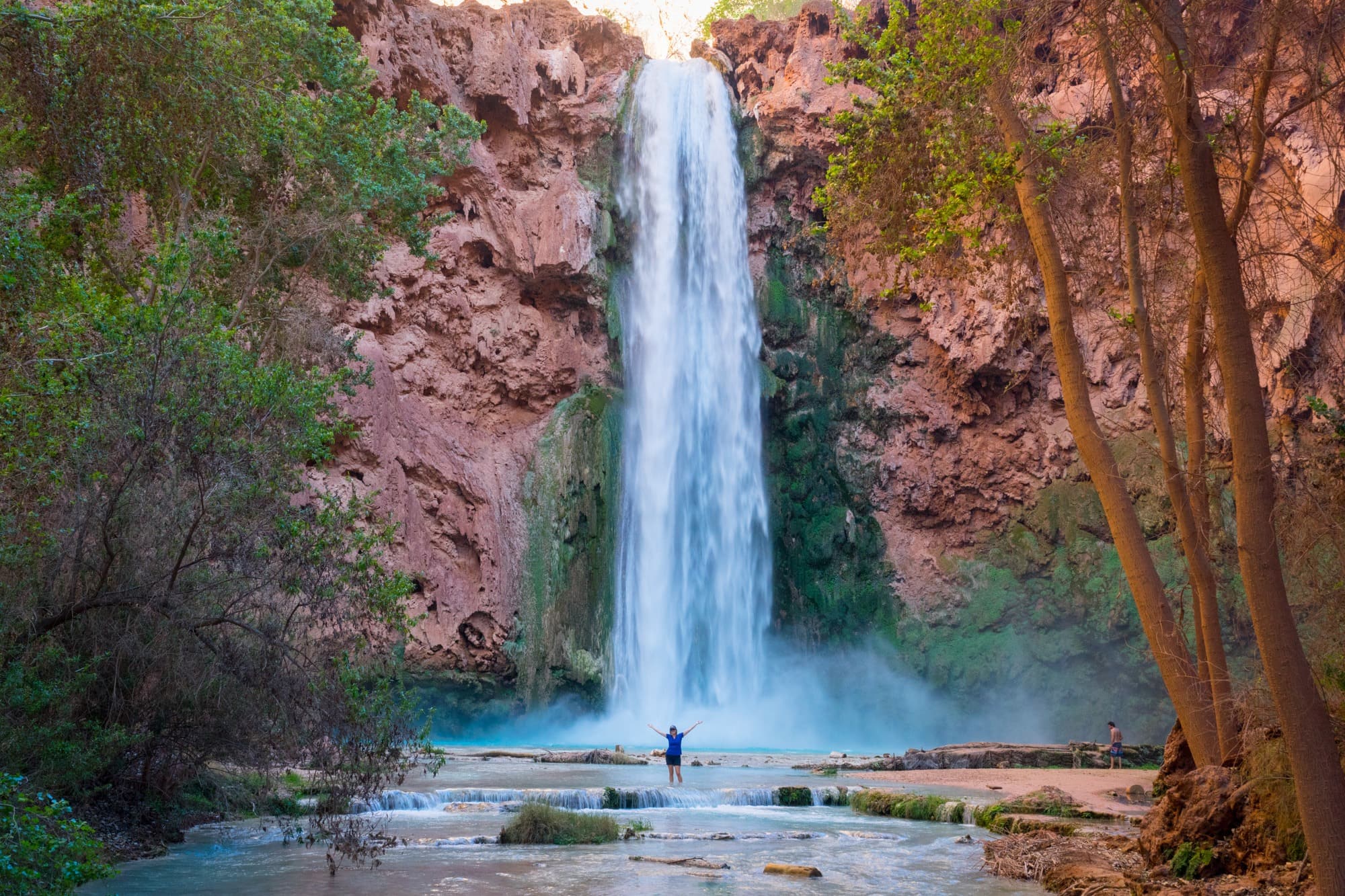
The base of Mooney Falls
The base of Beaver Falls. Told you it’s magical!

Plan for the whole day. Bring a day pack with water, lunch, a lightweight towel, sun protection, and a swimsuit. Also, wear a quality pair of water shoes. Don’t wear flip-flops!

What Camping Gear to Pack

For your 4-day / 3-night trip to Havasupai, you need to pack in AND OUT all of your gear and supplies. This includes food, supplies, trash, and camping gear.

For a complete list of what hiking and camping gear you need for Havasu Falls, check out my full Havasu Falls Packing Checklist.

You’ll want the basics (tent, sleeping bag, tent, sleeping pad, cooking gear, water filter, etc) plus gear for hiking and swimming at the falls, and a bear canister to protect your food.

Water is available at the campground. There is a small store in the village of Supai where you can get basic snacks and drinks, but don’t rely on supplies here.

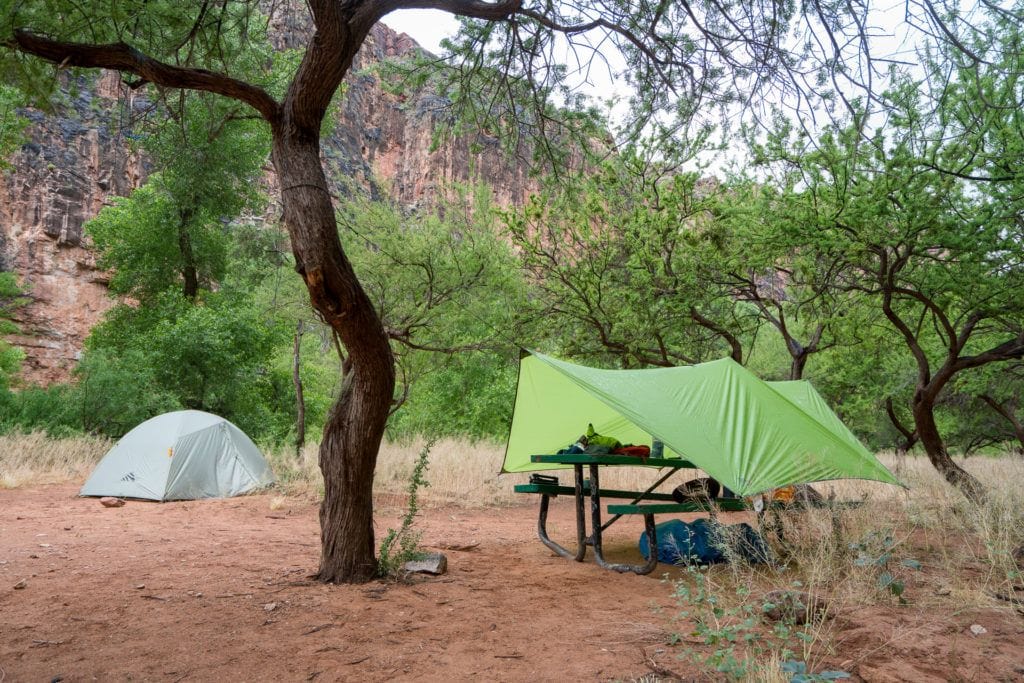
You’ll want to check the weather ahead of your trip, so you can plan accordingly. A tarp to hang over your picnic table isn’t a bad idea, and a hammock is a nice way to relax at your campsite.

Download my Free Havasu Falls Packing Checklist to your phone so you can make sure you don’t forget anything!

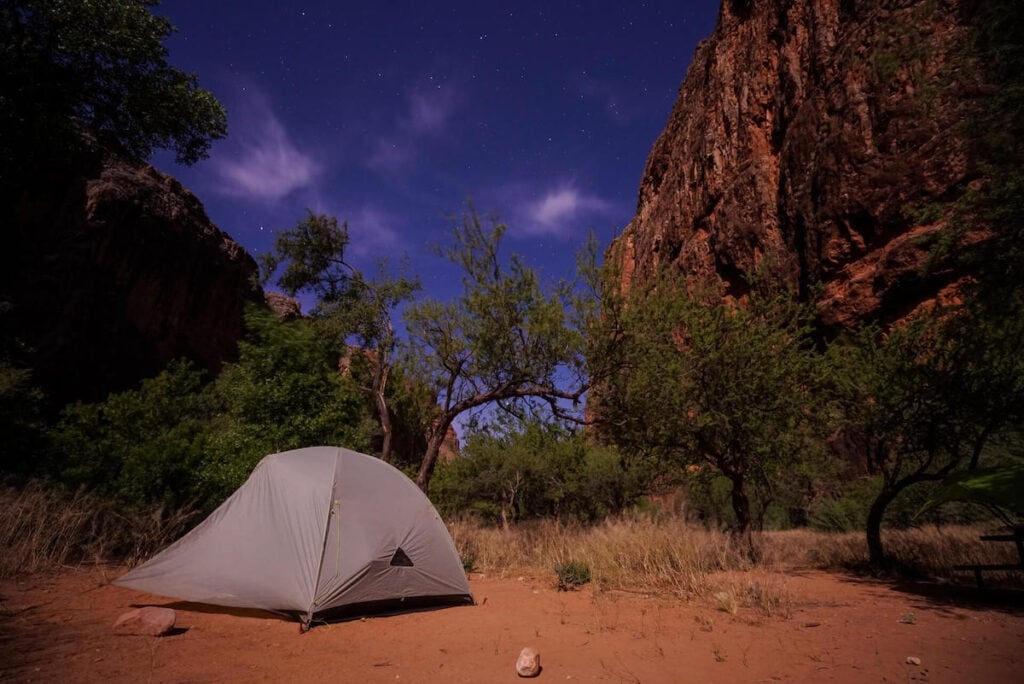
Tent set up at Havasupai Campground at night with twilight skies overhead
Our campsite during my second Havasu Falls camping trip

Best Time to Camp at Havasu Falls

The best time to camp at Havasu Falls depends on what you want to do there. Do you want to swim? Or do you want to avoid the crowds? Here are the pros and cons of visiting Havasu Falls in the different months:

February, March, and November

  • Pros: Less competitive to get a permit, fewer people, more comfortable (and safer) hiking temperatures
  • Cons: Variable weather and cold for swimming. The normal high in these months is 50s-60s and the average low gets down into the 30s. It also gets dark earlier.

April, May, and October

  • Pros: Typically great weather for hiking and comfortable for swimming. April, May, and October are also some of the least rainy months of the year. You can expect highs in the 80s and lows in the 50s.
  • Cons: Because these are prime weather months, it is more difficult to get a permit, and the campground will be busier.

June, July, August, and September

  • Pros: Temperatures start to really heat up in June, with the average high in July reaching 104 degrees. By September, the average high has dropped slightly to 96 degrees. Hot weather means you can sit and hang out in the water all day, and nights at the campground are comfortable. This also means you can pack lighter and leave the warm puffy jacket and other layers at home.
  • Cons: Hot temps mean hiking could be miserable and potentially even dangerous. In the heat of summer, people get up at 4am to begin the hike out and sun protection is essential. This is also monsoon season.

A note about monsoon season: Monsoon season in Arizona typically runs from mid-June through September. Havasu Canyon has historically seen flooding, including dangerous flash floods. Be prepared by checking the weather forecast, complying with rules and regulations, and paying attention to any alerts from the Rangers.

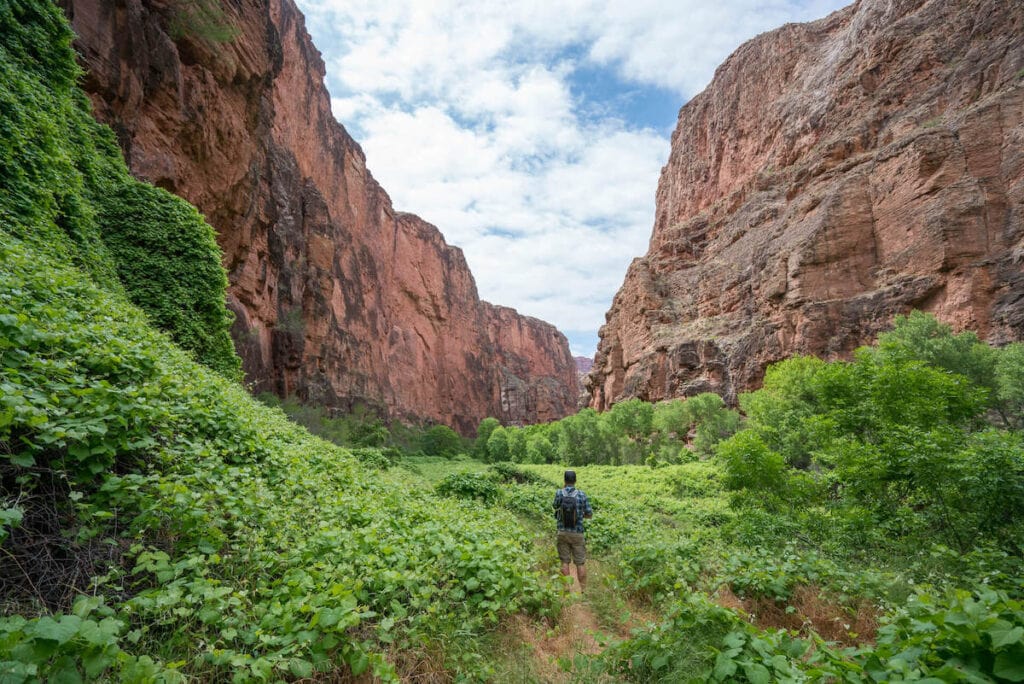
Man standing on trail in Havasu canyon surrounded by lush green vegetation and tall red rock cliffs
Hiking in spring to Beaver Falls was unbelievably lush and green

I hope this guide helps you plan an unforgettable camping trip to Havasupai! It’s one of the most special places I’ve ever camped, and I’m sure you will love it too!

Save this post to Pinterest

What questions do you have about planning a camping trip to Havasupai? Have you been? Leave a comment below!

The post Planning a Camping Trip to Havasu Falls? This Is the Only Guide You’ll Need appeared first on Bearfoot Theory.
2024 REI Winter Sale: These are the 15 Best Deals!

Every November, the REI has a huge winter sale that I think is one of their best sales of the year. This year’s sale is taking place November 15-25, and it’s a great time to stock up on winter gear, holiday gifts, or outdoor products that you want for next summer.

In this post, I’ve scoured the REI website and handpicked the best REI Winter Sale deals with discounts up to 40% off. Everything I recommend here I’ve personally tried.

If you’re an REI Member, you can also save 20% off one-full priced item and an extra 20% of one REI Outlet Item using the code WINTER24. If you’re not a REI Co-op Member already, here are 12 reasons why you should join!

Sponsored by REI Co-op

REI Co-op is my favorite outdoor gear retailer and a long-time supporter of my work here at Bearfoot Theory. Their 1-year return policy for Members is hands-down the best in the industry, and Members also get 10% back on their purchases every year.

1) 30% off All REI Clothing and Accessories

All REI Co-op Brand Clothing is 30% off. I’ve worn a lot of different REI apparel over the years, and here are a few of my favorite pieces that are worth checking out during the sale:

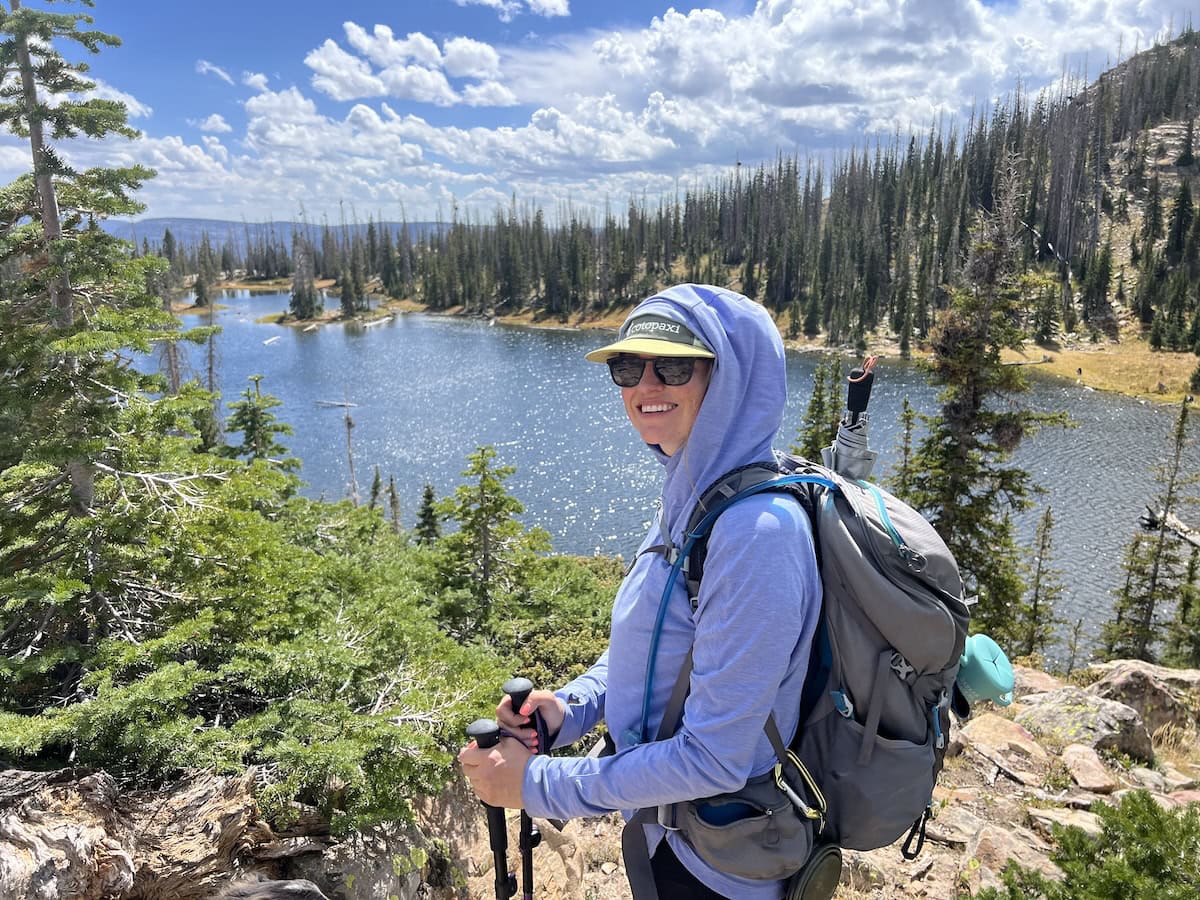
Kristen Bor hiking in the Uintas. She's wearing a sun hoody and there is a mountain lake in the background
Wearing my REI Sahara Shade Hoody

2) 30% off All REI Camping and Hiking Gear

If you’re looking to get a new tent or other big ticket item, all REI Co-op Brand Hiking and Camping Gear is 30% off. Here is some of my favorite REI gear to check out:

  • REI Co-op Siesta Hooded 20 Double Sleeping Bag: If you want to snuggle up with your sweetie, this 2-person 20-degree sleeping bag is cozy with a full zip on both sides so you can moderate your temperature.
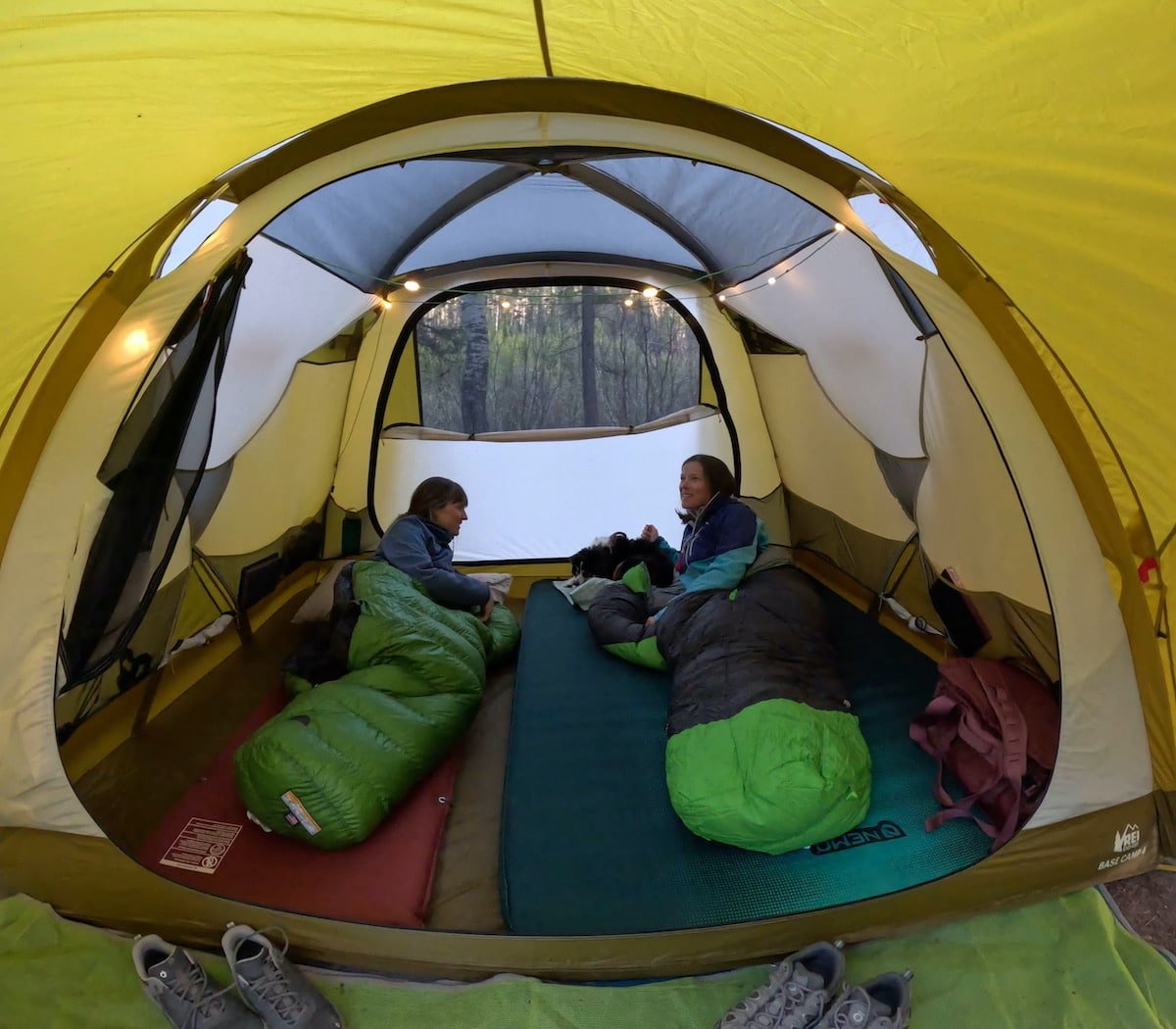
  • REI Base Camp 4 Tent: This is my go-to car camping tent. It’s spacious with a HUGE vestibule, tons of pockets, and plenty of windows for ventilation. I’ve used it in wind and rain, it is durable and great at keeping rain out. See my REI Base Camp 4 Review for more details.
  • REI Magma 15 Sleeping Bag: This lightweight, unisex sleeping bag is designed for backpacking. It’s very warm and comes in a lot of different sizes so you can get the perfect fit. See a full Magma 15 Sleeping Bag review here.
  • REI Co-op Multilite Towels: These quick-drying towels are so versatile. I have at least 4 of them in my rig that I use for drying dishes, wiping down the dogs, showers, and more.
Two women inside sleeping bags inside the REI Base Camp 4 Tent

3. $100 Off Garmin inReach Mini 2

If you’ve been following me for a while, you’ve heard me talk about the Garmin Mini 2. I think it’s a MUST for anyone who likes to get out in the backcountry where there isn’t cell service. It can be used to send and receive texts or to call for help if you have an emergency. I’ve even used it to get roadside assistance when my Sprinter Van battery died outside of Sun Valley one winter.

Hand holding Garmin inReach Mini GPS communication device with red rock canyon walls in background

4. 25% off all Oboz Footwear

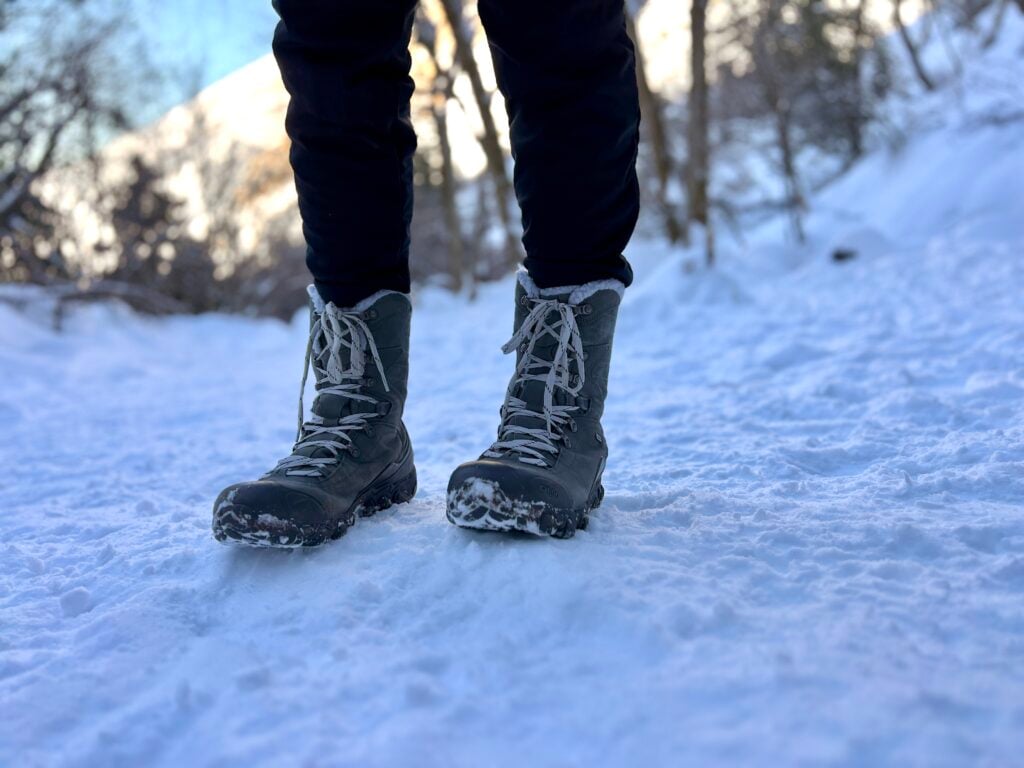
I’m a huge fan of Oboz Footwear, so I’m excited to see that every Oboz model is 25% off during the REI Winter Sale (both men’s and women’s). I’m especially fond of the Katabatic for fast and light summer hiking and the Insulated Bridger for winter. If you need help deciding which Oboz model is right for you, check out this post on the Oboz models I use most frequently.

Oboz Bridger Insulated womens hiking boots on a snowy trail
Hiking in the Oboz Bridger Insulated winter boots

5. 25% off All Outdoor Research Outerwear

I have two Outdoor Research jackets that I’m especially fond of and all Outdoor Research outerwear is 25% off (with the exception of ski jackets) in the REI Winter Sale. Check out these two:

Kristen Bor on a winter hike
Wearing the Outdoor Research Helium Down Hoody

6) 25% off all Icebreaker Clothing

I’m a huge fan of Icebreaker. They make my all-time favorite merino wool base layers for winter hiking and skiing, and I also have a few their sweaters that are so soft and comfortable. However, Icebreaker clothing tends to be pricey, so I always jump at the chance to grab a new piece when they are on sale. During the REI Winter Sale, all Icebreaker clothing is 25% off. If you’re new to Icebreaker, I recommend starting with the Oasis 200 crew top (women’s)(men’s) and the Oasis 200 Thermal leggings (women’s)(men’s).

Kristen Bor wearing the Oasis Icebreaker 200 baselayer in her Sprinter Van at the top of Galena Summit in Idaho
Here I’m wearing the Icebreaker Oasis 200 Baselayer, my go-to for snowy winter adventures

7) 25% off all Rumpl Blankets

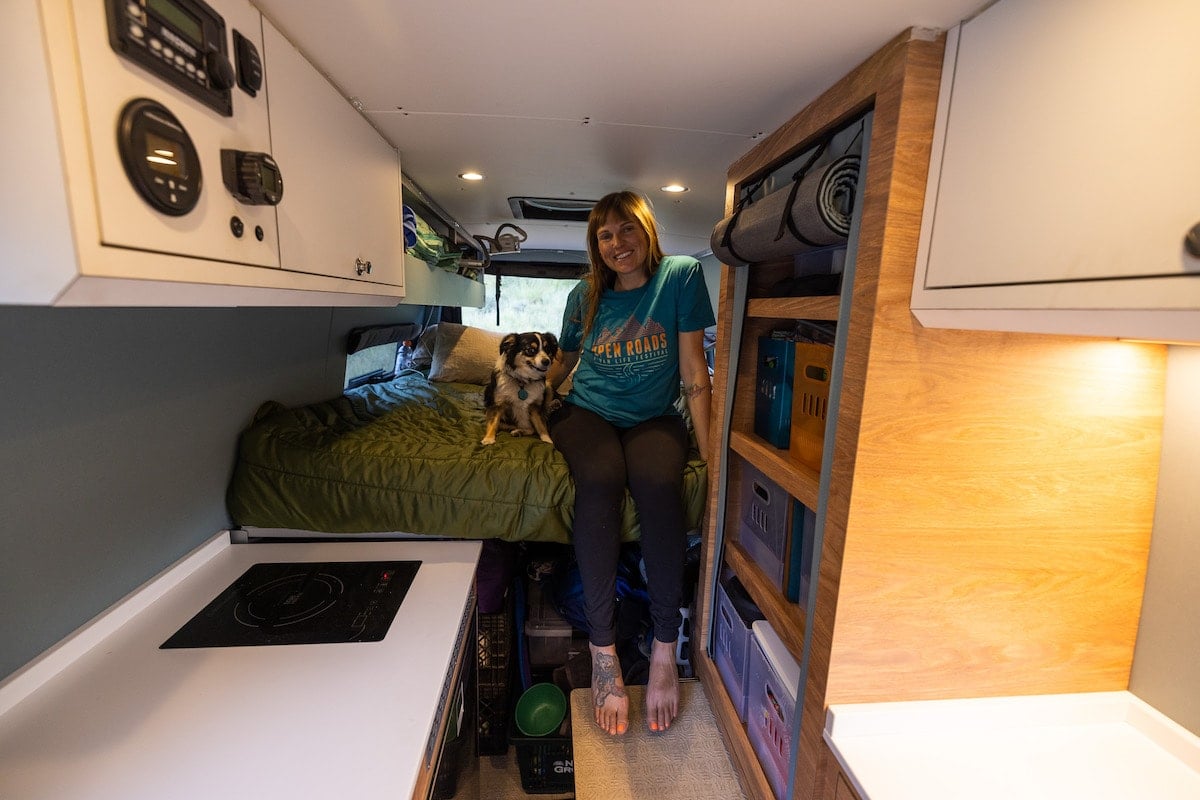
Rumpl makes awesome camping blankets. I’ve been using the 2-person, original puffy as my comforter in my Sprinter Van for years. They are very durable (standing up to my 2 dogs), shake off easily, and can be thrown in the washing machine when they need a refresh. Rumpl blankets come in different sizes and prints, all of which are 25% off.

Kristen Bor sitting on bed in sprinter van with dog

8) 25% off NEMO Tensor Ultralight Insulated Sleeping Pad

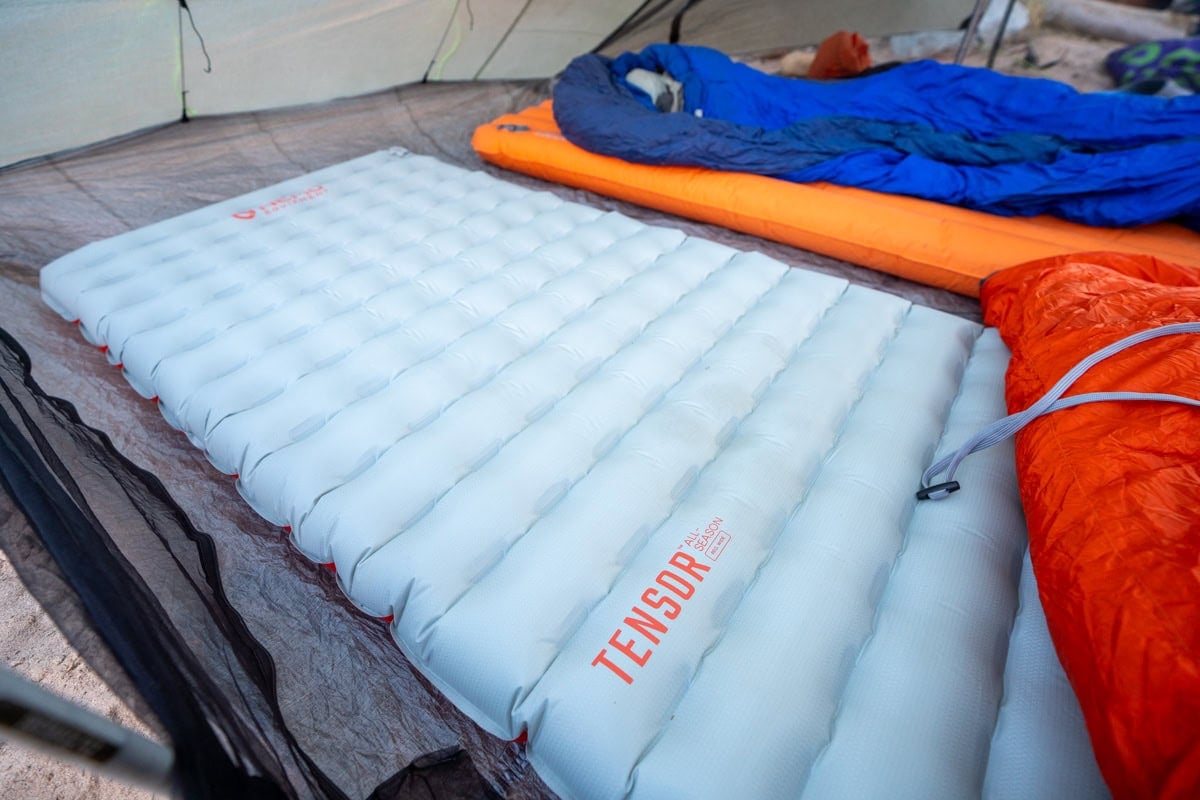
If you’ve struggled to find a comfortable sleeping pad for backpacking, I encourage you to try the NEMO Tensor Ultralight Insulated Sleeping Pad, which is currently 25% off. It’s 3.5 inches thick, and it has a valve that allows you to adjust the amount of air inside so you get just the right firmness. With an R-value of 5.4, you can rely on this even in the colder months. And to top it off, it’s incredibly easy to blow up thanks to the inflation sack that it comes with.

sleeping bags in tent

9) 20% off Kahtoola Traction Systems

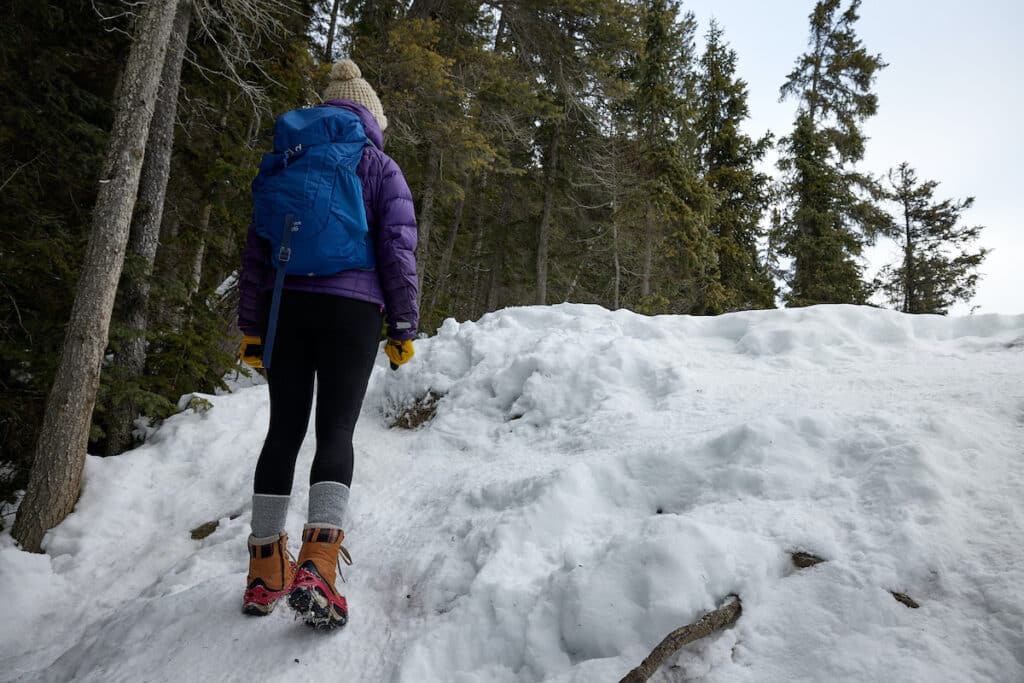
If you get nervous walking on ice in the winter, you have to get a pair of Kahtoola Microspikes which are 20% off during the REI Winter Sale. When I feel ice on the trail, I just slip these on over my boots, and I instantly feel so much safer and more confident. When you’re buying them, double check the sizing since you’ll want to get a bigger size if you are using them over bulkier winter boots.

Women walking up a snowy icy hill on the Wapta Falls hike in Yoho National Park
Using my Kahtoola microspikes to get better grip on an icy trail in Canada.

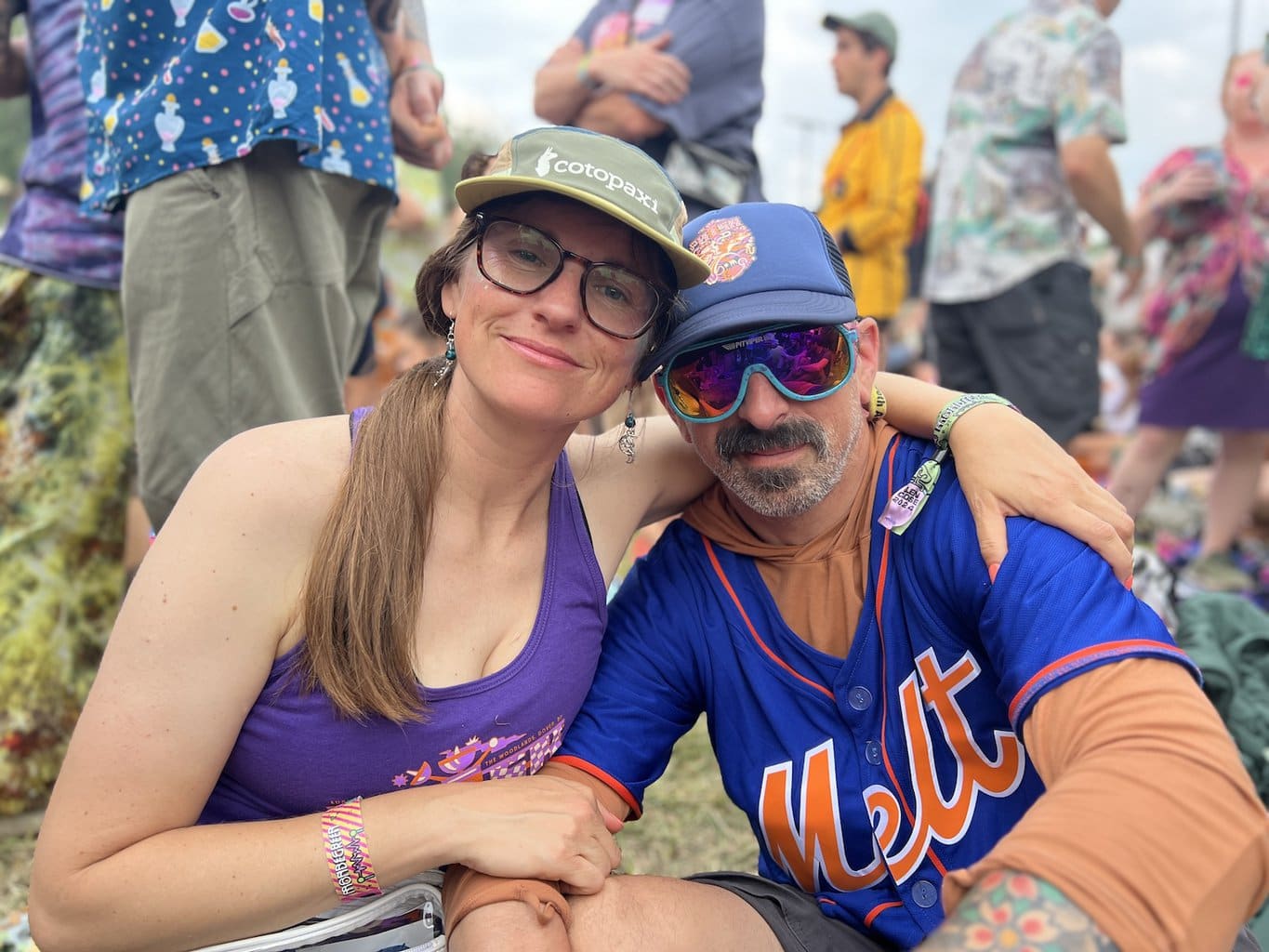
10) 25% off all Cotopaxi Clothing and Accessories

I’ve got a few Cotopaxi pieces that I really love, and all Cotopaxi apparel is 25% during the sale. I want to give a special shoutout to the Cotopaxi Tech 5-Panel Hat. I got this hat last summer, and it’s become a staple. It’s so light, I hardly notice I’m wearing it, and the brim doesn’t block my vision when I’m hiking. It’s also very breathable, even in the muggiest climates.

couple at music festival

11) 25% off all Biolite Lighting

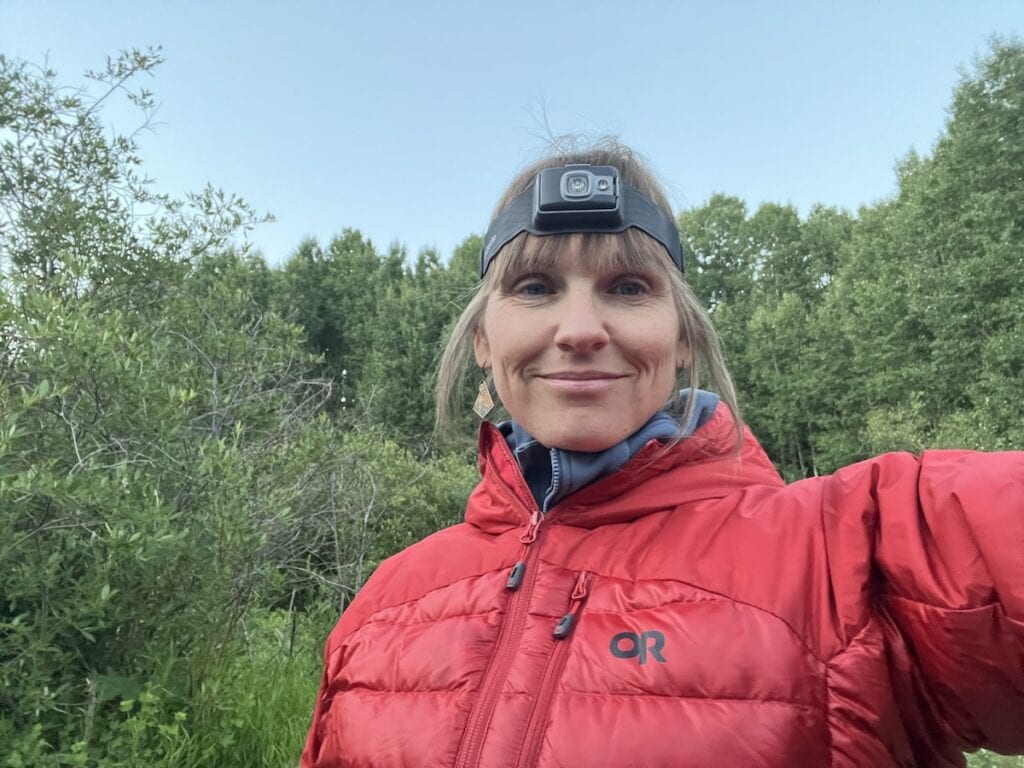
If you’re looking for a way to add some ambiance to your campsite, all Biolite lighting is 25% off. They make some compact, portable lanterns, and I really love the Biolite 325 Headlamp. I’m actually not sure why this headlamp doesn’t get better reviews, because I’ve been using it for years without any issues. I love how easy the strap is to adjust, it’s very light, and the charge easily lasts a 4-night backpacking trip as long as you aren’t using it on the highest setting.

Kristen Bor at a campsite wearing a headlamp
Wearing the Biolite 325 Headlamp

12) 20% off Strider Balance Bikes

If you’ve got a little tyke like me, my son Herbie who is almost 2, loves cruising around on his Strider Balance Bike, which is 20% off. Not only is it fun, but he’s learning how to balance, so when it’s time to graduate to a real bike, the transition will be much easier. The seat and handlebars are fully adjustable, so the bike can grow with your little one.

13) 25% off all Sea to Summit Cook Gear

Sea to Summit makes great collapsible cooking gear that can save space in your pack or camping bins. It’s all 25% right now too! I have some of their silicone collapsible pots that are great for backpacking, and I’ve been eyeing their dinnerware for my new truck camper.

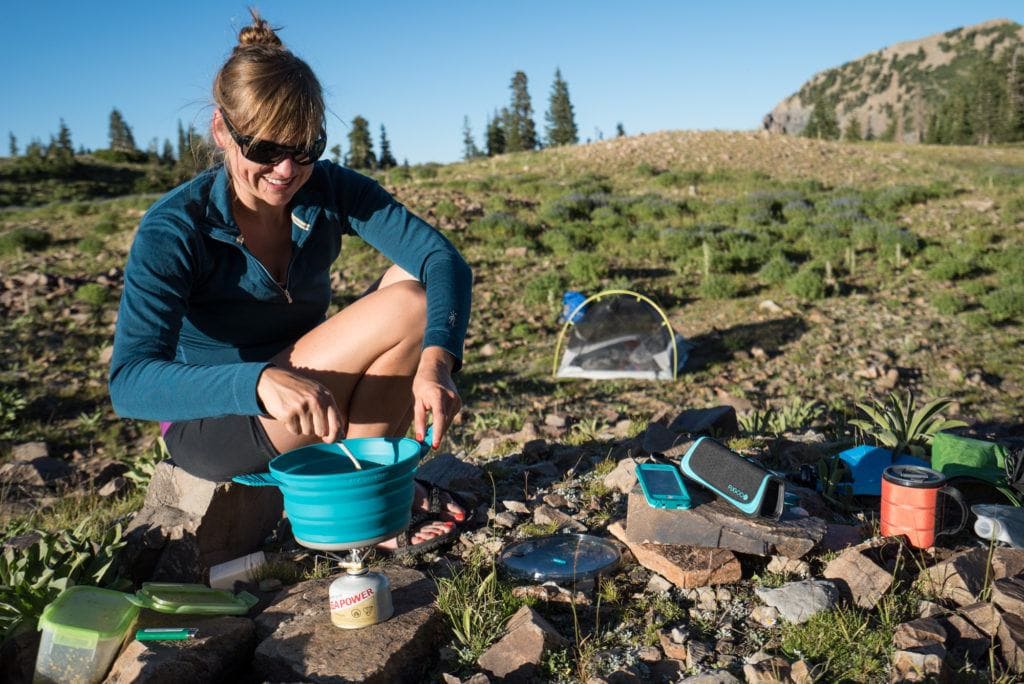
Want to cook in the backcountry? Learn the pros and cons of canister, liquid fuel, and alternative fuel backpacking stoves, plus get tips and our recommendations for choosing the best backpacking stove for your adventures.

14) 25% off all MSR Stoves and Cookware

In the above photo, I’m cooking on the MSR Pocket Rocket 2, which at 2.6 ounces is one of the lightest backpacking stoves out there. This stove and all other MSR stoves and cooking gear is 25% off.

15) 30% off all REI Brand Travel Gear

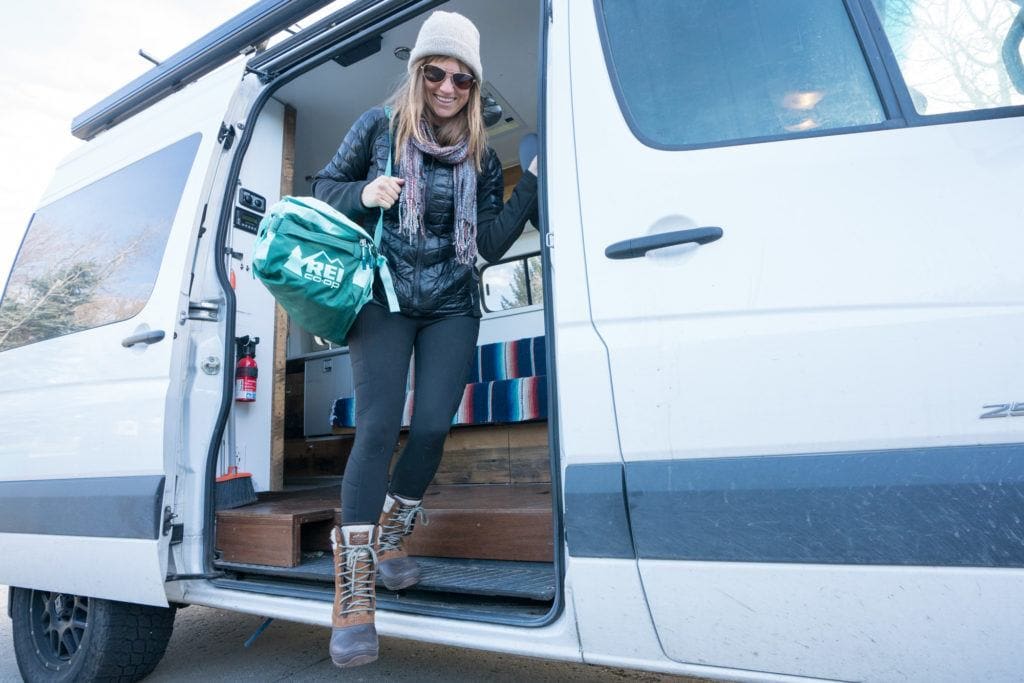
All REI travel gear is 30% off. I have two pieces of REI luggage that I use on a majority of my trips. The first is the REI Co-op Big Haul 28L Duffel which is my choice for short weekend trips. I also use it daily in the winter to keep all of my ski accesories organized in my car.

I also have the REI Co-op Big Haul 30″ Wheeled Duffel which is one of the toughest roller bags I’ve owned. It’s got a rugged, water-resistant exterior and really durable wheels that can withstand bumpy roads and being dragged over curbs.

Kristen Bor on the edge of a Sprinter Van holding an REI Big Haul Duffel
I got the REI Big Haul Duffel back in 2017, and I’m still using it today

What’s on your wishlist for the REI Winter Sale? Leave a note in the comments below!

The post 2024 REI Winter Sale: These are the 15 Best Deals! appeared first on Bearfoot Theory.
My Favorite Oboz Hiking Boots – Reviewed

I’ve been wearing Oboz hiking boots for the last 8 years, and I’ve tried almost every shoe in their lineup. Whether I’m tackling a rugged backcountry trail, on a quick hike with my dogs, or looking for a stylish option to transition seamlessly from trail to town, there is a pair of Oboz that fits the bill.

If you’re trying to figure out which pair of Oboz hiking shoes is for you, in this post, I’ll share my favorite Oboz picks, from the sturdy Bridger Bdry for serious backpacking to the versatile Katabatic for everyday wear and everything in between.

Many of these come in waterproof and non-waterproof versions. If you need help deciding on that, check out my post on waterproof vs. non-waterproof hiking boots.

1. Oboz Bridger Mid Waterproof Hiking Boots

Key Features

  • Height: Over-the-ankle
  • Waterproof: Yes
  • Weight: 2 lbs 0.4 oz (pair)

Where to shop

Pros and Cons

  • Pros: Supportive insole, excellent traction, waterproof membrane, ankle support, heel pocket that hugs, quick break-in period, comes in normal and wide options
  • Cons: Runs slightly small, heavy and bulky for casual hiking
  • Great for: Rocky trails, backpacking trips, hearty day hikes, wet climates

My Review

I’ve struggled with foot pain in the past when it comes to hiking boots, but Oboz women’s hiking boots have been a game-changer for me. They provide the support and comfort I need to enjoy long days on the trail without any discomfort.

For trips that require something super sturdy, especially when I’m backpacking, I rely on the Oboz Bridger Mid Waterproof Hiking Boots. These boots have been my go-to on countless big adventures, including a challenging 10-day backpacking trip in Alaska. The rugged terrain and constant rain were no match for these boots—they kept my feet completely dry, warm, and blister-free, even through bushwhacking and tough conditions.

I also wore them on a 5-day backpacking trip through Sequoia National Park, where I tackled the steep, rocky trail with a 40-pound pack. The Bridger Mids offer a solid, durable sole, a supportive insole, and fantastic ankle support, which helped immensely with balancing a heavy load. While moderately stiff, they still provide comfort over long distances, and there is no break in period required.

My feet are relatively flat and narrow, and these boots fit me perfectly. They sit about an inch above my ankle bone, and I love how the heel cup keeps my foot in place, eliminating any heel movement on ascents and descents.

If you have wider feet, the Bridger Mid also comes in a wide version. I recommend sizing up a half size to give your toes more room in the toe box, which adds extra comfort on long hikes.

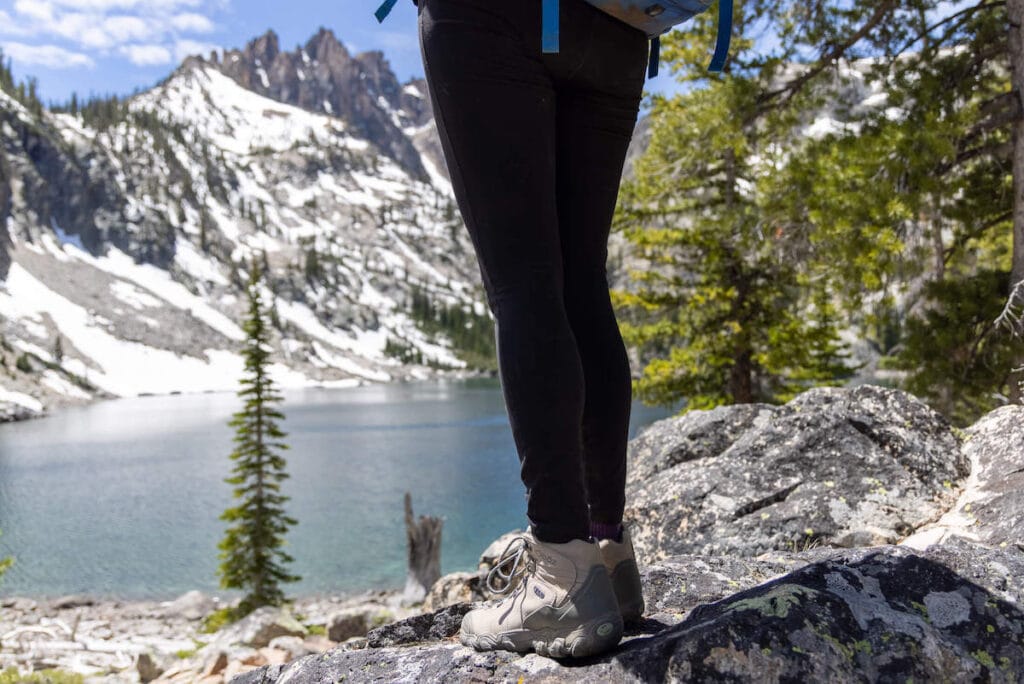
Photo of women's legs and high-ankle Oboz Bridger B-Dry Hiking Boot standing on rock overlooking alpine lake with snow-covered peaks in the background
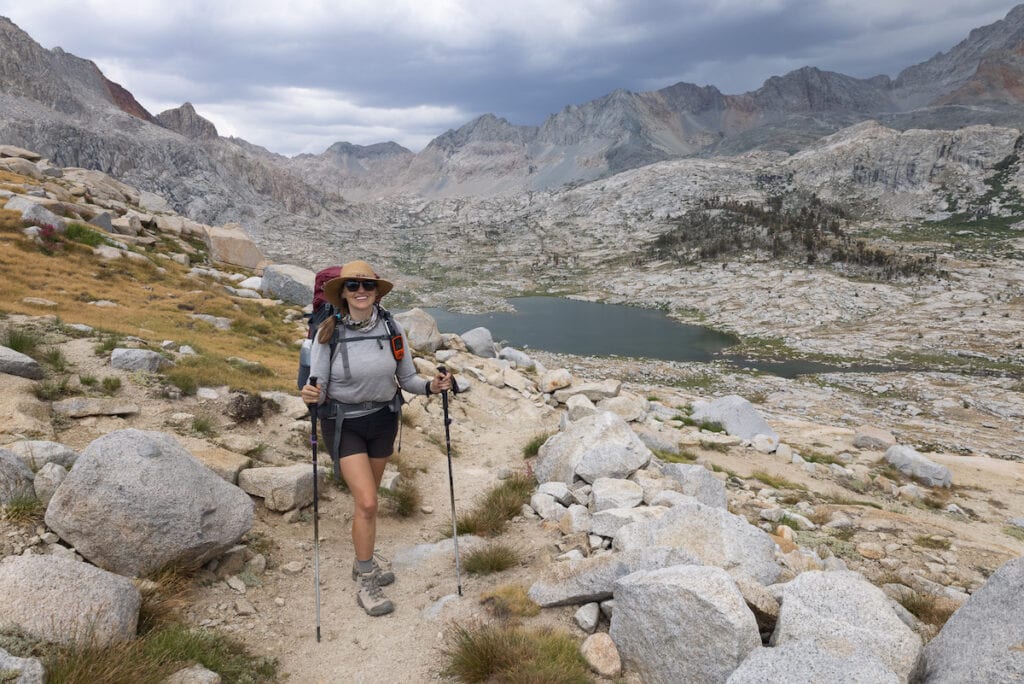
Kristen hiking on trail wearing backpacking pack and holding hiking poles in remote area of California's Sierra Nevada mountains
Tip: Clean your hiking boots!

In order to maintain the waterproofness of any hiking boot, it’s important to clean them periodically. Learn how to properly clean your hiking footwear here.

2. Oboz Sawtooth X Low Hiking Shoes

Key Features

  • Height: Ankle (also comes in mid-ankle)
  • Waterproof: Waterproof and Non-waterproof available
  • Weight: 1 lb 12.2 oz (pair)

Where to shop

Pros and Cons

  • Pros: Lightweight yet sturdy, low profile, comes in regular and wide options.
  • Cons: Heel slippage for narrow ankles
  • Great for: All-day hiking, easy backpacking trips, wet climates

My Review

The Oboz Sawtooth II was my go-to low-top hiking shoe for years, and I was excited to see the updated Sawtooth X model, released in 2022, which comes with even better traction and durability—especially useful for those wet, rainy days on the trail.

For bigger day hikes with steep, uneven terrain, the Sawtooth X Low is a great choice. These shoes are built tough, offering a sturdy, waterproof design with a super grippy sole that ensures great traction, whether on rock, mud, or loose dirt. They also feature an asymmetric collar around the ankle, designed to work with natural ankle bone variations, which I’ve found helpful for preventing chafing and rubbing on long hikes.

I’ve put these shoes to the test on steep Colorado 14ers, on my Trans-Catalina Trail backpacking trip, and clocked countless miles on easier day hikes. They’re even comfortable enough to wear around camp on cooler nights, making them a versatile option in any hiking wardrobe.

However, I do experience a bit of heel slippage with these, so if you have narrow heels or ankles, the Firebrand II may be a better fit (which I’ll discuss in more detail next).

Additionally, the Sawtooth X is available in a mid-ankle version if you prefer more ankle support, with both waterproof and non-waterproof options. I have the waterproof model, ideal for the mountain hikes I tend to do.

For an in-depth breakdown, check out my full Oboz Sawtooth X review.

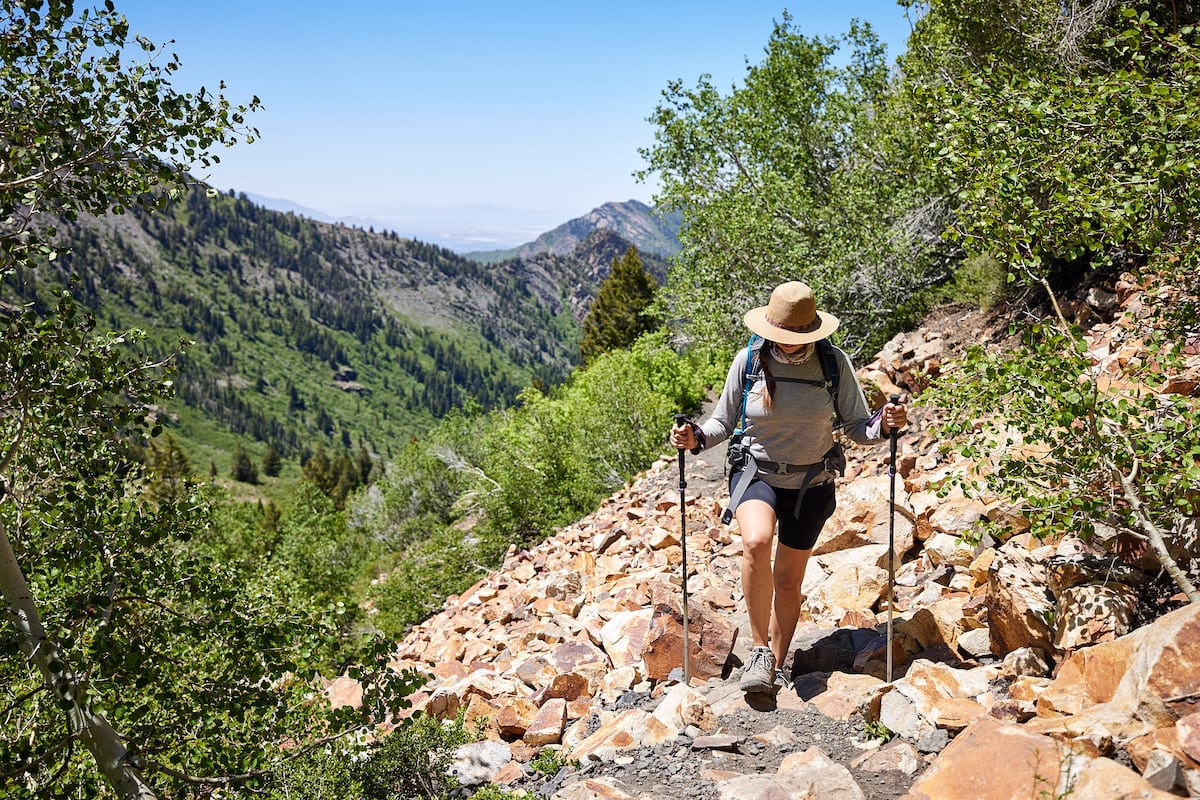
Kristen Bor hiking up a rocky trail in Salt Lake City

3. Oboz Firebrand II

Key Features

  • Height: Ankle
  • Waterproof: Yes
  • Weight: 1 lb 11.6 oz (pair)

Where to shop

Pros and Cons

  • Pros: Great for narrower feet, durable toe cover, waterproof, very supportive
  • Cons: stiffer
  • Great for: All-day hiking, tougher trails, easier backpacking trips, wet climates

My Review

If you have narrow heels like me, you might find that the Oboz Sawtooth X allows for a bit of heel movement. That’s why I actually prefer the Oboz Firebrand II, which has the same supportive midsole and grippy outsole as the Sawtooth X.

This means you get identical cushion, stability, and traction, but with a couple of key upgrades for narrower feet. The Firebrand II has a slightly lower overall volume, which helps hug a narrower foot securely, and it features a larger heel drop, offering a bit more lift.

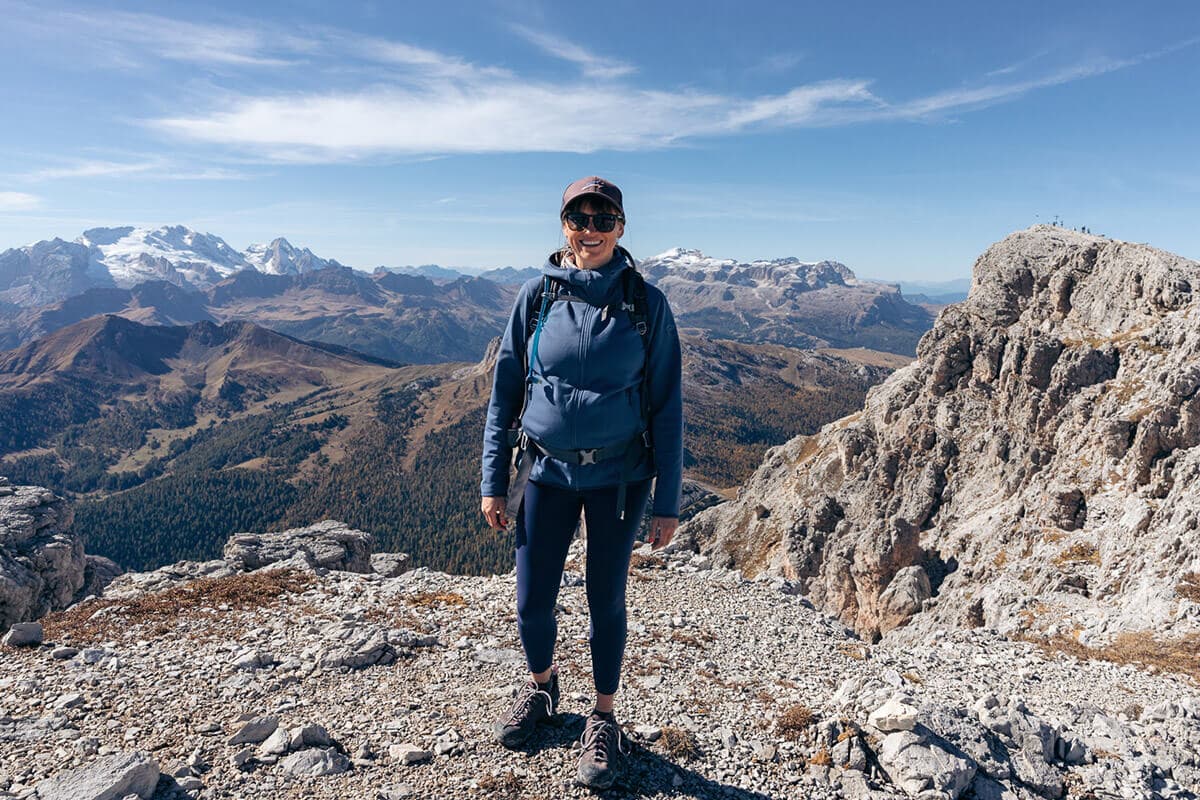
I wore the Firebrand II while pregnant, tackling rocky and steep trails in the Italian Dolomites. Even on challenging terrain, the locked-in feel around my heel gave me confidence, and the slightly stiffer construction provided solid support on uneven surfaces.

Oboz includes their BDry waterproofing on the Firebrand II, so you don’t have to worry about water sneaking into your shoes.

Kristen Bor hiking in Cortina d Ampezzo in the Italian Dolomnites

4. Oboz Katabatic Low Hiking Shoes

Key Features

  • Height: Ankle
  • Waterproof: Waterproof and Non-waterproof available
  • Weight: 1 lb 4 oz (pair)

Where to shop

Pros and Cons

  • Pros: Lightweight and versatile, flexible, roomy toe box, comes in a waterproof and non-waterproof version, fast on a variety of terrain
  • Cons: Less support and cushion than more sturdy hiking boots
  • Great for: everyday wear, light day hikes, camping trips, van life, neighborhood walks, travel where you only want to pack 1 pair of closed-toe shoes

My Review

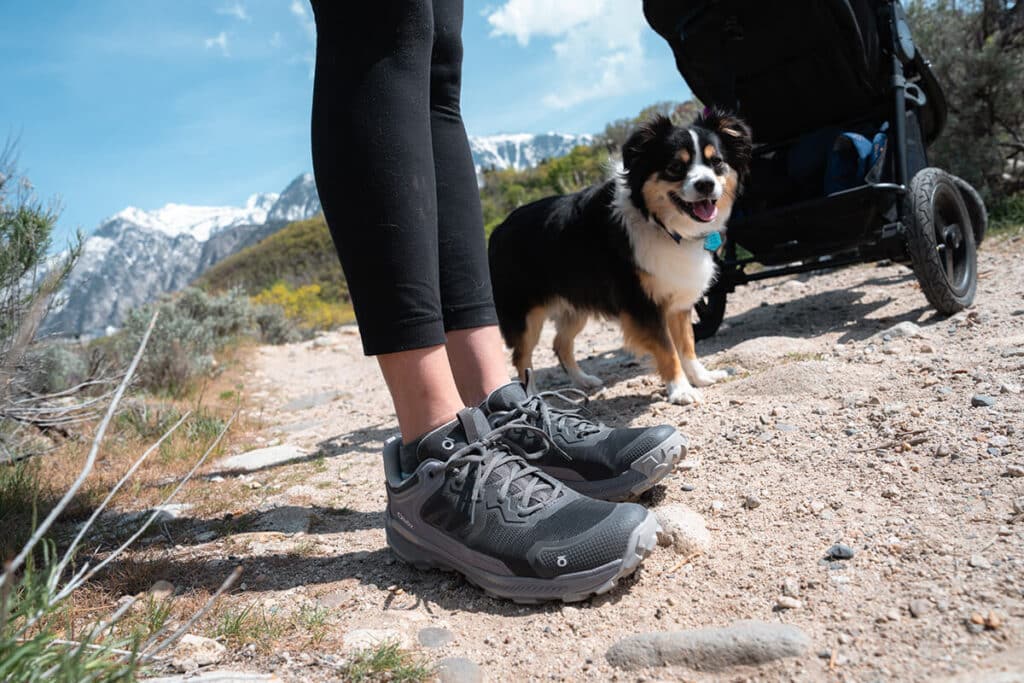
The Oboz Katabatic Low Hiking Shoes have quickly become my top choice for lightweight, everyday adventures—whether I’m heading out for a day hike, setting up camp, taking a stroll around the neighborhood, or just running errands. They’re comfortable from day one and have such a low-profile design that they transition effortlessly from the trail to casual outings.

When I’m living and traveling in my van, I need to be intentional about the gear I bring along, especially footwear. I rely on versatile, comfortable shoes that can handle everything from rugged trails to campsite hangs and trips into town. The Oboz Katabatic Low ticks all those boxes, and they’ve been my everyday go-to on the road for the past two summers.

The Katabatic is one of the lightest shoes Oboz makes, and it’s a lot more flexible than their other hiking boots.

On the trail, the Katabatic’s durable sole provides solid traction on rocky terrain, keeping me stable on uneven ground. While it doesn’t have quite as much cushioning as the Sawtooth X, it still provides enough support to prevent foot fatigue on longer hikes. The fit is also ideal for me—my heel stays snug and secure, while the toe box is wide enough to allow my toes to spread naturally without feeling cramped.

I opted for the non-waterproof version, which has been great for warm, dry hikes in the desert. For those hiking in wetter climates, the Katabatic is also available in a waterproof model.

If you’re looking for a comfortable, adaptable shoe for outdoor and everyday use, the Katabatic Low is a solid choice. For a deeper dive, check out my full review of the Oboz Katabatic.

Closeup of the Oboz Katabatic light and fast hiking shoes on a dirt trail with a dog and mountains in the background

5. Oboz Bridger Insulated 9″

Key Features

  • Height: 9″ (women’s) / 10″ (men’s)
  • Waterproof: Waterproof
  • Weight: 3 lbs 0.3 oz (pair)

Where to shop

Pros and Cons

  • Pros: Incredibly warm, tall cuff prevents snow from getting inside boot, effective waterproofing, thermal insoles provide additional insulation, durable lugs designed for ice
  • Cons: the cuff is stiff, they run large, a bit heavy
  • Great for: snowshoeing, winter hikes, wearing after skiing

My Review

The Oboz Bridger Insulated boots have been my go-to for winter hiking and snowshoeing, and they’ve truly proven their worth in cold, snowy conditions. My feet get very cold (my toes even go numb sometimes), and right off the bat, I was impressed with how warm they kept my feet, thanks to the 400g 3M Thinsulate insulation.

For comfort, the O FIT Thermal insole is a great addition. It’s lined with wool and Mylar, adding another layer of insulation so my feet don’t feel cold from the bottom.

With the B-DRY waterproof membrane, my feet have stayed dry through slushy trails and snowbanks. Plus, the 9″ cuff on the women’s (10″ on men’s) is tall enough that I’m able to trudge through some powder without the snow entering the top of the boot.

Traction is another area where the Bridger Insulated excels. The outsole has deep lugs and a winter-ready rubber compound that grips well on snow and mixed terrain. I feel steady on my feet even on icy patches, although on pure ice, they can slip a bit, so I recommend pairing with microspikes if the trail is really slick.

They’re heavier than some other winter boots, though, which I definitely notice on longer hikes. At over 3 pounds a pair, the weight can start to feel like a workout, but for the warmth and protection they provide, it’s a trade-off I’m okay with.

If you want something lighter, these do come in a 7″ version (women’s) or 8″ version (men’s), but these only have 200 g of insulation compared to 400 g in the taller version.

Oboz Bridger Insulated womens hiking boots on a snowy trail
Save this post to Pinterest

Have you tried Oboz Footwear? What are your favorite of their hiking shoes?

The post My Favorite Oboz Hiking Boots – Reviewed appeared first on Bearfoot Theory.
How Live in a Van as a Couple: Tips for Maintaining Harmony

When my partner Ryan and I first moved into a van together, we quickly learned that living in a tiny space together — just the two of us and our stuff (plus a dog)— brought new challenges to our relationship. Privacy became a rare luxury, and at times the van, though cozy, felt very cramped.

Navigating van life with a significant other is both beautiful and challenging. There are amazing moments—like watching sunsets from bed and laughing over quirky van life mishaps—but it also takes effort. Setting boundaries, communicating well, and finding ways to balance time together and apart are essential. Over time, Ryand I found a rhythm that works, and it’s brought us closer in ways I hadn’t expected.

In this post, I’ll share what I’ve learned about keeping your relationship strong when you are a couple living in a van.

1. Be Willing to Compromise

Being willing to compromise is the #1 most important thing you need to do to make van life work as a couple. In a tiny space, you quickly realize that you can’t have everything your way—not if you want peace and harmony. Ryan and I have had to learn when to push for what’s important and when to let the little things go.
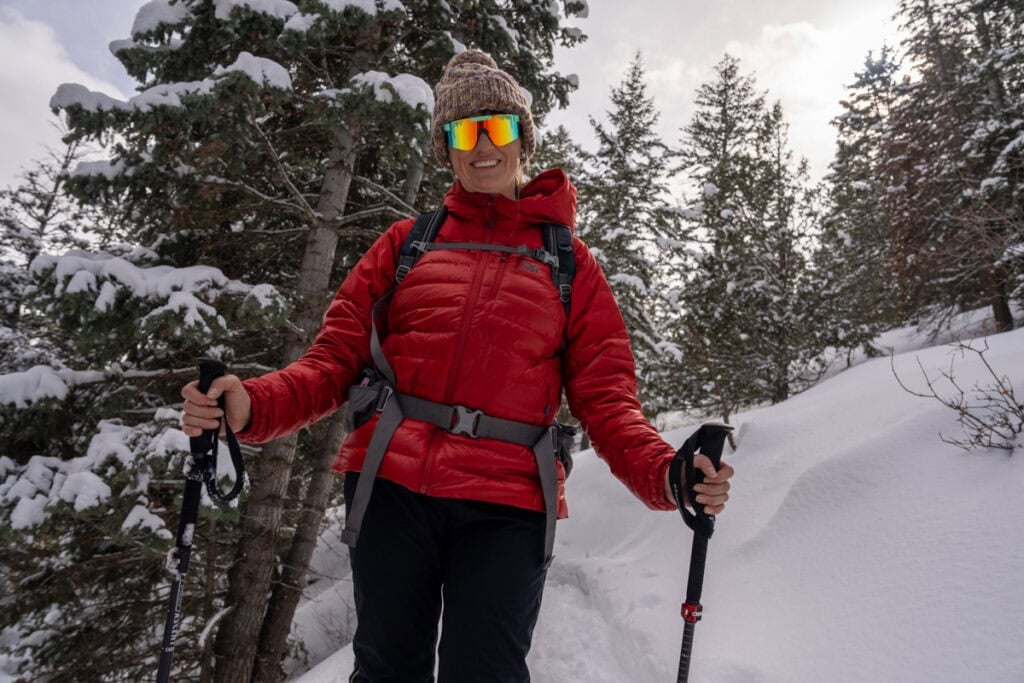
For example, some days I’m set on hitting a hiking trail, while Ryan has his sights on a mountain bike ride. Instead of clashing, we find ways to make it work. Sometimes we split up for the morning and then meet back at the van for lunch, or we take turns picking our activities.

Every choice in van life becomes a shared decision, from daily plans to where we’ll park for the night. Sometimes I get my way, and other times Ryan gets his. Compromise keeps the peace and means that we both get we want – just not always at the same time.

2. Respect your partner’s priorities

Respecting each other’s priorities is essential. If you don’t, you surely won’t last long as a couple in a van.

In our case, I have to make time to work and run my business. I also like to carve out a few quiet moments for meditation, and I absolutely cannot sleep if the van isn’t perfectly flat. For Ryan, coffee is a non-negotiable; he doesn’t like driving anywhere until he’s had his morning brew. Balancing these needs takes a little planning and a mutual respect.

We’ve learned to accommodate each other’s priorities by building them into our days. If we’re moving early, we make sure we have enough time for Ryan to get his coffee, and I’ll find a quiet moment to meditate before we hit the road. When it’s time to park, we both keep an eye out for level ground so I can sleep comfortably. Then when I need to work, Ryan takes the dogs out so I can focus.

Respecting these little but important things for each other not only keeps our routine smooth but shows that we’re both invested in making van life enjoyable for each other. These small gestures of respect go a long way toward keeping us both happy and balanced on the road.

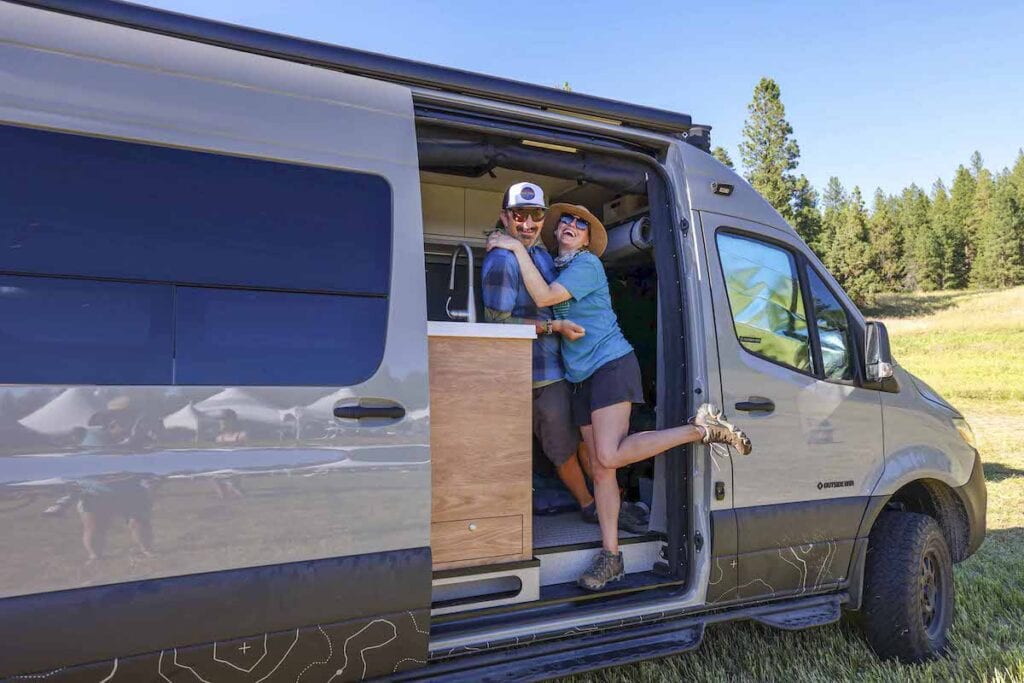
couple in sprinter van

3. Communicate Clearly & Effectively

This probably sounds obvious, but communication has been the cornerstone of making our van life relationship work. It’s not like a house where when you have a fight, you can escape to another room. So in order to maintain a happy home on wheels, it’s important to be able to put out fires before they get too big.

The reality is that things can get tense—especially when you’re tired, hungry, or just can’t find a good spot to park for the night. We’ve had our share of snippy exchanges, but learning to communicate openly and calmly has made all the difference.

We are far from perfect, but over the years, we’ve learned what each other’s triggers are, and we try to take a breather if things start to get heated. Sometimes it’s better to just let things go, especially if what you are arguing about isn’t all that important.

4. Take Time for Yourself

Living on the road doesn’t leave a lot of room for alone time, but it’s crucial. Spending so much time together really can be wonderful, but without moments to recharge on your own, it’s possible to feel a bit claustrophobic or like you are losing yourself.

Alone time helps us maintain our individuality. We are different people and have our own interests that need to be tended to. It doesn’t have to be much — a quick solo walk or a half-hour outside with a book or a podcast is enough. These small breaks give me space to clear my mind and allow us to fully appreciate each other’s company for the other 23.5 hours a day that we are together.

5. Split the chores

One thing we quickly learned was how important it is to share the workload. Van life involves a surprising amount of chores and upkeep, from cleaning and cooking to organizing and fixing things on the fly. Ryan loves organizing our van’s garage, while I usually handle things like making the bed and tidying up the front. Ryan also takes charge of dinner, and I usually clean up afterward (unless I’m busy working on my blog).

By dividing tasks, we avoid the constant back-and-forth of “who’s turn is it?” and we both get to focus on the parts we enjoy most. Having a clear division of labor has made life on the road a lot smoother.

Man filling up water in sprinter van

6. Stay Connected with the Outside World

While it’s great to share the journey closely with your significant other, having a social life on the road brings fresh energy to your relationship. We love visiting friends and family whenever possible, attending festivals and events, and camping with other van lifers. These connections help us avoid isolation and prevent us from relying solely on each other for social interaction.

Bearfoot Theory founder Kristen Bor sitting in a camp chair next to her dad at a campsite with their Sprinter vans behind them

7. Have Fun!

Ultimately, we got into van life because we wanted to share incredible experiences together, and it’s important not to lose sight of that. Even when we’re spending every day side-by-side, we try to make time for the things that bring us both joy. For us, that might be watching the sunset from a cozy spot or planning our next big hike.

Van life isn’t conventional, and it’s definitely not for everyone. But if you can find ways to respect each other’s needs and communicate effectively, van life as a couple will likely be one of your greatest adventures together.

Living in a van with your significant other can be both rewarding and challenging. Learn our tips for healthy van life relationships here.

Save this post to Pinterest

What is the best thing about living van life with your significant other? What is the most challenging thing? Share your questions, tips, and experiences down in the comments.

The post How Live in a Van as a Couple: Tips for Maintaining Harmony appeared first on Bearfoot Theory.